
Italy · Restored
Castello Aragonese
The Castello Aragonese (Castel San Angelo) is a late 15th-century fortress on the waterfront at Taranto, Italy, built to guard the narrow link between the old town peninsula and the mainland. Erected for Ferdinand II of Aragon and attributed to Francesco di Giorgio Martini, its thick curtain walls and rounded towers dominated the harbour and later served various military and prison functions. The site remains a visited historic fortification under restoration and cultural use.
First raised
1486
Its prime
1500
Today
Restored
As it stood in 1500
What Castello Aragonese looked like in its prime.
A low, massive rectangular stone fortress of warm-beige limestone set directly on the water, with a continuous flat parapet and seven rounded towers projecting from the curtain walls; the principal façade presents two large semicircular bastion-towers flanking a central arched gate above a quay. Small rectangular gun-ports and rows of narrow embrasures puncture the walls; the building sits on a moat/canal cut through low ground with the sea in the foreground and a simple, flat roofline behind the parapet.
Its story
The story of Castello Aragonese.
The Byzantine Rocca and the Cutting of 1481
The first nucleus of the castle goes back to 780, when the Byzantines began a rocca on the southern corner of the island that carries the old town, to shield the city from Saracen raiding and from the Republic of Venice. That first work was made of tall, narrow towers, fought from with lances, arrows, stones and boiling oil. Older fortification on the ground is traced back further still, to the Greek occupation of the third and fourth centuries BC.
In 1481 a first navigable channel was cut in front of the site, narrower than the present one and irregularly banked, to let small craft through and to leave the castle standing behind water.
Francesco di Giorgio Martini's Seven Towers, 1486–1492
In 1486 Ferdinand I of Naples commissioned the Sienese architect and military engineer Francesco di Giorgio Martini to enlarge the castle and give it the shape it still keeps. Gunpowder had overtaken the medieval tower, built for dropping fire on attackers below: cannon called for towers low and broad and round, to deaden the impact of shot, with ramps to shift the pieces from one tower to the next and a heavy parapet cut with openings for the muzzles. The design carried seven towers, four bound together into a quadrilateral and the other three ranged along the ditch as far as the Mar Piccolo. The four were dedicated to San Cristoforo, San Lorenzo, the Bandiera and the Vergine Annunziata.
Money for the Aragonese quadrilateral ran short, so the first castellan levied a duty on the fishery, then extended the castle to take in the tower of Sant'Angelo, built at the commune's expense. The finished towers stood twenty metres high and twenty across, linked by curtains forty metres long carrying four tiers of fire, and two drawbridges served the place: the ponte del Soccorso across the ditch towards the open country now called the Borgo, and the ponte dell'Avanzata towards the old town. A triangular ravelin went up on the Mar Grande side between the Bandiera and San Cristoforo towers in 1491, and a slab set into the Porta Paterna, bearing the Aragonese arms quartered with those of Anjou, records the work finished in 1492.
Spanish Works and the Ottoman Attack of 1594
Under the Spanish the defences were pushed out again, the ditch widened and a further fortification of three towers raised. The fortress repelled an Ottoman attack in 1594, but its military weight fell away quickly with the advance of artillery. It was converted into a gun platform, many of its interior spaces filled in to give the guns a stable base.
A Habsburg Prison and the Prisoners of 1799
With the arrival of the Habsburgs in 1707 the castle lost its standing as a military work and became a hard prison. One room was fitted for torture, its vault pierced by a central opening through which the cries below were amplified and carried to the other prisoners. Under Napoleon it returned to its original function as a fortress.
Its most illustrious prisoners were the French generals Thomas-Alexandre Dumas and Jean-Baptiste Felix de Manscourt du Rozoy, taken in 1799 by the pro-Bourbon Sanfedisti when their damaged ship put into Taranto harbour for shelter. Taranto was then part of the Kingdom of Naples.
The Canal, the Swing Bridge and the Navy after 1883
In 1883 the tower of Sant'Angelo, one of five that tied the curtain wall together, was pulled down together with the Mater Dei, Monacella and Vasto towers of the civic wall, to clear ground for the navigable canal and the Ponte Girevole that crosses it. The work was completed in 1887, the year the castle became a station of the Regia Marina, and the Italian Navy has held it since. The chapel of San Leonardo inside, used over the years as a guardroom and a stable, was reconsecrated in 1933.
From 2003 the Navy has carried out restoration and archaeological work on the site, stripping plasterwork and investigating fortification going back to the Byzantine period. The castle is protected as Italian national heritage and is open for tours.
Step inside
7 places to explore in 1500.
The record describes 7 distinct spots at Castello Aragonese, including 1 interior: inner courtyard/parade ground. Create your own photoreal reconstruction and explore every one, more scenes means more rooms, more angles, and more of the place to stand in.
Build Your Own Castle
Recreate Castello Aragonese with AI to explore it.
The artist rebuilds it as it stood in 1500, a photoreal reconstruction that belongs to you alone. Pay with coins, no subscription needed.
Recreate this castle →Defend this castle →From the archive
Castello Aragonese on paper: the measured plan and period views.
The survey plan and photographs below are the ground truth this page's reconstructions are checked against, drawn and photographed while the castle was still a working garrison. Every image is public-domain or openly licensed, with its source named.
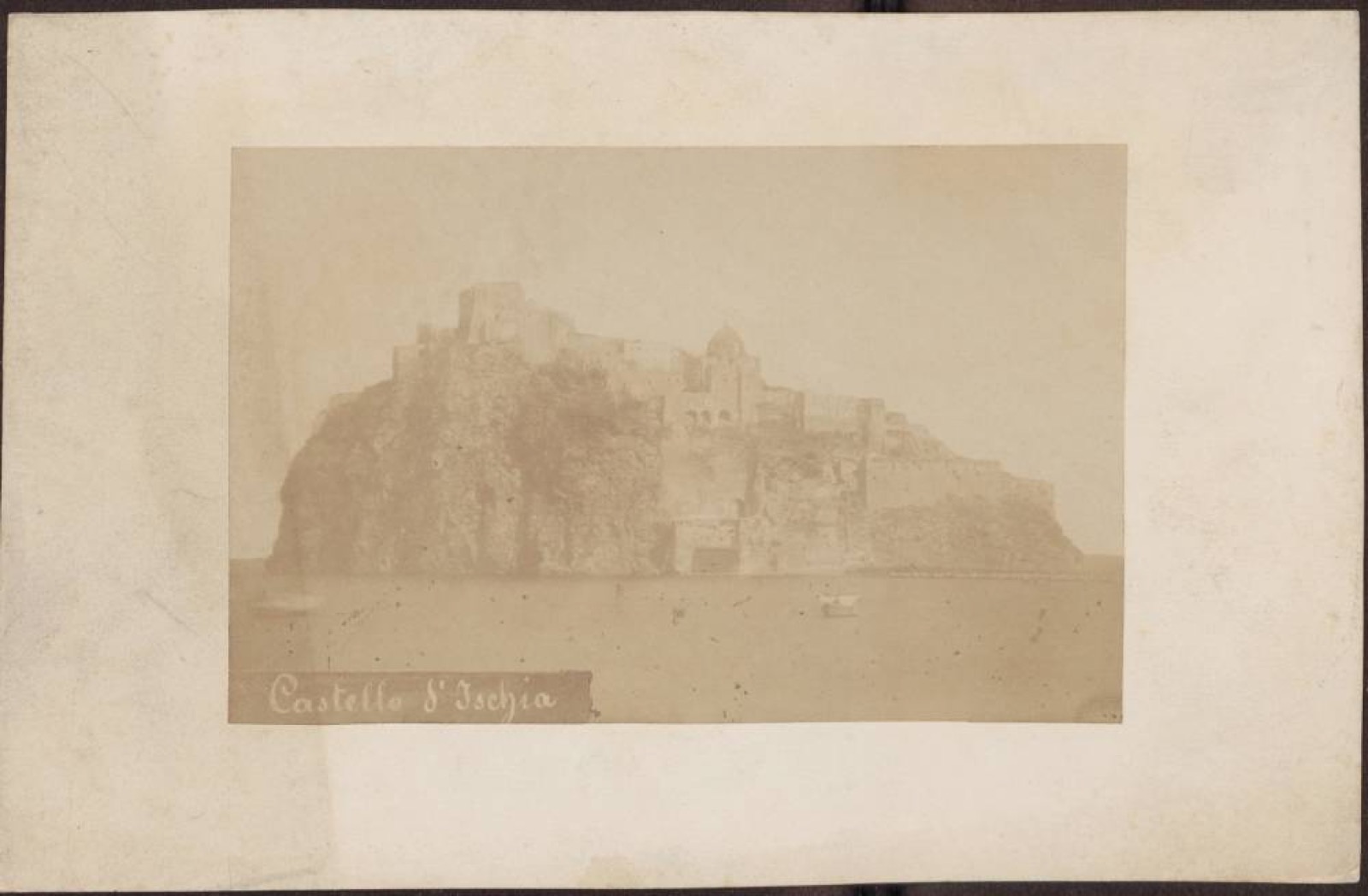
Ischia, Castello Aragonese.
· State Archives of Baden-Württemberg (via Europeana)
CC BY
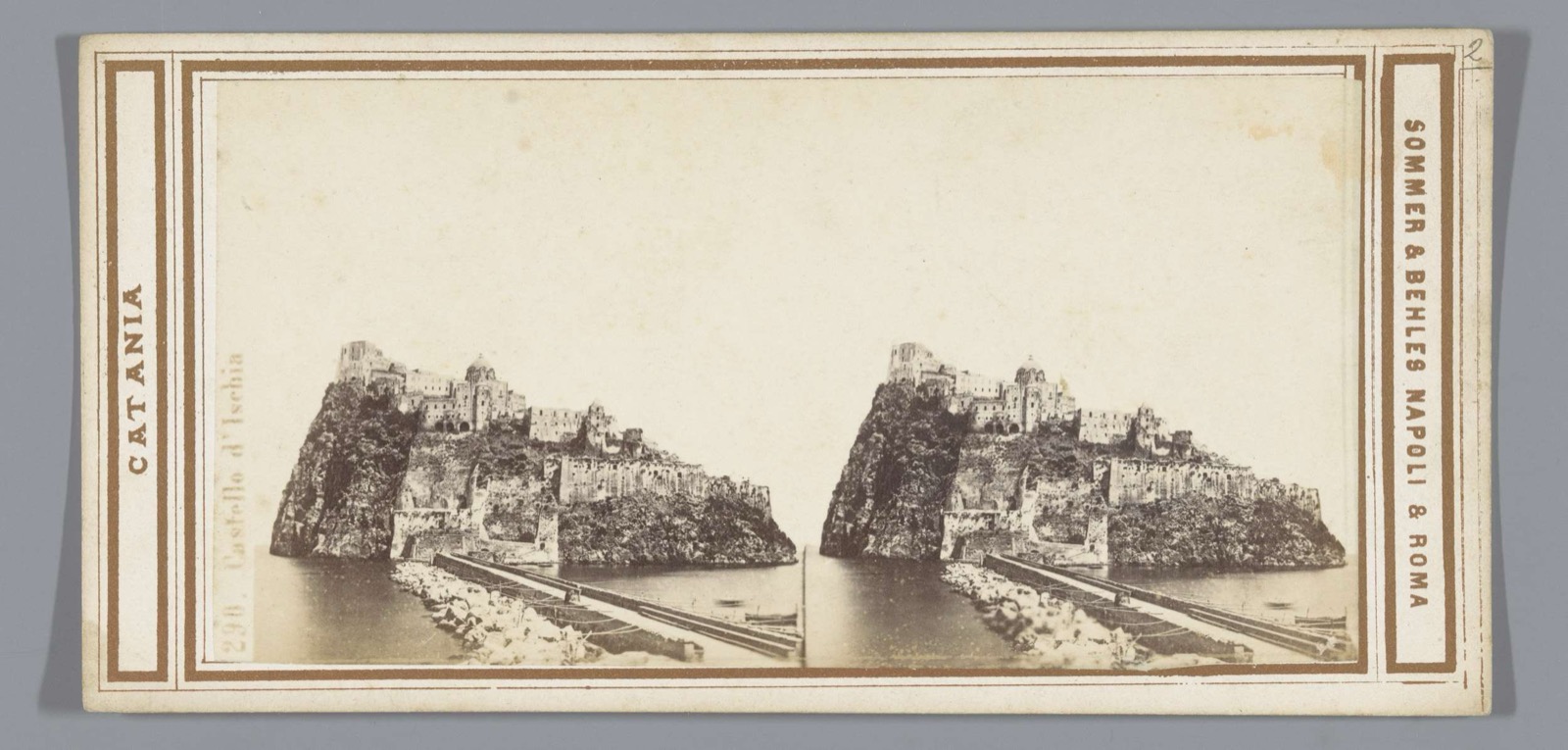
Gezicht op het Castello Aragonese bij Ischia
· Rijksmuseum (via Europeana)
Public domain


