
Italy · Restored
Castello Normanno
Castello di Aci
The Castello Normanno (Castello di Aci) is a medieval Norman castle built on a rocky outcrop that juts into the sea at Aci Castello, Sicily. Constructed on earlier Byzantine foundations, the fortress dominated the small town and coast and today houses a museum. The structure retains its compact curtain walls, a prominent square keep and ramped access from the shoreline.
Its prime
1296
Today
Restored
As it stood in 1296
What Castello Normanno looked like in its prime.
Perched atop a dark volcanic rock spur projecting into the sea, the castle reads as a compact stone fortress with thick curtain walls hugging the cliff, a tall square keep with crenellated top, and lower rectangular towers. The stone is coarse, weathered volcanic basalt and tufa, darker at the cliff base. A steep, stepped ramp and narrow stairways climb the cliff to the gate; the sea laps the rocky foreshore and a small town lies behind the castle.
Its story
The story of Castello Normanno.
Castrum Jacis and the Surrender of 902
The origin of the fortification on this basalt promontory is uncertain. A first castle is placed in the seventh century, by other accounts the sixth, built by the Byzantines against raiding on an earlier Roman work perhaps of the year 38, and called Castrum Jacis.
In the summer of 902, with Taormina destroyed and occupied in the Muslim conquest of Sicily, the emir Ibrahim II moved to assault the castle of Aci. Certain of defeat, the people chose to capitulate, pay the jizya and lay down their arms; the town was left intact, but the castle and its walls were razed.
Bishops of Catania and Frederick II, 1092-1239
The Norman conquerors Robert Guiscard and Roger de Hauteville brought the feudal system and its incastellamento to the region, Aci among the fortresses taken in hand; a Norman castle raised on the Byzantine foundations is dated 1076 by some accounts. In 1092 the castle and its lands were granted to Angerio da Sant'Eufemia, abbot and bishop of Catania, the first recorded act concerning the Terra di Aci.
On 17 August 1126 the bishop-abbot Maurizio of Catania received in the castle the relics of Saint Agatha, brought home from Constantinople. The earthquake of 4 February 1169, among the most destructive to strike Catania, drove part of the population inland to the district of Aquilio. In 1239 the castle returned to the imperial demesne when Frederick II removed Bishop Gualtiero di Palearia, meaning to be feudal lord of Catania himself.
Roger of Lauria, the Cicogna and the Angevin Sack, 1297-1326
During the Sicilian Vespers, Frederick III of Aragon granted the Universita delle Aci to the admiral Roger of Lauria in 1297, against a yearly rent of thirty ounces of gold to the bishop of Catania that was never paid. When Roger afterwards went over to the Angevins against the Aragonese court, Frederick stormed the castle with a wooden mobile tower called the cicogna, took it back into the royal demesne and stripped him of his fiefs.
In 1320 Frederick III made over the castle's territory, by then held by Roger's daughter Margaret of Lauria, to Blasco II de Alagona, succeeded by his son Artale I. While Blasco was away defending Palermo from the Angevins, the troops of Robert of Anjou under Bertrando di Balzo sacked Aci, in 1326.
The Scacco di Ognina and Artale II's Siege, 1353-1402
King Louis of Aragon died in the castle in 1353, aged only seventeen. The next year the territory of Aci was devastated and the castle stormed by the marshal Niccolo Acciaiuoli, sent to Sicily by Louis of Anjou. Acciaiuoli was sent back in 1356 at the request of the governor of Messina, Niccolo Cesareo, who had fallen out with Artale I Alagona; his troops, backed by five Angevin galleys, sacked the territory again and besieged the castle before moving on to Catania. Artale I threw off the attack and counter-attacked with the Sicilian Aragonese fleet, putting the Angevin ships to flight. That sea fight, between the Catanian quarter of Ognina and the castle of Aci, was called lo scacco di Ognina, and marked the decisive turn in favour of the Aragonese in the war of the Vespers.
In 1396, in the anti-Aragonese revolt, Artale II Alagona rose against King Martin the Younger and shut himself into the castle; it fell only after a long royal siege, and the story goes that the king managed it by wrecking the castle's water supply while Artale II was away. In 1398 Martin had the parliament of Syracuse declare the Aci lands perpetually royal demesne, and in 1402 he made the castle his own residence with his second wife Bianca of Navarre.
Barons, Barracks and Civic Museum, 1421-1985
In 1421 the viceroy of Sicily Ferdinando Velasquez bought the castle's territory and the neighbouring Bosco d'Aci for 10,000 florins and refeudalised it, to much popular discontent, quieted by the grant of a duty-free fair, the Fiera Franca, ordered by Alfonso the Magnanimous. The land passed on to the barons of Mastrantonio in 1468. On 28 August 1528 the inhabitants offered Charles V 20,000 florins to be taken back into the royal demesne out of baronial hands; the emperor accepted on 5 July 1530.
From the middle of the sixteenth century the Universita di Aci was lost, and the castle was put to use first as a barracks and then as a prison. Philip IV of Spain sold it in 1647 to Duke Giovanni Andrea Massa for 7,500 scudi, and it took damage in the Val di Noto earthquake of 11 January 1693. It returned to the communal demesne under the Bourbons in the nineteenth century, when Giovanni Verga set his tale Le storie del Castello di Trezza there. Restored between 1967 and 1969, it has been open to visitors since 1985 as the seat of a civic museum, and it is protected as Italian national heritage.
Step inside
8 places to explore in 1296.
The record describes 8 distinct spots at Castello Normanno, including 2 interiors: inner courtyard, museum exhibition room (interior). Create your own photoreal reconstruction and explore every one, more scenes means more rooms, more angles, and more of the place to stand in.
Build Your Own Castle
Recreate Castello Normanno with AI to explore it.
The artist rebuilds it as it stood in 1296, a photoreal reconstruction that belongs to you alone. Pay with coins, no subscription needed.
Recreate this castle →Defend this castle →Whose castle
Clans who held Castello Normanno.
The families that held Castello Normanno for a decade or more across its history, follow a name to its clan.
Lauria
Roger of Lauria, admiral of the Aragonese fleet, was granted the fief of Aci and its castle in 1296 by Frederick III of Sicily.
From the archive
Castello Normanno on paper: the measured plan and period views.
The survey plan and photographs below are the ground truth this page's reconstructions are checked against, drawn and photographed while the castle was still a working garrison. Every image is public-domain or openly licensed, with its source named.
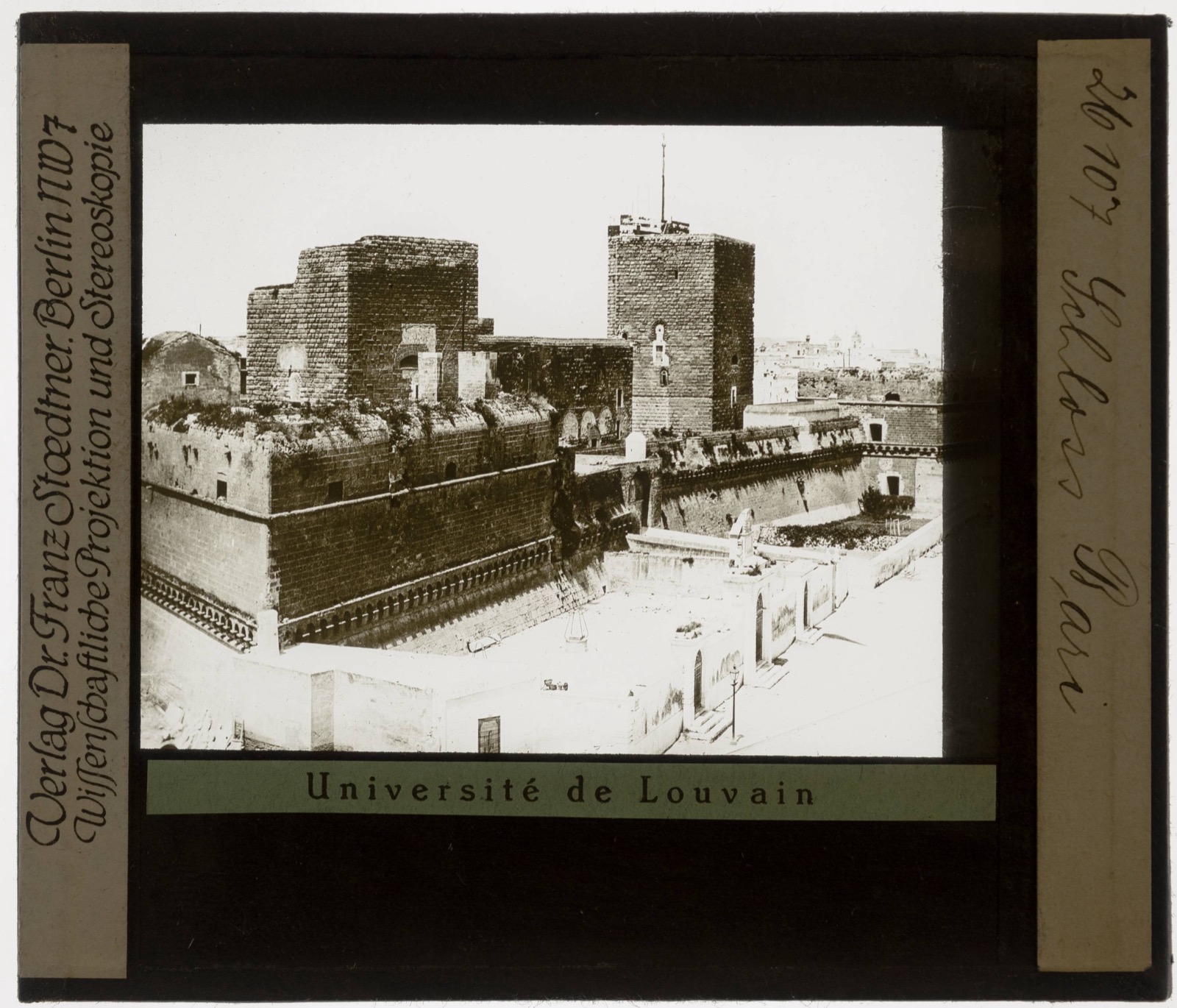
Bari. Castello Normanno-Svevo Exterieur
· Catholic University of Leuven (via Europeana)
Public domain
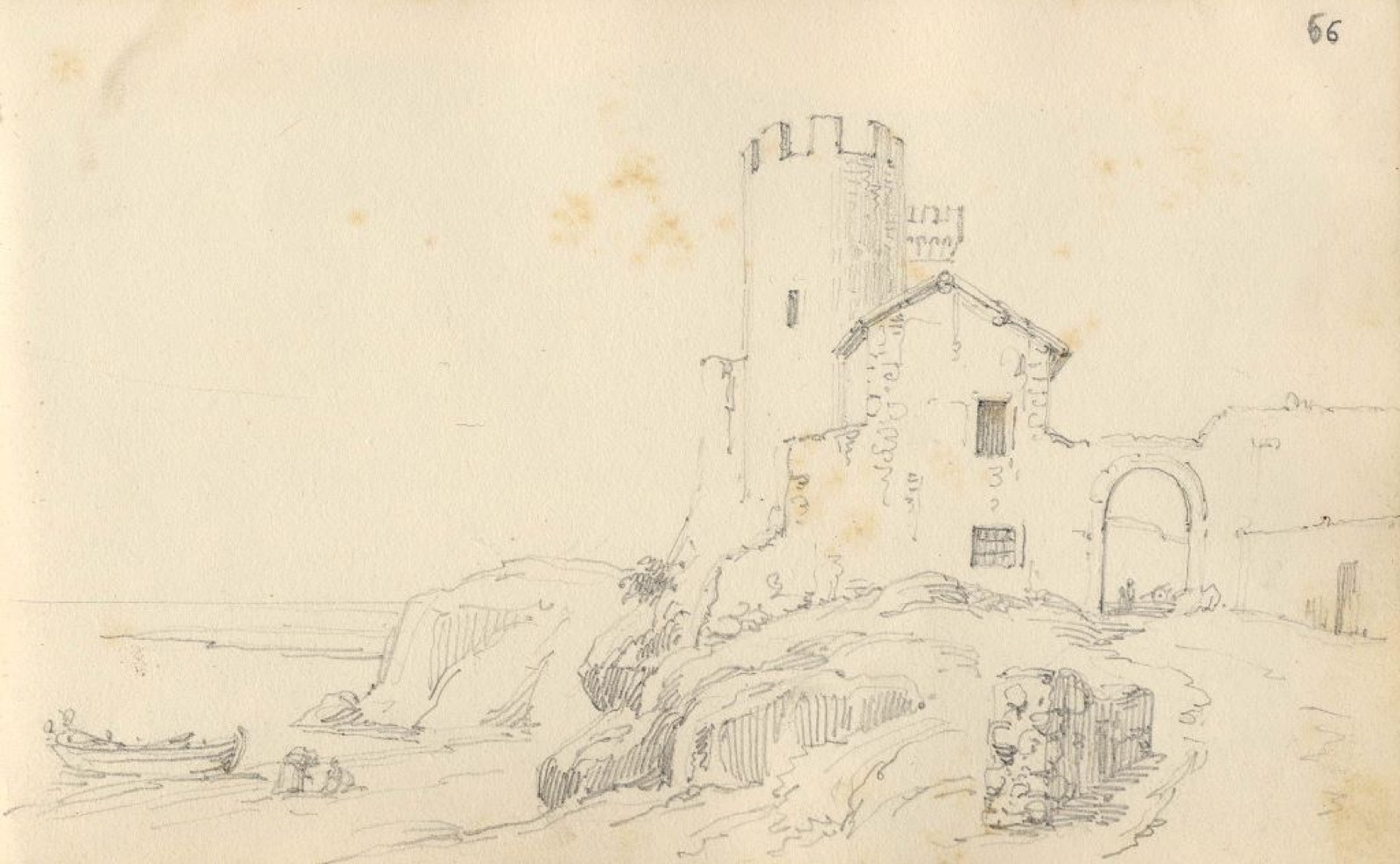
Castello normanno presso Taormina
· Turin Gallery for Modern and Contemporary Art (via Europeana)
CC BY


