
Italy · Restored
Fort Bard
Forte di Bard
Fort Bard is a 19th-century fortified complex on a rocky promontory above the town of Bard at the entrance to the Aosta Valley, rebuilt by the House of Savoy between 1830 and 1838. It was restored in the late 20th century and today houses the Museum of the Alps and exhibition spaces while the main courtyard serves for public events.
First raised
1830
Its prime
1838
Today
Restored
Ranked among Europe’s castles
As it stood in 1838
What Fort Bard looked like in its prime.
A compact, multi-tiered stone fortress perched on a steep rocky spur above the Dora Baltea, composed of stacked terraces of curtain walls that step up the slope to a large rectangular upper block of barracks. The lower tier presents long polygonal casemate faces pierced by regular rows of small rectangular gun-ports; stone is pale grey with low-pitched slate or stone roofs on internal buildings. Narrow approach ramps and parapets connect the levels, with a tight village clustered at the rock base and steep wooded cliffs surrounding the gorge. The complex reads as complete and fully fortified.
Its story
The story of Fort Bard.
Theodoric's Garrison and the Lords of Bard
The rock rises on the left bank of the Dora Baltea at the point where the valley tightens into a gorge, a narrows that has marked a cultural, political and religious boundary of the Aosta Valley for centuries. Whoever held it controlled the road between the Po plain and Savoy, and the position was garrisoned early: documents record an Ostrogothic post here, the Clausurae Augustanae, manned by sixty soldiers in the age of Theodoric.
Travellers who crossed the valley in the early Middle Ages wrote of the place with something like awe, and in 1034 it was described as an inexpugnabile oppidum, then held by Boso, viscount of Aosta. The counts of Bard, a feudal house probably answering to the bishopric of Aosta, kept the rock until the middle of the 13th century. Hugh was the last of that line to garrison it: around 1250 Amadeus IV of Savoy took the fort into his own hands and installed a heavy garrison of his own, and under Savoy the defences were repeatedly strengthened.
Charles Emmanuel II Concentrates the Guns, 1661
In 1661 Charles Emmanuel II, Duke of Savoy, made Bard the ducal garrison for the whole valley, moving his artillery there after dismantling the neighbouring strongholds at Verrès and at Montjovet's castle of Saint-Germain. Consolidation and enlargement of the defences continued through the 17th and 18th centuries. In 1704, during the War of the Spanish Succession, Victor Amadeus II used the position to obstruct a French descent into Italy.
Four Hundred Men Against Napoleon, May 1800
On 14 May 1800 a French army of 40,000 was brought to a halt beneath Bard by 400 Austro-Piedmontese soldiers. They held the gorge for a fortnight and wrecked Bonaparte's plan for a surprise descent on the Po Valley and Turin; when the news reached him he called the place the vilain castel de Bard. The army that had crossed the Great St Bernard in a snowstorm took the fort on 1 June.
The defence cost the fortress its life. Bonaparte ordered it razed to the ground, angered by the resistance of the Italian and Austrian soldiers who had shamed him, and set on removing an anti-French stronghold from the road for good. In 1801 Nicolas-Antoine Taunay painted the First Consul resting after the crossing, the outline of the fort behind him among the ravines and rough paths.
Olivero's Fort, 1830-1838
Thirty years passed before Savoy, fearing fresh French aggression, ordered the rock refortified, the order credited to Charles Felix by some accounts and to Charles Albert by others. The design went to the military engineer Antonio Francesco Olivero, and the work ran eight years, from 1830 to 1838.
Olivero built not one fort but a set of self-contained works stacked up the slope: the pincer-shaped Opera Ferdinando and Opera Mortai on two lower levels, the Opera Vittorio in the middle, the Opera Gola and Opera Carlo Alberto above. The upper level carried conventional battlements; lower down, fifty gun ports were cut into casemates laid out so that each work covered its neighbours if the place were attacked. Its 283 rooms could billet 416 men, twice that if they slept on the floor, and 176 service rooms faced a courtyard that served as the parade ground. Magazines at the Opera Mortai held ammunition and food for three months, watched, like the rest of the fortress, by some fifty guns.
Powder Magazine to Museum of the Alps
By the end of the 19th century the fort had lost its military value and fell out of use, serving afterwards as a military prison and then as a powder magazine of the Italian Army until 1975, when ownership passed to the government of the Autonomous Region of Valle d'Aosta. A partial reopening to visitors in the early 1980s came with many buildings still in urgent need of repair, and in the late 1990s it closed again for a restoration that ran more than ten years.
The Museum of the Alps opened in the restored works in January 2006. In 2015 the fort and the town below it stood in for the fictional eastern European state of Sokovia in Joss Whedon's Avengers: Age of Ultron.
Step inside
10 places to explore in 1838.
The record describes 10 distinct spots at Fort Bard, including 4 interiors: lower casemate battery, upper courtyard (main courtyard), barracks and arsenal (upper block) and more. Create your own photoreal reconstruction and explore every one, more scenes means more rooms, more angles, and more of the place to stand in.
Build Your Own Castle
Recreate Fort Bard with AI to explore it.
The artist rebuilds it as it stood in 1838, a photoreal reconstruction that belongs to you alone. Pay with coins, no subscription needed.
Recreate this castle →Defend this castle →Whose castle
Clans who held Fort Bard.
The families that held Fort Bard for a decade or more across its history, follow a name to its clan.
Bard
The local lords of Bard controlled the castle until the middle of the 13th century.
Savoy
Held by the House of Savoy from the mid-13th century; Charles Albert rebuilt the fortifications between 1830 and 1838.
From the archive
Fort Bard on paper: the measured plan and period views.
The survey plan and photographs below are the ground truth this page's reconstructions are checked against, drawn and photographed while the castle was still a working garrison. Every image is public-domain or openly licensed, with its source named.
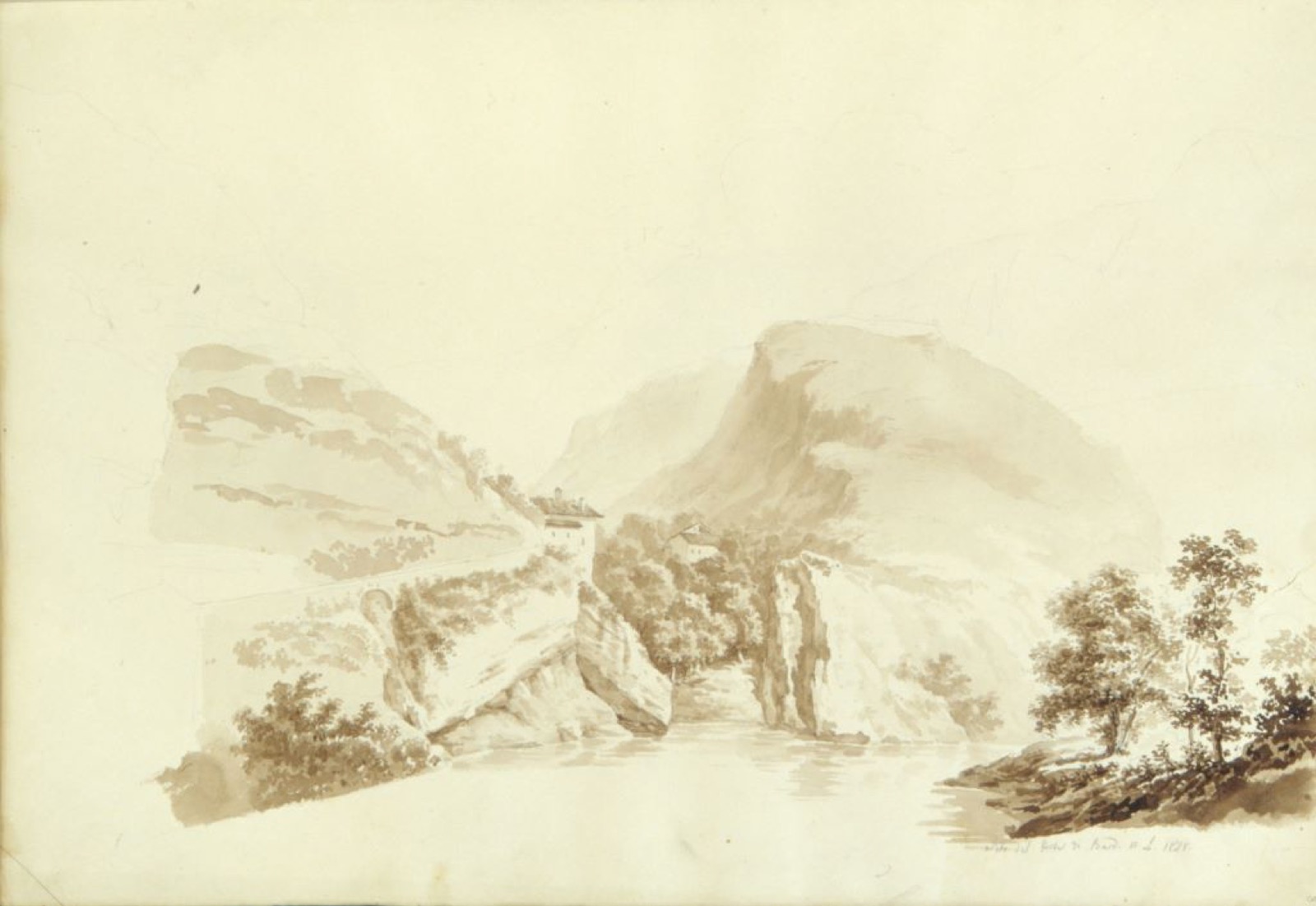
Surroundings of Fort Bard
· Turin Gallery for Modern and Contemporary Art (via Europeana)
CC BY
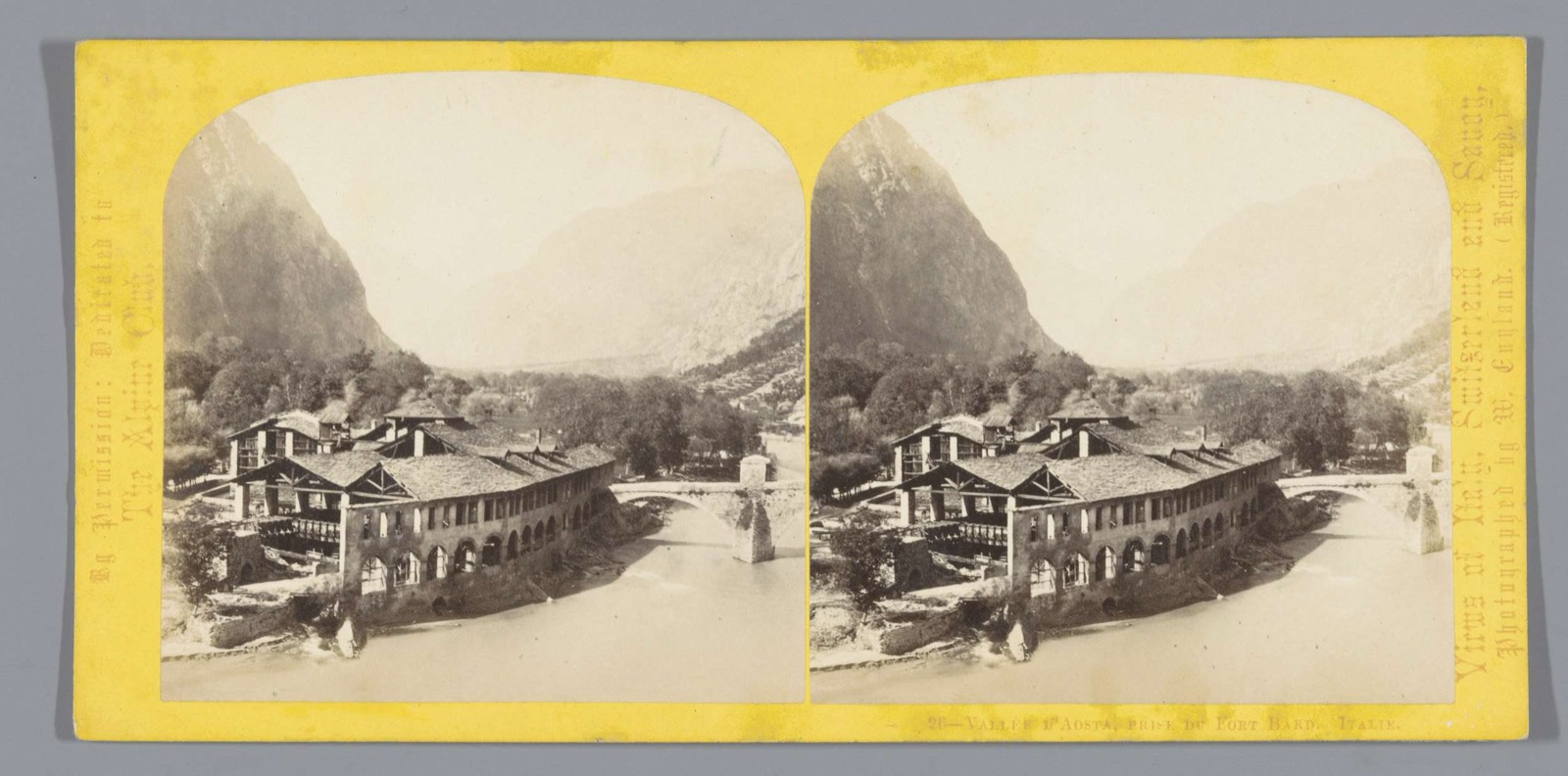
Gezicht op het Aostadal
· Rijksmuseum (via Europeana)
Public domain


