Italy · Restored
Gradara Castle
Castello di Gradara
Gradara Castle is a medieval fortress on a hill above the town of Gradara in the Marche region of Italy. The site comprises two concentric curtain walls enclosing a compact historical village and a large inner keep; the present complex dates from the 11th–15th centuries and is associated in legend with the story of Paolo and Francesca.
First raised
1150
Its prime
1450
Today
Restored
Ranked among Europe’s castles
As it stood in 1450
What Gradara Castle looked like in its prime.
Hilltop medieval fortress of pale-beige masonry with two concentric crenellated curtain walls encircling a compact cluster of terracotta-roofed houses; a straight narrow street climbs from the lower gate toward the inner bailey. The inner stronghold is a rectangular, high-walled keep and bailey with square and round towers at intervals, and an open grassy yard in front of the main keep; surrounding landscape is farmland and distant low hills.
Its story
The story of Gradara Castle.
The De Grifo Fortress and the Malatesta Walls, 1150–14th Century
Gradara's fortress was built around 1150 by the De Grifo family. When the De Grifo fell out of papal favour, control passed to the Guelph condottiero Malatesta da Verucchio, known as "Mastin Vecchio", founder of the Malatesta dynasty of Rimini, Cesena and Pesaro. It was the Malatesta who ordered the two circuits of walls that still ring the castle, raised between the 13th and 14th centuries, the outer wall running for almost 800 metres.
The Legend of Paolo and Francesca, c. 1275
Tradition places the castle's best-known story here around 1275, when Guido da Polenta, lord of Ravenna, married his daughter Francesca to his ally Giovanni Malatesta, lord of Rimini, called "Gianciotto" for his lameness. Sent to present himself to Francesca in his stead was his brother Paolo, a courteous knight already married with two children. The pair fell in love; warned by a servant, Gianciotto caught them together and killed them both. Dante immortalised the pair in his Divine Comedy, fixing Gradara in literature as a symbol of tragic love.
The Forty-Day Siege by Francesco Sforza, 1446
In 1445 Galeazzo Malatesta agreed to sell Gradara to the condottiero Francesco Sforza for 20,000 gold florins. When Sforza arrived to take possession, Sigismondo Pandolfo Malatesta refused to hand over the castle or return the money. Sforza, allied with Count Federico da Montefeltro, marched on Gradara in 1446 and besieged it with cannon, bombards and hand-guns for forty days; the fortress seemed close to falling, but bad weather and the approach of Malatesta reinforcements forced Sforza to withdraw, leaving Gradara in Sigismondo's hands.
The Montefeltro Siege and Sforza Rule from 1463
Malatesta rule ended in 1463, when Sigismondo Pandolfo Malatesta, excommunicated by Pope Pius II, was attacked by Federico da Montefeltro, who besieged Gradara on the Church's behalf. The fortress, which had withstood earlier attacks, surrendered, and the pope granted it in vicariate to the Sforza of Pesaro. Under Giovanni Sforza's lordship the castle was remodelled into a protected, secure residence for stately occasions.
Ruin, Restoration and State Ownership, 1641–2015
Gradara later passed to the Borgia and Della Rovere families, following the fortunes of those houses across the papal territories of the Marche and Romagna. From 1641 it came under the direct control of the Papal States through papal legates, beginning a long decline; by 1920, when the Zanvettori family bought the fortress, the castle and its walls had been reduced to ruin.
Umberto Zanvettori funded a restoration, more interpretive than strictly historical, that returned the fortified village to something like its former state, and in 1928 the rocca was sold to the Italian state, with his widow retaining usufruct until 1983. Since December 2014 it has been managed by Italy's Ministry of Culture; it carries Italian national heritage designation and, recorded at 205,536 visitors in 2015, hosts museum, musical and artistic events.
Step inside
8 places to explore in 1450.
The record describes 8 distinct spots at Gradara Castle, including 1 interior: gatehouse passage. Create your own photoreal reconstruction and explore every one, more scenes means more rooms, more angles, and more of the place to stand in.
Build Your Own Castle
Recreate Gradara Castle with AI to explore it.
The artist rebuilds it as it stood in 1450, a photoreal reconstruction that belongs to you alone. Pay with coins, no subscription needed.
Recreate this castle →Defend this castle →Whose castle
Clans who held Gradara Castle.
The families that held Gradara Castle for a decade or more across its history, follow a name to its clan.
Sforza
The Malatesta–Montefeltro conflict over Gradara ended only after control of the castle fell to the Sforza family.
From the archive
Gradara Castle on paper: the measured plan and period views.
The survey plan and photographs below are the ground truth this page's reconstructions are checked against, drawn and photographed while the castle was still a working garrison. Every image is public-domain or openly licensed, with its source named.
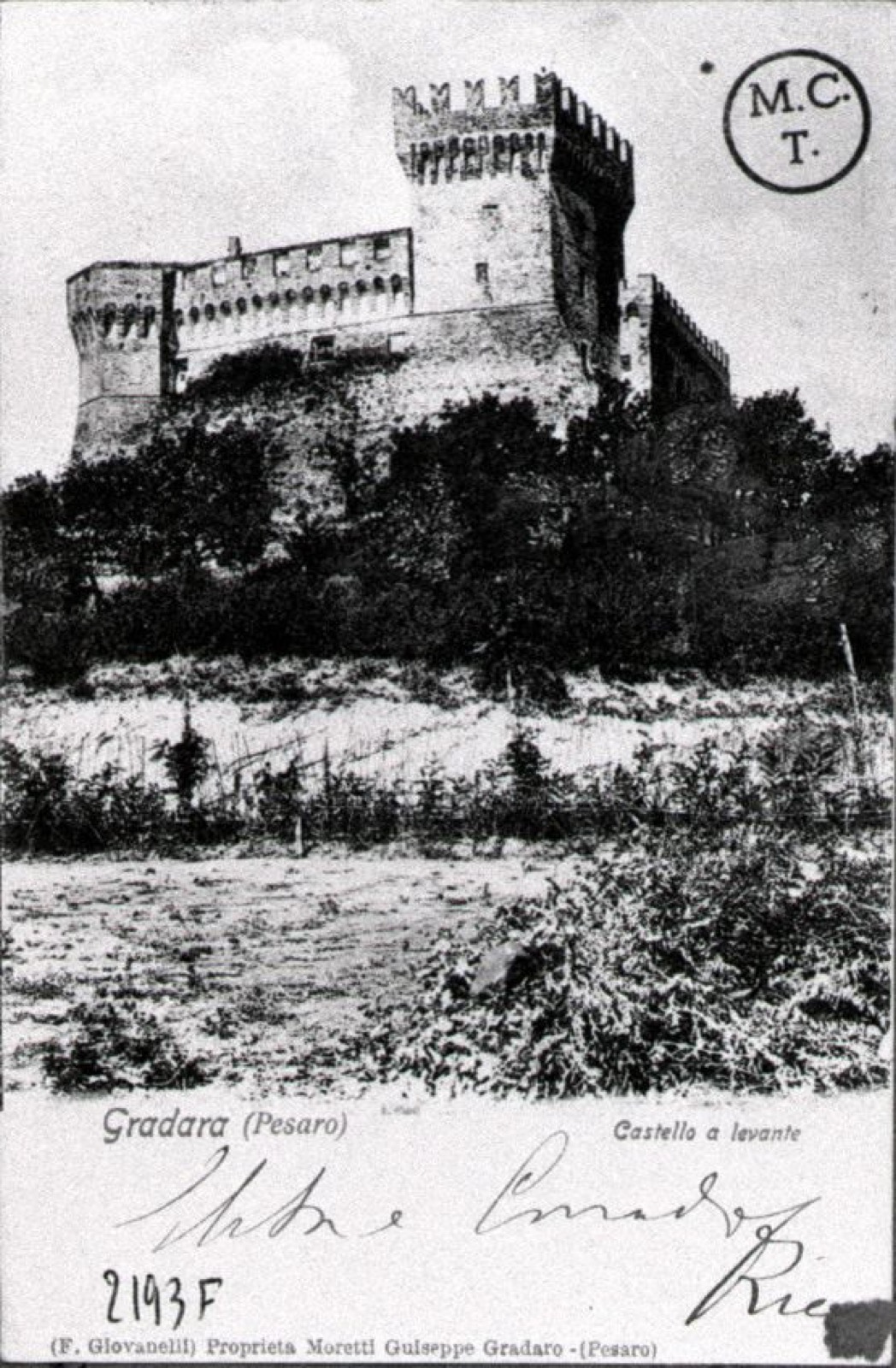
Gradara - Castello, lato est (cartolina)
· Turin Gallery for Modern and Contemporary Art (via Europeana)
CC BY