
Luxembourg · Restored
Clervaux Castle
Clervaux Castle is a medieval castle on a rocky spur above the town of Clervaux in northern Luxembourg, with origins in the 12th century and major additions through the early modern period. Heavily damaged in the Second World War, it has been fully restored and now houses municipal offices and museum spaces.
First raised
1200
Its prime
1750
Today
Restored
As it stood in 1750
What Clervaux Castle looked like in its prime.
White‑washed curtain walls rise directly from a rocky spur, punctuated by several broad cylindrical towers capped with steep conical dark‑slate roofs. A very large, steeply pitched slate roof dominates the compound, pierced by small dormer windows; lower slate roofs cover wings and service ranges. Window openings are regular, rectangular and small by modern standards. The castle sits above the town surrounded on three sides by a looping river and dense woodland on the slope behind it.
Its story
The story of Clervaux Castle.
Gerard of Sponheim and the Spur Above the Clerve
The castle occupies a rocky spur at 365 metres, with a loop of the River Clerve around three sides. A castle on the site was first recorded in 1126, when Gerard of Sponheim, a stepbrother of Count Frederick I of Vianden, was named as its builder; he had been lord of Clerf since 1106, over a lordship that appears to have been formed out of estates of Stavelot Abbey, so the first castle may have been an advocate's stronghold held for Stavelot.
Some historians look for the roots of the site in a Roman fort, but the oldest known building fabric is only 13th-century and the idea has not been proven.
Meysenburg, Brandenbourg and the Burgundian Siege, 1405-1488
After the counts of Clerf died out the castle and lordship passed to the lords of Meysenburg. The marriage of Maria von Meysenburg to Friedrich I von Brandenburg brought the castle in 1405 to his family, a cadet line of the counts of Vianden, who held it until 1426. The large palace and the rounded towers are probably of about 1400, from the years when the prosperous lords of Brandenburg lived there; the Gothic south wing with its extensive cellars and the Brandenburg Tower covering the south flank followed in the early 15th century.
The new tower did not keep out Duke Anthony of Burgundy, who took the castle for the Bourguignons in 1413 after a siege of several days, though its buildings were undamaged. The Brandenburgs later recovered it, and Friedrich II von Brandenburg held it as lord from 1441 to 1488.
Eltz Fortifications and the Lannoy Knights' Hall, 1563-1731
Margarethe von Brandenburg-Clerf carried the castle to her husband Nicolas de Heu, and when Elisabeth de Heu married Gottfried von Eltz in 1563 it passed to his family. Amid frequent raids and plundering by Dutch troops during the Eighty Years' War, Gottfried had the place more heavily fortified between 1595 and 1597.
The marriage of Claudine von Eltz brought Clervaux in 1617 to Claude de Lannoy, governor of Maastricht and Namur. In 1634 and 1635 he replaced the small buildings on the north side with a Renaissance range of reception rooms and a great Knights' Hall in a style showing Flemish and Spanish influence. His family held the castle for close to 240 years and turned it into a residence: a farm court with stables, barns and a chapel went up outside the ring wall, a gatehouse was added in 1670 and the semicircular Witches' Tower at the eastern point to cover the outer bailey, and a brewhouse facing the castle gate in 1731.
The Klöppelkrieg, the Berlaimont Demolitions and the 1935 Listing
During the Klöppelkrieg, the rising of Luxembourg peasants against the French occupation, the castle was a theatre of war for a single day. On 30 October 1798 the resistance at Clerf collapsed as it did across the country; a number of insurgents had fled into the castle ahead of their French pursuers, and almost all of them got away again through a sally port.
Adrien de Lannoy, the last male of his line, died in 1854, and the succession suit that followed was won by the de Berlaimont family. Under Adrien de Berlaimont the outer bailey was pulled down in 1885-87, leaving only the gatehouse, the horse stable and the Witches' Tower, and its stone was used to build a small palace north-east of the castle. In 1927 an auction sold the castle to the former state minister Pierre Prüm and the Hames family, who opened a hotel in one part while Prüm set up a castle museum in the rest. It was listed as a Monument national on 26 September 1935.
Burnt Out in the Ardennes Offensive, 1944-2013
German troops set the north wing alight by shellfire on 18 December 1944, during the Ardennes offensive and the fighting for Clervaux of 16-18 December, part of the Battle of the Bulge; the fire spread to the adjoining buildings and the castle burned out completely. After the war the Luxembourg state bought the ruin and began rebuilding. A youth hostel was planned at first, but in 1972 the commune's administration moved in, and the reconstruction ran until 1994.
A museum of scale models of 22 major Luxembourg castles opened in 1970, and a museum of the Battle of the Ardennes in 1974. Edward Steichen, born at Bivange in 1879, curated The Family of Man for the Museum of Modern Art in 1955; it then travelled to 150 museums between 1955 and 1962. A selection hung at Clervaux from 1974 to 1989, and after the prints were restored the full set of 503 photographs by 273 photographers from 68 countries opened as a permanent exhibition in 1994. It has been inscribed in the Memory of the World Register since 2003, and reopened in July 2013 after a further restoration that added a library and historical context. The castle belongs to the State of Luxembourg and is open to visitors.
Step inside
8 places to explore in 1750.
The record describes 8 distinct spots at Clervaux Castle, including 3 interiors: knights' hall (reception hall), old kitchen in the brandenbourg house, south wing rooms. Create your own photoreal reconstruction and explore every one, more scenes means more rooms, more angles, and more of the place to stand in.
Build Your Own Castle
Recreate Clervaux Castle with AI to explore it.
The artist rebuilds it as it stood in 1750, a photoreal reconstruction that belongs to you alone. Pay with coins, no subscription needed.
Recreate this castle →Defend this castle →Whose castle
Clans who held Clervaux Castle.
The families that held Clervaux Castle for a decade or more across its history, follow a name to its clan.
Sponheim
The oldest 12th-century parts were built by Gerard, Count of Sponheim, brother of the Count of Vianden.
Brandenbourg
The Lords of Brandenbourg lived at Clervaux around 1400, when the great palace and rounded towers were probably built.
From the archive
Clervaux Castle on paper: the measured plan and period views.
The survey plan and photographs below are the ground truth this page's reconstructions are checked against, drawn and photographed while the castle was still a working garrison. Every image is public-domain or openly licensed, with its source named.
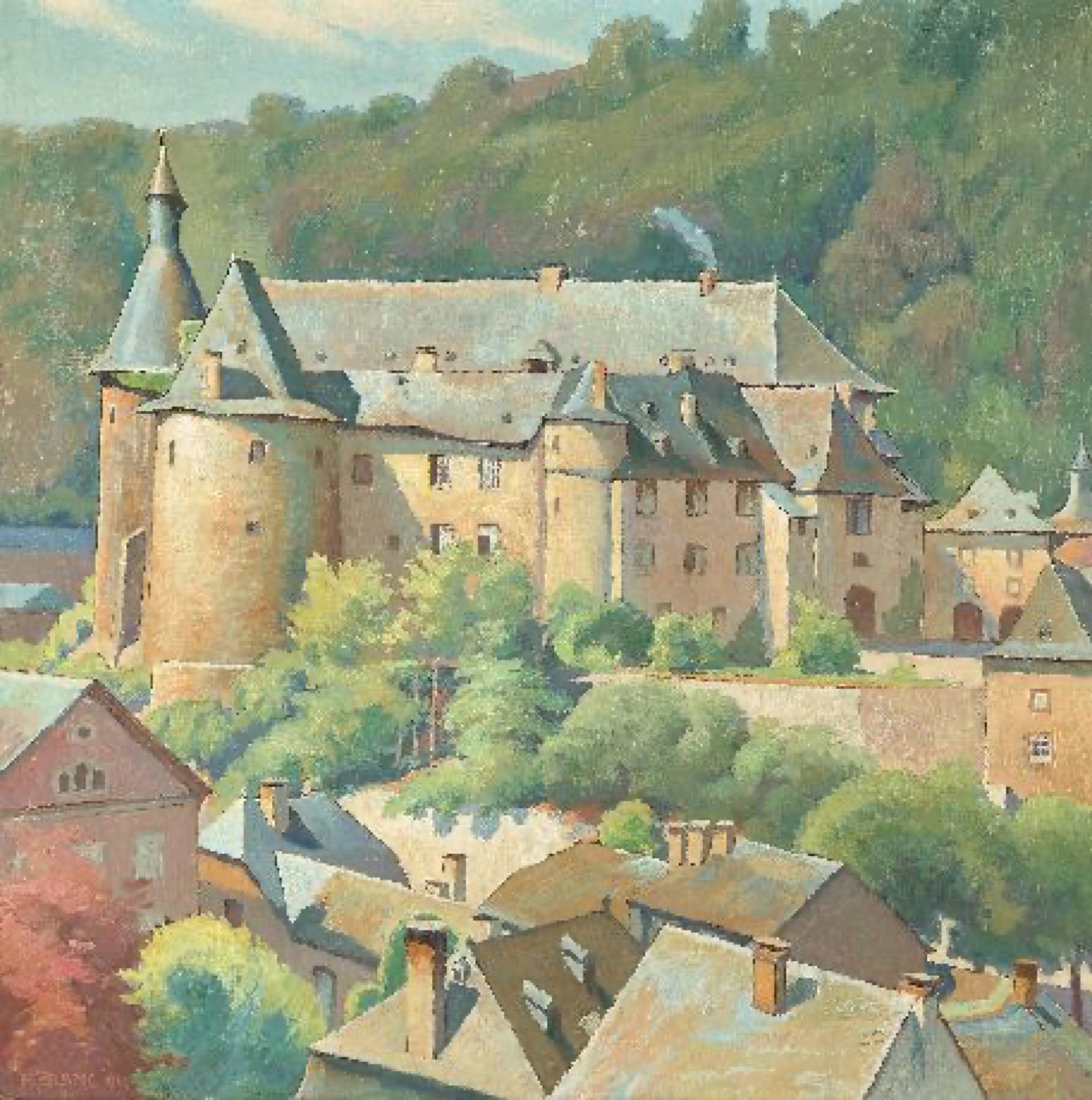
Château de Clervaux
· National Museum of Archaeology, History and Art (via Europeana)
Public domain
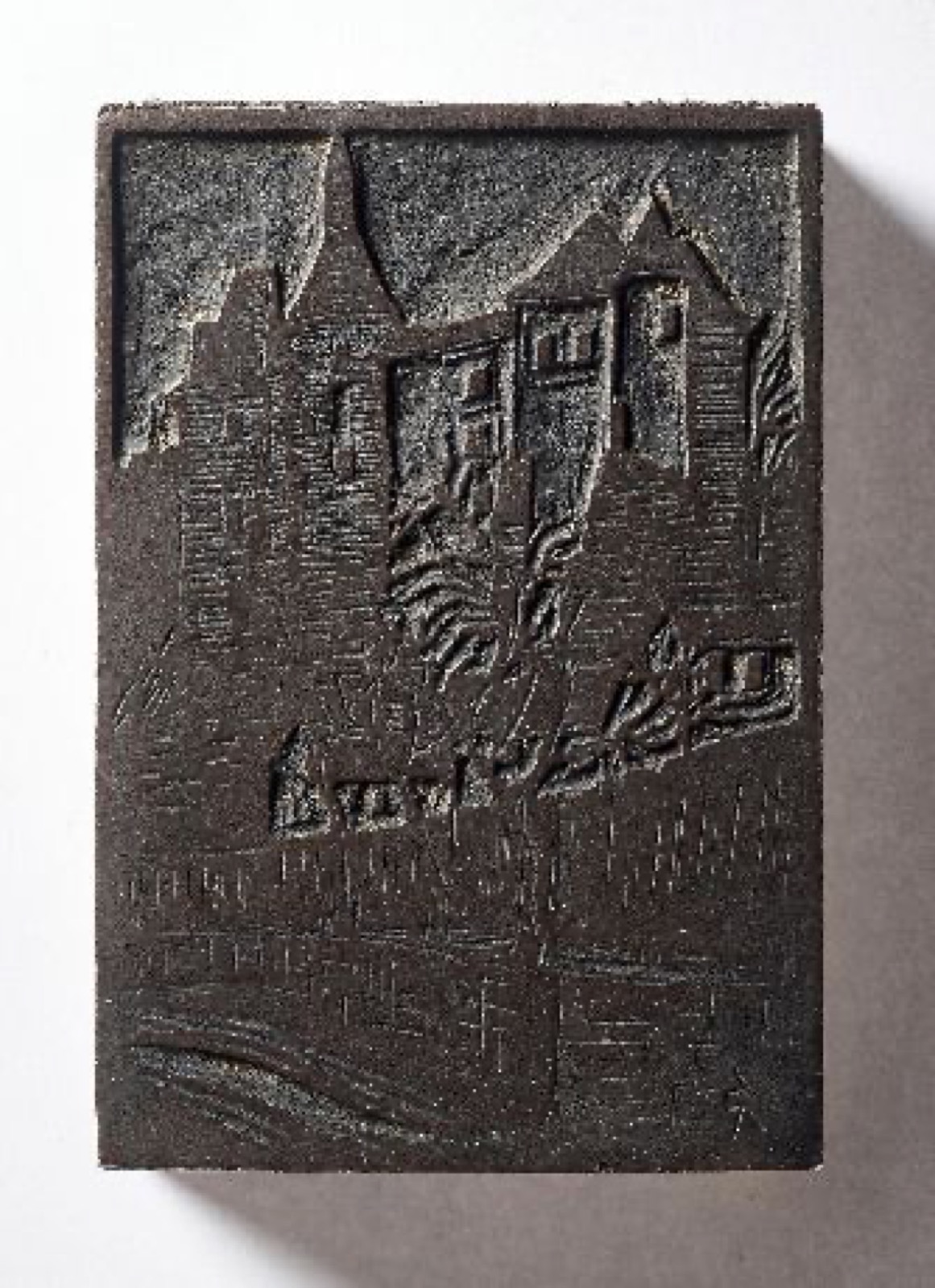
Château de Clervaux
· National Museum of Archaeology, History and Art (via Europeana)
Public domain
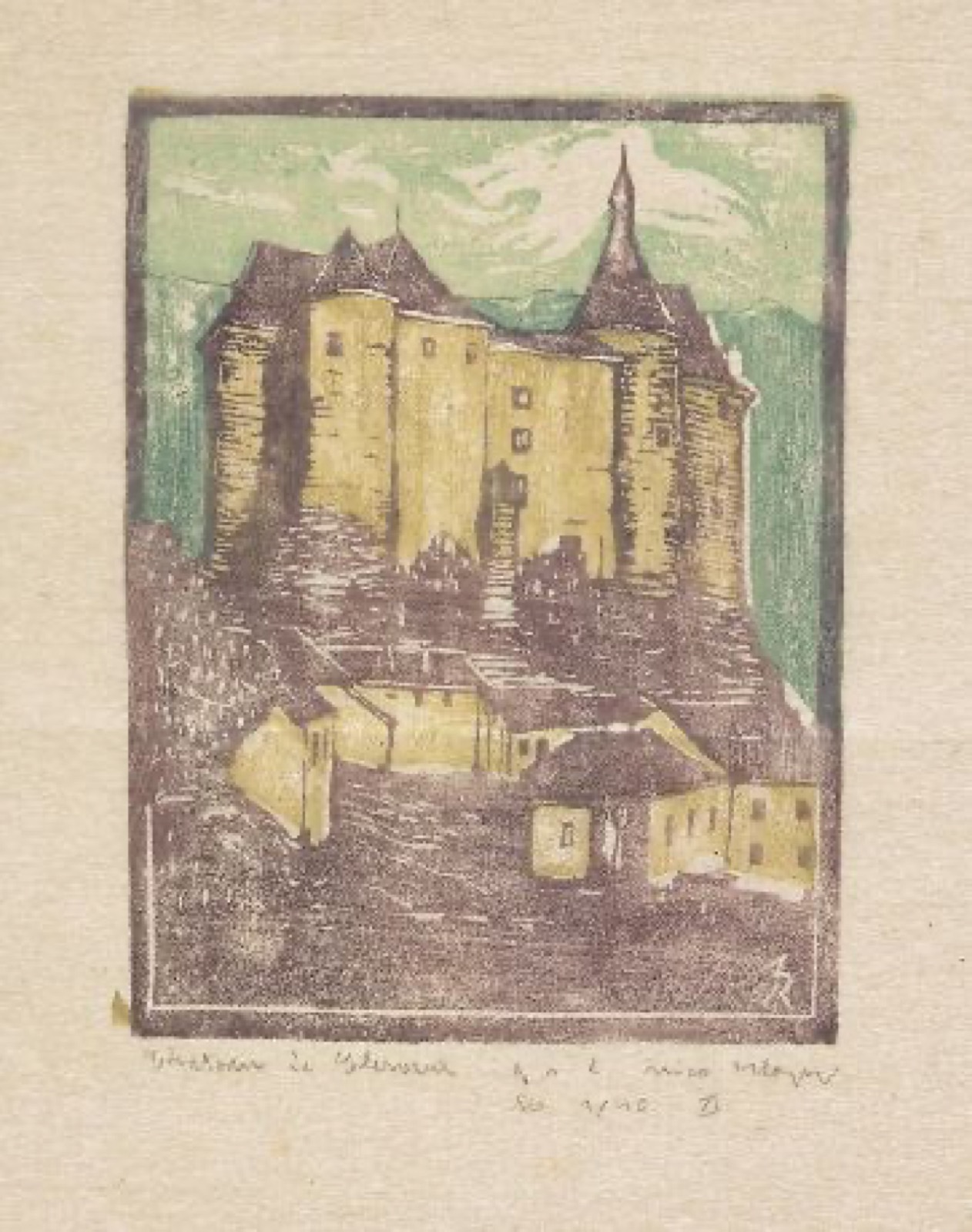
Château de Clervaux
· National Museum of Archaeology, History and Art (via Europeana)
Public domain


