
Scotland · Still standing
Ackergill Tower
Ackergill Tower is a five-storey oblong Scottish tower house on the coast of Sinclair's Bay near Wick in Caithness, built in the early 16th century with a later rear wing. It is a Category A listed building and has been used in recent decades as a venue and hotel. The present silhouette combines the tall stone tower, a lower crenellated curtain wall with a round drum tower, and a multi-storey wing to the rear.
Its prime
1860
Today
Still standing
As it stood in 1860
What Ackergill Tower looked like in its prime.
A tall five-storey oblong stone tower of roughly rectangular plan, faced in local grey sandstone, with narrow vertical windows and a ground-floor arched entrance; a lower crenellated curtain wall stretches from the tower and terminates in a round drum/turret to one side. A four-storey rear wing is attached to the main block, and a small cap-house/roof structure tops the tower with steep slate roofs and flagstaffs. The castle sits on short grass near the coast with an open forecourt.
Its story
The story of Ackergill Tower.
The Keiths of Inverugie and the Tower on Sinclair's Bay, 1354–1593
Clan Keith, under John Keith of Inverugie, inherited the lands of Ackergill from the Cheyne family in 1354. The tower itself may have been built by his son, though it is first mentioned in 1538. Possession of it became a running quarrel with the Sinclairs of Girnigoe: in 1547 the Sinclairs attacked and seized the castle. Mary of Guise, then Regent of Scotland, granted them remission for the raid and restored the tower to the Keiths, installing Laurence Oliphant, 4th Lord Oliphant, as its keeper in 1549, only for the Sinclairs to capture it again in 1556 and be pardoned a second time. John Keith, Captain of Ackergill, was present at Mary of Guise's death in Edinburgh in 1560. In 1593 Robert Keith seized the tower by force from his own brother, George Keith, 5th Earl Marischal, its rightful owner, and was declared a rebel; the castle was returned to the Earl.
Night Assault and Siege, 1597–1623
In September 1597 John Keith of Subster stormed the tower in the dead of night, scaling its walls with ladders, taking the occupants by surprise and capturing the place. The Sinclairs won Ackergill back by legal means in 1612, when George Keith, 5th Earl Marischal, sold it to the Earl of Caithness. By 1623 the tower was under attack once more, besieged by Sir Robert Gordon during his feud with George Sinclair, 5th Earl of Caithness; the Sinclairs surrendered before any assault took place.
Cromwell, Breadalbane and the Dunbars, 1651–1699
Oliver Cromwell may have used Ackergill to garrison troops in 1651 while besieging the Keiths' Dunnottar Castle during his hunt for the Honours of Scotland. In 1676 John Campbell, 2nd Earl of Breadalbane and Holland, took possession of the tower in repayment of debts owed to him by the Sinclairs, and put it up for sale in 1699, when it was bought by Sir William Dunbar of Hempriggs.
From Baronetcy to Wedding Venue, 18th Century–2019
The Dunbars extended the tower with a lean-to wing, and in the mid-19th century the architect David Bryce added a cap-house for George Sutherland Dunbar, 7th Lord Duffus. In 1963 Maureen Blake, who from girlhood had lived with her mother and C. S. Lewis for about twenty years, became the eighth baronetess of Hempriggs and steward of Ackergill until its sale in 1986; a two-year restoration followed before it reopened as a hotel. Under later owners AmaZing Venues it earned a five-star rating in 2012 after a £2 million refurbishment, and operated as an events and wedding venue from 2014 to 2019. The five-storey tower, with its early-18th-century rear wing, is a Category A listed building.
Step inside
6 places to explore in 1860.
The record describes 6 distinct spots at Ackergill Tower, including the full exterior approach. Create your own photoreal reconstruction and explore every one, more scenes means more rooms, more angles, and more of the place to stand in.
Build Your Own Castle
Recreate Ackergill Tower with AI to explore it.
The artist rebuilds it as it stood in 1860, a photoreal reconstruction that belongs to you alone. Pay with coins, no subscription needed.
Recreate this castle →Defend this castle →Whose castle
Clans who held Ackergill Tower.
The families that held Ackergill Tower for a decade or more across its history, follow a name to its clan.
Cheyne
Held the lands of Ackergill until 1354.
Keith
Inherited Ackergill in 1354 under John Keith of Inverugie; held, through feud and seizure, until sold in 1612.
Acquired legally in 1612 when the Earl Marischal sold the tower to the Earl of Caithness; held until 1676.
John Campbell, 2nd Earl of Breadalbane, took possession in 1676 in repayment of Sinclair debts; sold 1699.
Dunbar
Bought by Sir William Dunbar of Hempriggs in 1699.
From the archive
Ackergill Tower on paper: the measured plan and period views.
The survey plan and photographs below are the ground truth this page's reconstructions are checked against, drawn and photographed while the castle was still a working garrison. Every image is public-domain or openly licensed, with its source named.
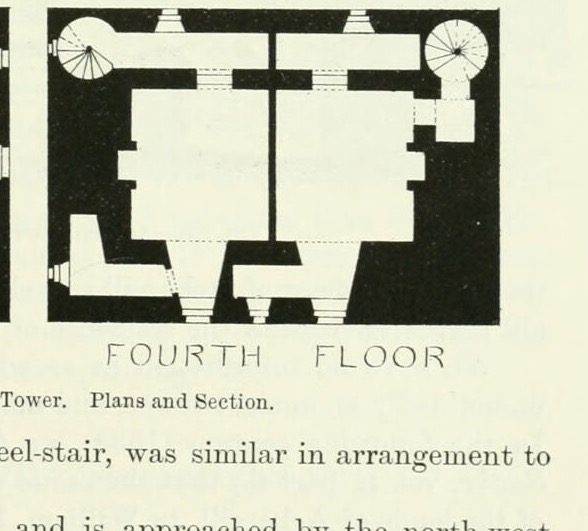
THIRD FLOOR
1889 · MacGibbon & Ross, vol. 3 (1889)
Public domain
FIRST FLOOR
1889 · MacGibbon & Ross, vol. 3 (1889)
Public domain
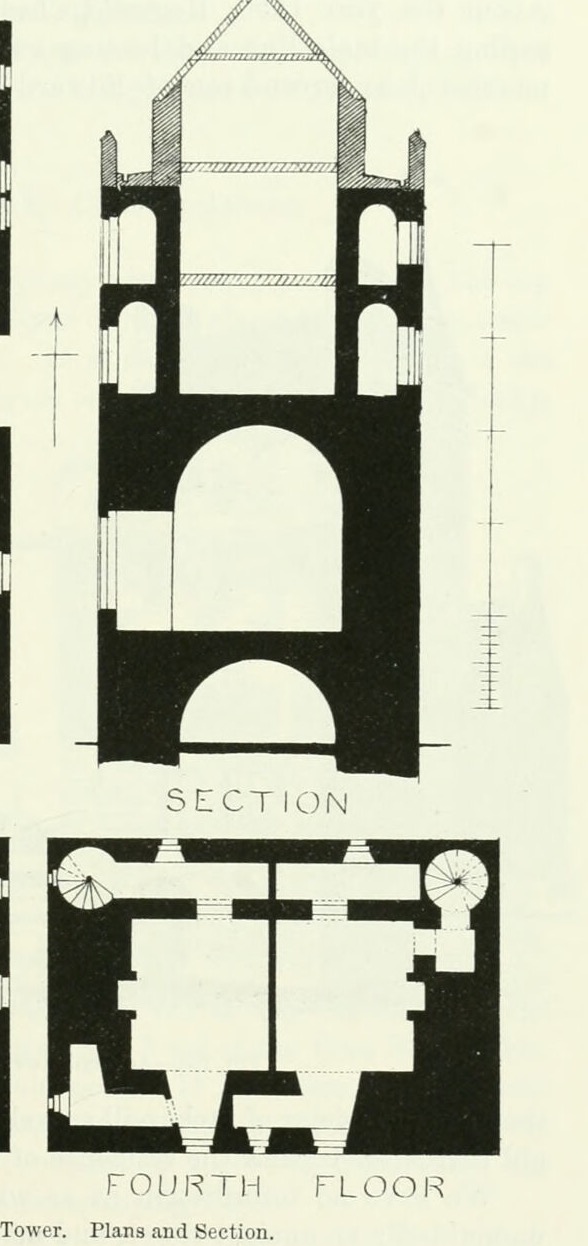
SECTION
1889 · MacGibbon & Ross, vol. 3 (1889)
Public domain


