
Scotland · Partial ruin
Balgonie Castle
Balgonie Castle is a medieval tower house and courtyard castle on the south bank of the River Leven in Fife, Scotland. The 14th‑century keep stands with later ranges added between the 15th and early 18th centuries; the keep and chapel have been restored while other ranges remain roofless ruins. The site includes a 15th‑century gatehouse, an enclosed courtyard and remnants of a landscaped park.
Its prime
1706
Today
Partial ruin
As it stood in 1706
What Balgonie Castle looked like in its prime.
A tall, rectangular 14th‑century stone keep with pitched roof and crow‑stepped gables dominates the silhouette, linked to lower multi‑storey ranges to the east and south by stone stair and corridors. A semi‑ruinous 15th‑century gatehouse opens onto a cobbled courtyard around a well, with roofless east and north ranges showing exposed walls and chimney stacks. Large mature trees and the River Leven lie close by, and an external parapet walk and cannon spouts are visible at the keep roofline.
Its story
The story of Balgonie Castle.
The Sibbalds and Sir Robert Lundie, 1246–1496
The lands of Balgonie, on the south bank of the River Leven in Fife, were held by the Sibbalds from at least 1246. Probably in the 1360s they built a barmkin, a fortified courtyard, with a tower house at its north-west corner; the keep's ground and first floors are vaulted, and the first-floor hall was built, unusually, without a great fireplace, originally reached by a moveable timber stair.
The lands and castle passed with a Sibbald daughter to Sir Robert Lundie, who extended Balgonie in 1496 after his appointment as Lord High Treasurer of Scotland, adding a two-storey range east of the keep with a long hall and solar that absorbed an earlier corner tower and the 14th-century chapel. King James IV visited on 20 August 1496 and gave the masons eighteen shillings as a gift.
Field Marshal Leslie and the Earls of Leven, 1635–1681
Balgonie was sold to the Boswells in 1627 and sold on again in 1635 to Sir Alexander Leslie, who had fought for the Swedish army during the Thirty Years' War, risen to Field Marshal, and led the Covenanters in the Bishops' Wars. He was created Lord Balgonie and Earl of Leven in 1641 and retired in 1654, adding a two-storey building at the courtyard's south-east corner; initials found inside it for Leslie and his wife Dame Agnes Renton suggest the block was built before his elevation to the peerage. He also raised the late-15th-century north range by a storey and laid out a park, remnants of which survive.
John Leslie, 7th Earl of Rothes, disputed the earldom of Leven with David Melville after the 2nd Earl's death in 1664, and brought in John Mylne junior, the king's master mason, to build a grand stair linking keep and north range where a wooden bridge had previously stood. David Melville inherited Balgonie along with the earldom on Rothes's death in 1681.
Rob Roy's Raid and the Melville Additions, 1706–1720s
In 1706 Melville added a three-storey range linking the north range to the south-east block, built by master mason Gilbert Smith. Rob Roy MacGregor captured Balgonie Castle during a raid in 1716, though it was soon returned to the Melvilles. David Melville, 6th Earl of Leven, made minor improvements in the 1720s, including the insertion of sash windows, and further buildings went up within the courtyard.
Decline and Restoration, 1824–1975
James Balfour of Whittingehame, grandfather of Arthur Balfour, prime minister from 1902 to 1905, bought Balgonie in 1824 but could not arrest its decline; the roofs were removed in the mid-19th century to avoid paying tax on the property, and the castle suffered further vandalism in the 1960s. Restoration began in 1971 under owner David Maxwell and continued through the 1970s and 1980s, helped by European funding during European Architectural Heritage Year in 1975.
The keep and chapel are now fully restored and occupied by the family of Raymond Morris, originally of Walsall, while the north and east ranges remain roofless; the restored chapel and great hall are hired out for events such as weddings. Balgonie, excepting the residential tower, is a Scheduled Ancient Monument, and has been a category A listed building since 1972. The castle's ghost stories include Green Jeanie, said to be one of the Lundie household, along with a 17th-century soldier, a dog and a hooded man; a skeleton was found beneath the great hall floor during works in 1912.
Step inside
9 places to explore in 1706.
The record describes 9 distinct spots at Balgonie Castle, including 4 interiors: keep, first‑floor hall, vaulted chapel (basement of north range), long hall and solar (east range) and more. Create your own photoreal reconstruction and explore every one, more scenes means more rooms, more angles, and more of the place to stand in.
Build Your Own Castle
Recreate Balgonie Castle with AI to explore it.
The artist rebuilds it as it stood in 1706, a photoreal reconstruction that belongs to you alone. Pay with coins, no subscription needed.
Recreate this castle →Defend this castle →Whose castle
Clans who held Balgonie Castle.
The families that held Balgonie Castle for a decade or more across its history, follow a name to its clan.
Sibbald
Held the lands of Balgonie from at least 1246.
Lundie
Came by marriage to Sir Robert Lundie, who extended the castle in 1496 as Lord High Treasurer of Scotland.
Bought by Sir Alexander Leslie in 1635; created Lord Balgonie and Earl of Leven in 1641.
Melville
Held by the Melville Earls of Leven; David Melville, 6th Earl, added sash windows in the 1720s.
Balfour
Bought by James Balfour of Whittingehame in 1824, grandfather of Prime Minister Arthur Balfour.
From the archive
Balgonie Castle on paper: the measured plan and period views.
The survey plan and photographs below are the ground truth this page's reconstructions are checked against, drawn and photographed while the castle was still a working garrison. Every image is public-domain or openly licensed, with its source named.
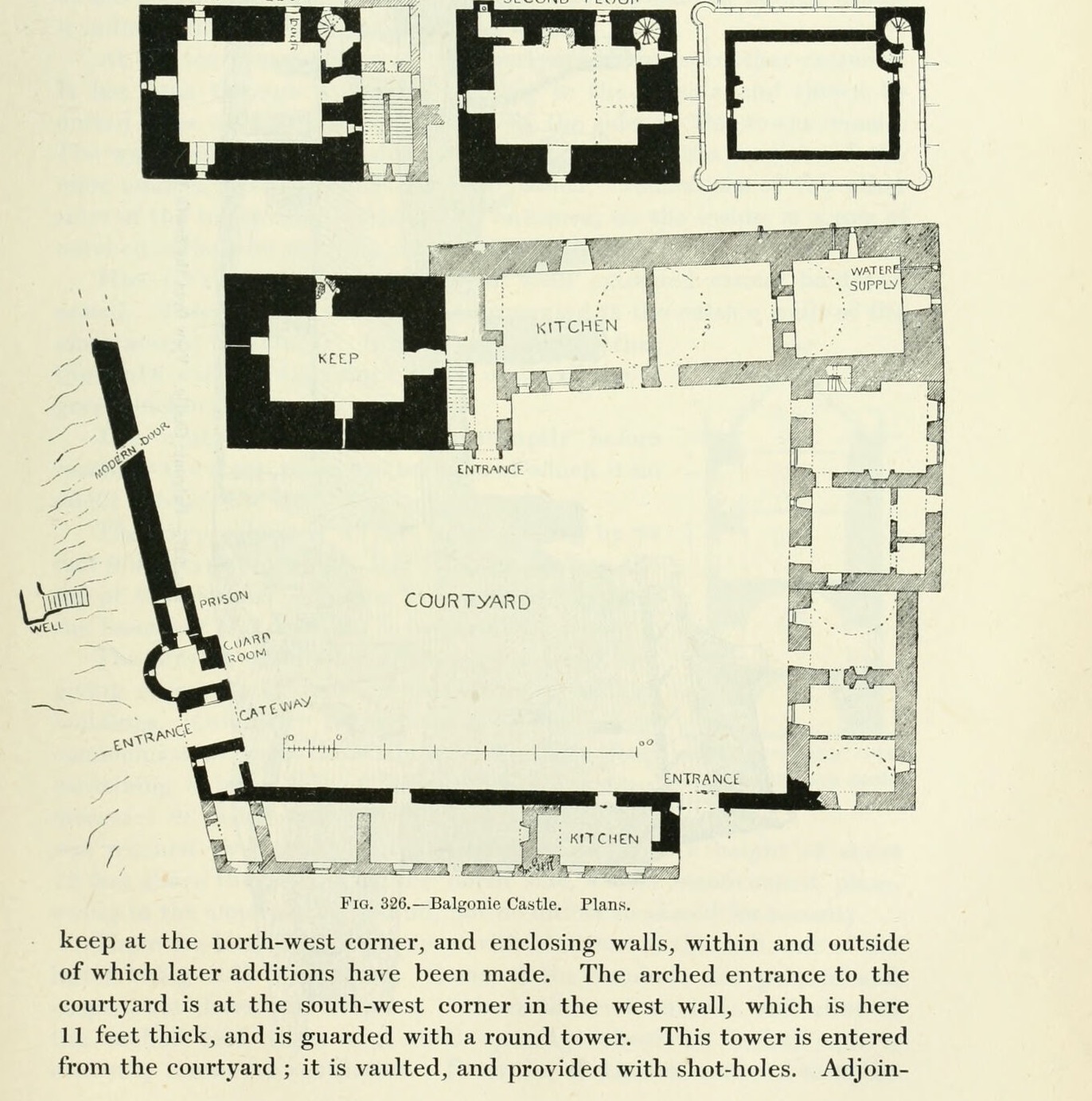
Fig. 326. Balgonie Castle. Plans.
1887 · MacGibbon & Ross, Castellated and Domestic Architecture of Scotland, vol. 1 (1887)
Public domain
Nearby


