Scotland · Partial ruin
Barony and Castle of Kilbirnie
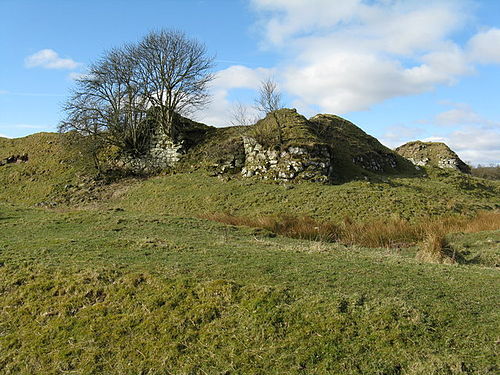
Kilbirnie Castle (the Place of Kilbirnie) stands on the lower slopes of the Glengarnock Hills west of Kilbirnie in North Ayrshire, Scotland. The site consists of a 15th-century rectangular tower (keep) with a 1627 mansion wing built at right angles; extensive pleasure grounds and a ravine/stream lie immediately adjacent.
Its prime
1627
Today
Partial ruin
As it stood in 1627
What Barony and Castle of Kilbirnie looked like in its prime.
A four-storey rectangular stone keep (about 42 by 33 feet) with very thick masonry walls sits at right angles to a 17th-century mansion wing faced with sandstone ashlar; the mansion has a shallow projecting south porch and corbelled turrets at hall level. The complex stands on high ground above the bend of a deep ravine with a stream below, approached from a long straight avenue and surrounded by walled gardens; roofs and windows are intact at their original lines.
Its story
The story of Barony and Castle of Kilbirnie.
Kilbirnie Castle, the Place of Kilbirnie, stands on the lower slopes of the Glengarnock Hills west of Kilbirnie: a 15th-century rectangular keep with a mansion wing of 1627 built at right angles, its site once defended by a stream and a small but deep ravine. In 1707 both baronies were united in the Barony of Kilburnie, with the manor house as principal messuage.
The Barclays of Kilbirnie, thought a branch of the ancient Barclays of Ardrossan, passed the castle to the Crawfurds through the marriage of the heiress Marjory to Malcolm Crawfurd. Fire ended its habitation: the 21st Earl of Crawfurd, his infant daughter Jean, later a Countess of Eglinton, and their domestics had little time to escape the flames, and until the earl's death in 1781 the cause was carefully concealed, with supernatural forces held to blame.
The family moved first to the Kilbirnie barony manse and later settled at Bourtreehill House near Irvine. The Knox family built a later estate house called Place nearby, now mostly demolished, and in 1925 the Kilbirnie Place Golf Club was laid out on the old landscaped pleasure grounds once attached to the castle.
Step inside
11 places to explore in 1627.
The record describes 11 distinct spots at Barony and Castle of Kilbirnie, including 4 interiors: vaulted hall in the keep, cellar and vaulted sleeping loft beneath the keep, 'starving pit' prison at north-west corner and more. Create your own photoreal reconstruction and explore every one, more scenes means more rooms, more angles, and more of the place to stand in.
Build Your Own Castle
Recreate Barony and Castle of Kilbirnie with AI to explore it.
The artist rebuilds it as it stood in 1627, a photoreal reconstruction that belongs to you alone. Pay with coins, no subscription needed.
Recreate this castle →Defend this castle →Whose castle
Clans who held Barony and Castle of Kilbirnie.
The families that held Barony and Castle of Kilbirnie for a decade or more across its history, follow a name to its clan.
Barclay
The Barclays of Kilbirnie, thought a branch of the Barclays of Ardrossan, held the castle until it passed by marriage to the Crawfurds.
Crawfurd
Held by the Crawfurds from the marriage of the Barclay heiress Marjory to Malcolm Crawfurd; the 21st Earl of Crawfurd fled the fire that ended its habitation, dying in 1781.
Nearby