Scotland · Restored
Blackness Castle
Caisteal Blackness
Blackness Castle is a 15th-century royal fortress on a rocky spit on the south shore of the Firth of Forth near the village of Blackness, Scotland. Built in the 1440s and strengthened in the mid-16th century, it served as a fortress, state prison and artillery strongpoint guarding the approaches to Linlithgow and the Forth.
Its prime
1540
Today
Restored
Ranked among Europe’s castles
As it stood in 1540
What Blackness Castle looked like in its prime.
Long, narrow stone fortress oriented north–south, jutting from a rocky spit into the Firth of Forth. A continuous curtain wall encloses a rectangular courtyard of lawn with a separate five-storey central tower rising from the middle and integrated north and south towers at each end. A triangular 16th-century spur/forework defends the east gate; gun-ports and thickened inner walls appear in places. The castle is built of grey local stone and sits directly over rock with a water-gate to the northwest.
Its story
The story of Blackness Castle.
From Crichton's Port Fortress to Royal Prison, 1440s–1512
Blackness was built in the 1440s, probably on the site of an earlier fort, by Sir George Crichton (Lord High Admiral of Scotland and later Earl of Caithness) at a time when Blackness was the main port serving the royal burgh of Linlithgow. The Crichtons were then among the most powerful families in Scotland and close to James II, and the castle probably rose during their feud with the Black Douglases, which had seen Crichton's tower at Barnton in Edinburgh destroyed in 1444. First mentioned in 1449, Blackness was already doing double duty as Crichton's residence and a state prison.
In 1453 George Crichton handed his lands, castle included, to James II. His dispossessed heir James Crichton seized Blackness and held it briefly against the King, who besieged and recaptured it the same year, and it has been crown property ever since, a royal fortress and prison under a keeper who was often the Sheriff of Linlithgow. James IV knew it well: in November 1512 he came aboard the great warship Michael off Blackness to hold audience with the French ambassador, confirming the Auld Alliance.
Finnart's Artillery Walls, 1534–1547
Between 1534 and 1540 the King's Master of Works, Sir James Hamilton of Finnart, rebuilt Blackness for the gunpowder age. Finnart had studied artillery fortification in Europe, and here he thickened the curtain wall on the south and east from 1.5 metres to over 5 metres in places, opened gun ports, heightened the south wall to enclose a new south tower, and built a complex entrance covered by a caponier, a passage within the wall for firing into the backs of attackers who breached the gate, one of only three surviving in Scotland. The result was one of the most advanced artillery fortifications of its time in the country. Work continued after Finnart's execution for treason in 1540 and halted on the death of James V in 1542.
The new works were soon tested. After the battle of Pinkie, on 15 September 1547, the English captain Richard Broke rowed the Galley Subtle up the Forth to Blackness, exchanged fire, captured the Mary Willoughby, the Anthony of Newcastle and the Bosse, and burnt other ships. In the last years of the Rough Wooing the castle's captain was the Italian military engineer Camillo Marini.
State Prisoners and the Fight for Queen Mary, 1560–1594
As a state prison Blackness held Cardinal Beaton, Archbishop of St Andrews, and Archibald Douglas, 6th Earl of Angus, regent of Scotland in the 1520s. During the Reformation crisis the castle was surrendered by negotiation to the Duke of Châtellerault, and two English captains took possession on Easter Day 1560.
In the civil war that followed Mary, Queen of Scots' forced abdication, the garrison stayed loyal to her. Lord Claud Hamilton recaptured the castle for Mary in 1572 and harried shipping in the Forth into the following year despite a blockade. On 27 January 1573 James Kirkcaldy arrived from France with arms and money for the Queen's party; his ship was taken the next day, Regent Morton laid siege, and castle and Kirkcaldy surrendered within a week. Later prisoners included the Earl of Huntly in 1592 and John Wemyss of Logie in 1594.
Cromwell's Guns and the Covenanters' Cells, 1650–1815
The defences were not tested again until 1650, when Oliver Cromwell's New Model Army besieged Blackness during his invasion of Scotland. Artillery had improved beyond anything Finnart's walls could withstand; bombarded from land and sea, the garrison soon surrendered, and the damaged castle was abandoned. It was not repaired until 1667, when it returned to prison service holding Covenanters, and in 1693 the spur guarding the gate was heightened and the north tower cut down to carry three gun platforms over the Forth. After the Union of 1707 Blackness was one of only four Scottish fortresses kept garrisoned by the British Army, and between 1759 and 1815 it held French prisoners of war through the Seven Years' War and the Napoleonic Wars.
From Ammunition Depot to Historic Monument, 1870 to Today
In 1870 Blackness became the central ammunition depot for Scotland: the whole courtyard was roofed over, the defensive ditch filled in, and barracks and officers' quarters built. A cast-iron pier had gone up in 1868, with a gate and a drawbridge, one of the last drawbridges built in Britain. The depot closed in 1912, the army briefly returned during the First World War, and a restoration of 1926–35 stripped away almost all the Victorian works. Jutting into the Forth on its rocky spit, long and narrow, the castle has been characterised as "the ship that never sailed", its towers dubbed "stem", "stern" and "main mast"; it is now in the care of Historic Environment Scotland.
Step inside
9 places to explore in 1540.
The record describes 9 distinct spots at Blackness Castle, including 5 interiors: spur forework and caponier passage, upper chamber of the central tower, south tower great hall and accommodation and more. Create your own photoreal reconstruction and explore every one, more scenes means more rooms, more angles, and more of the place to stand in.
Build Your Own Castle
Recreate Blackness Castle with AI to explore it.
The artist rebuilds it as it stood in 1540, a photoreal reconstruction that belongs to you alone. Pay with coins, no subscription needed.
Recreate this castle →Defend this castle →Whose castle
Clans who held Blackness Castle.
The families that held Blackness Castle for a decade or more across its history, follow a name to its clan.
Crichton
Built by Sir George Crichton in the 15th century.
From the archive
Blackness Castle on paper: the measured plan and period views.
The survey plan and photographs below are the ground truth this page's reconstructions are checked against, drawn and photographed while the castle was still a working garrison. Every image is public-domain or openly licensed, with its source named.
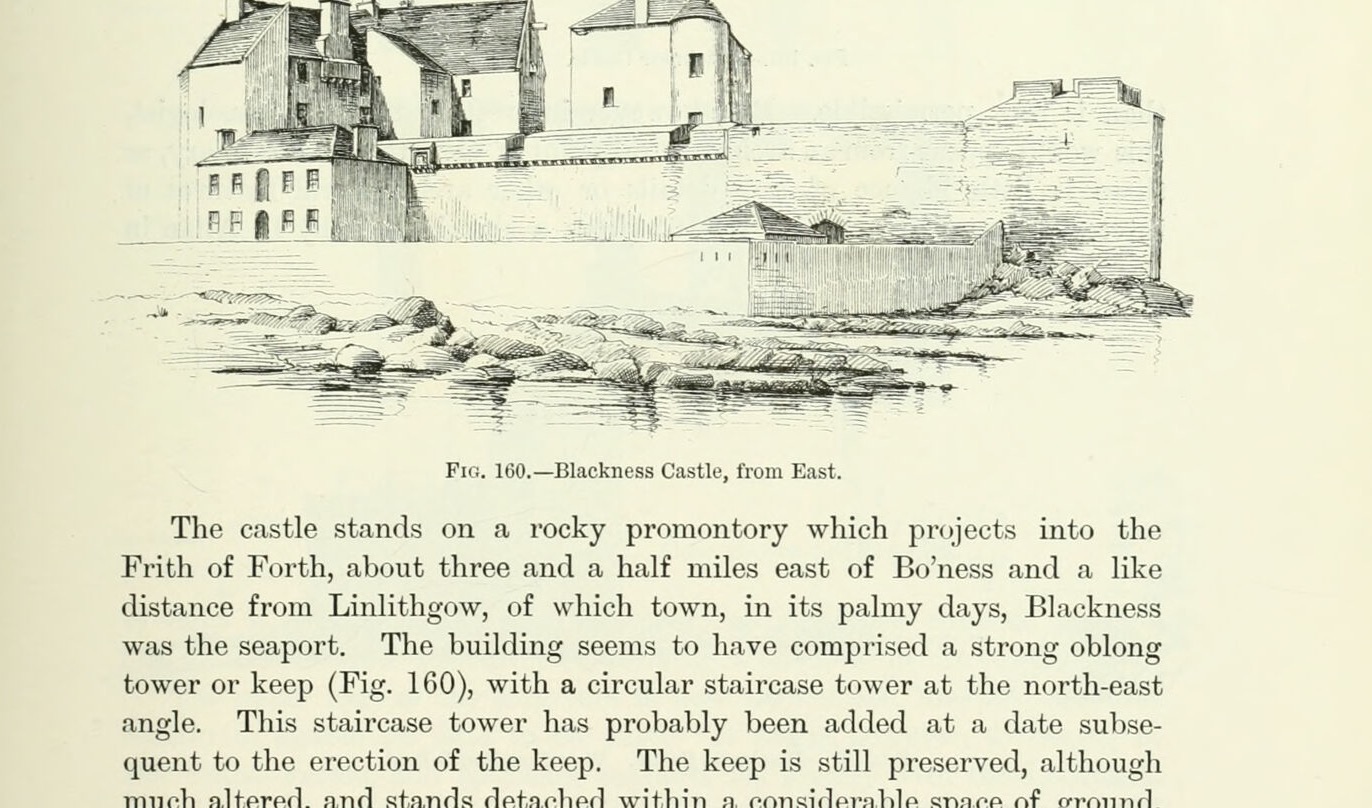
Fig. 160. Blackness Castle, from East.
1889 · MacGibbon & Ross, vol. 3 (1889)
Public domain
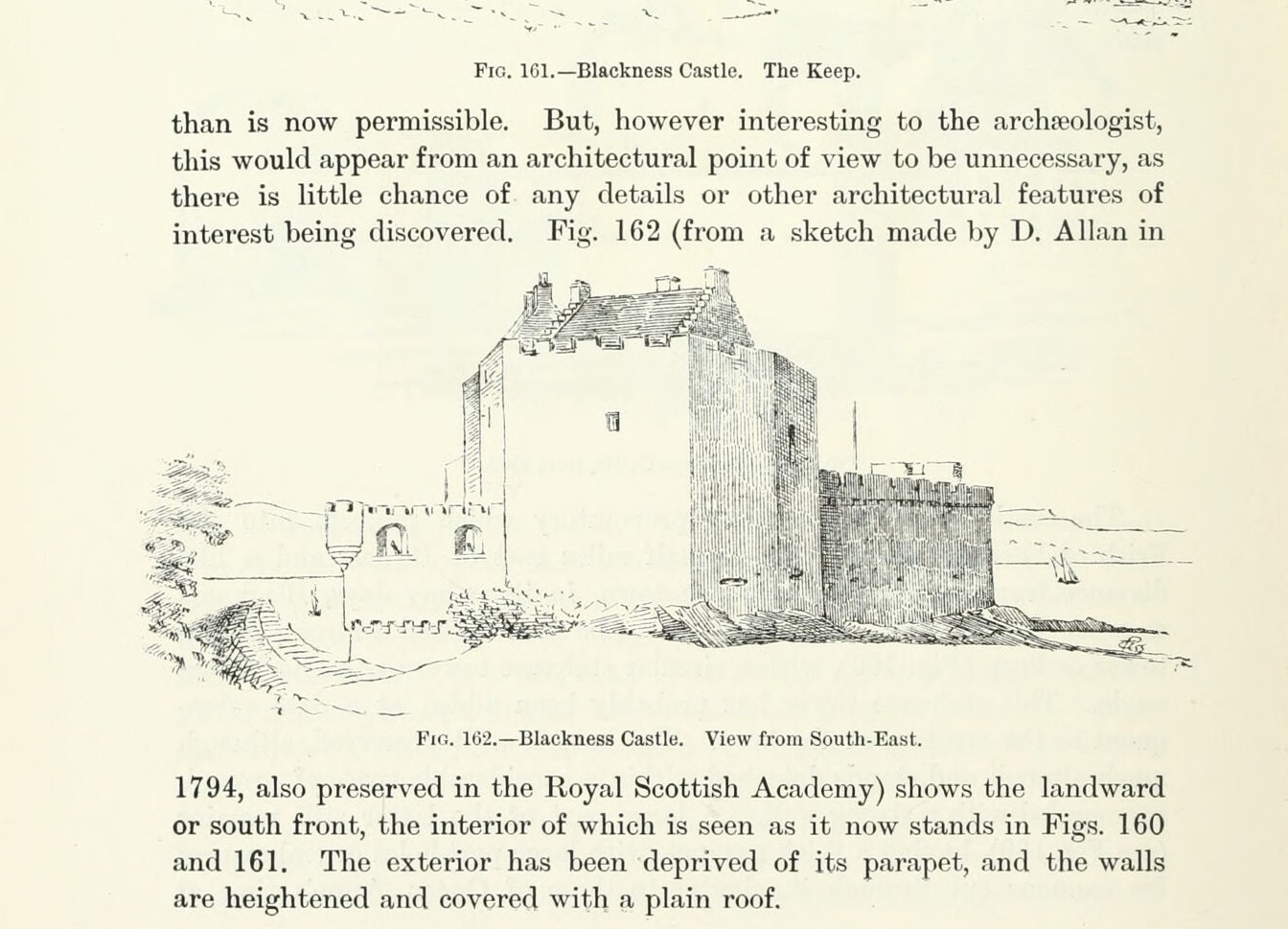
Fig. 161. Blackness Castle. The Keep.
1889 · MacGibbon & Ross, vol. 3 (1889)
Public domain
Fig. 162. Blackness Castle. View from South-East.
1889 · MacGibbon & Ross, vol. 3 (1889)
Public domain
Nearby