
Scotland · Restored
Blair Castle
Blair Castle is a Scottish baronial-style country castle near Blair Atholl in Perthshire, long associated with the Murray family and the Dukes of Atholl. The building preserves medieval fabric alongside large 16th–19th century additions and sits within landscaped grounds that include church ruins and a burial ground.
First raised
1269
Its prime
1885
Today
Restored
As it stood in 1885
What Blair Castle looked like in its prime.
White harled Scots Baronial massing with a symmetrical central block flanked by tall rectangular towers and round corbelled tourelles; crow-stepped gables and a crenellated parapet punctuate the roofline. The main façade features a central arched entrance set between paired round stair-turrets and vertical sash windows in regular rows. Stone dressings appear darker against the rendered walls. The castle stands behind a wide gravel forecourt with low boundary walls and distant Highland hills beyond.
Its story
The story of Blair Castle.
The Comyn Tower and the Crusading Earl, 1269
Caisteil Bhlàir is said to have begun in 1269, when John I Comyn, Lord of Badenoch, started building on the land of his neighbour David I Strathbogie, Earl of Atholl, while the earl was away on crusade. Strathbogie came home, complained to Alexander III, won back the ground and took the interloper's tower into a castle of his own. Six storeys of it survive as the Cummings or Comyn's Tower, largely 15th-century work that may keep some 13th-century fabric within it. The site commands the main route through the central Highlands, the line the A9 follows today.
David II Strathbogie forfeited titles and estates in 1308 after rebelling against Robert the Bruce, and the king granted them to Niall mac Cailein. The earldom passed through several hands until 1457, when James II gave it to his half-brother John Stewart. It reached the Murrays in 1629, when John Murray, son of the second Earl of Tullibardine, was created Earl of Atholl, and it has stayed with them since.
Cromwell's Army and the Siege of 1689
The Murrays held for the king in the Wars of the Three Kingdoms, and Blair was taken by Cromwell's army after his invasion of 1650. At the Restoration Charles II made John Murray, 2nd Earl, Marquess of Atholl; the dukedom followed for the 2nd Marquess in 1703.
When Viscount Dundee raised the first Jacobite rising in April 1689, Atholl stayed loyal to the government, though two of his sons went out with the Jacobites and his factor, Patrick Stewart of Ballechin, held Blair for King James. Dundee visited in May. In July Ballechin shut the gates on Atholl's whiggish heir, Lord John Murray, who laid siege to his own family's seat while General Mackay marched to join him and take the place for the Williamites. Dundee relieved it, and fought at Killiecrankie rather than retreat and surrender the castle to Mackay. He held a council of war at Blair with his officers and clan chiefs on 26 July, the eve of the battle; the Jacobites won the next day, and Dundee was killed. The castle stayed in Jacobite hands afterwards, and in August the Highland chiefs swore a bond there to continue the rising.
The Forty-Five and the Siege of March 1746
Prince Charles Edward Stuart occupied Blair twice, for several days in early September 1745 and again for several days in early February 1746. The Jacobites then abandoned it, and government forces including the Lowland Clan Agnew moved in and held it against them. The Jacobite army laid siege in the closing stage of the rising, and by March 1746 the garrison had been reduced to near starvation; the besiegers broke off and withdrew to meet the government army at Culloden.
Queen Victoria's Visit of 1844 and the Atholl Highlanders
The building grew around the old tower: 16th-century extensions formed the central block, apartments were added to the south in the mid-18th century to designs by John Douglas and James Winter, and the south-east range with its clock tower was rebuilt by Archibald Elliot after a fire in 1814. In the 1870s David Bryce recast the whole building in Scots Baronial for the 7th Duke and added a ballroom, and James Campbell Walker added a further ballroom wing in 1885.
Queen Victoria and Prince Albert stayed at Blair in 1844, and it was after that visit that she gave permission to establish the Atholl Highlanders, the Duke of Atholl's private army, noted as the only legal private army in Europe and garrisoned at the castle. Part of the building served as an auxiliary hospital in the First World War, and it has been open to the public since 1936. Shortly before his death in February 1996 the 10th Duke placed Blair and most of the estates in a charitable trust, keeping them clear of inheritance tax and under Scottish control, his heir having no wish to leave South Africa.
Step inside
11 places to explore in 1885.
The record describes 11 distinct spots at Blair Castle, including 3 interiors: clock tower interior and mechanism, ballroom interior, south apartments (private apartments). Create your own photoreal reconstruction and explore every one, more scenes means more rooms, more angles, and more of the place to stand in.
Build Your Own Castle
Recreate Blair Castle with AI to explore it.
The artist rebuilds it as it stood in 1885, a photoreal reconstruction that belongs to you alone. Pay with coins, no subscription needed.
Recreate this castle →Defend this castle →From the archive
Blair Castle on paper: the measured plan and period views.
The survey plan and photographs below are the ground truth this page's reconstructions are checked against, drawn and photographed while the castle was still a working garrison. Every image is public-domain or openly licensed, with its source named.
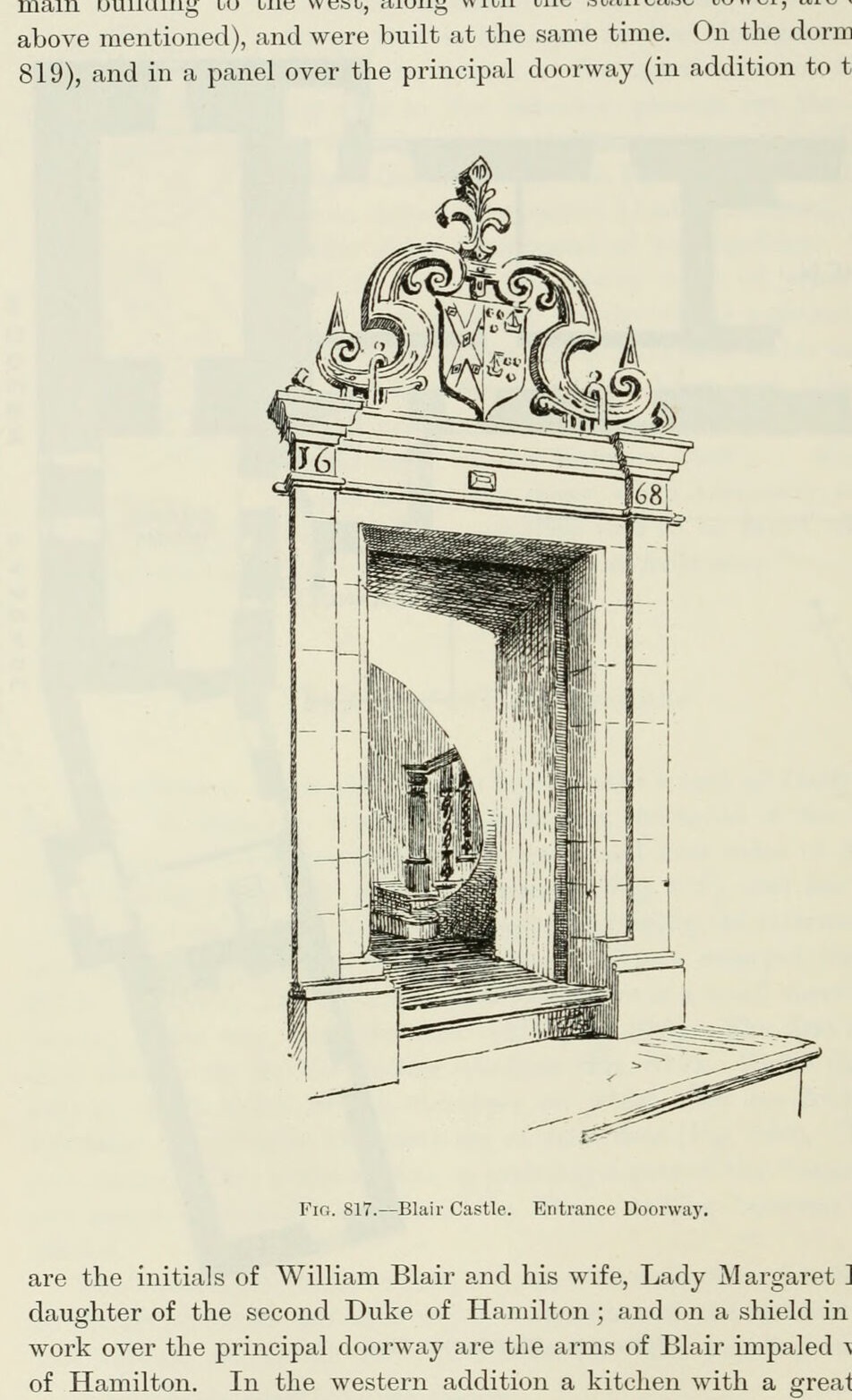
Fig. 817. Blair Castle. Entrance Doorway.
1892 · MacGibbon & Ross, vol. 4 (1892)
Public domain
Fig. 818. Blair Castle. Date on Doorway in Turret.
1892 · MacGibbon & Ross, vol. 4 (1892)
Public domain
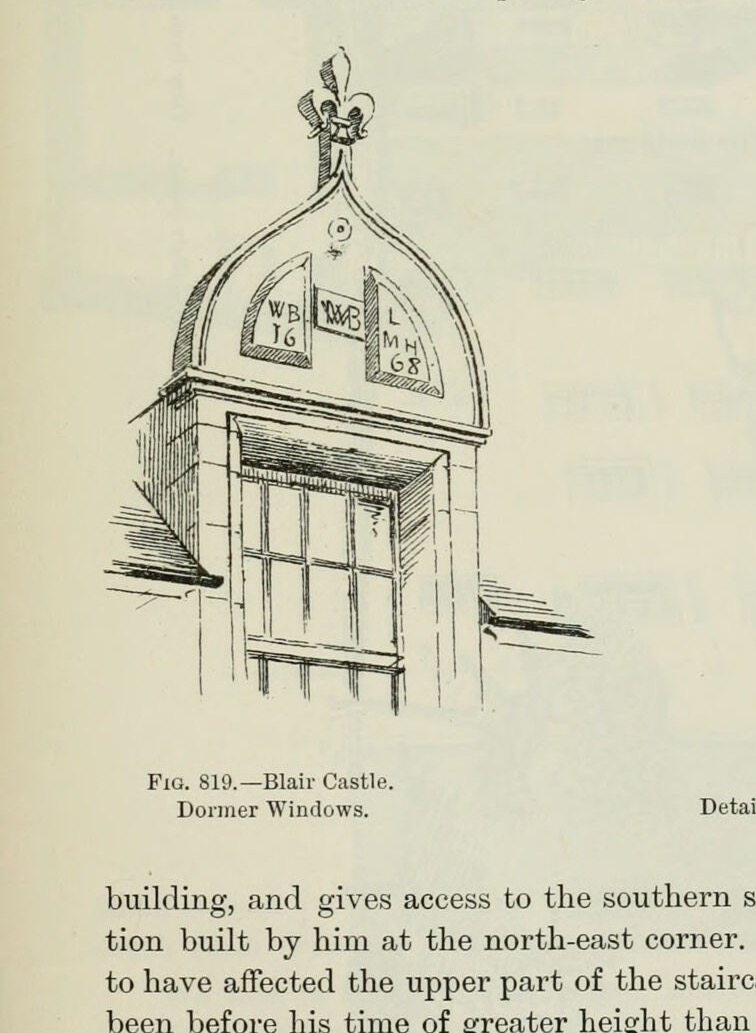
Fig. 819. Blair Castle. Dormer Windows.
1892 · MacGibbon & Ross, vol. 4 (1892)
Public domain


