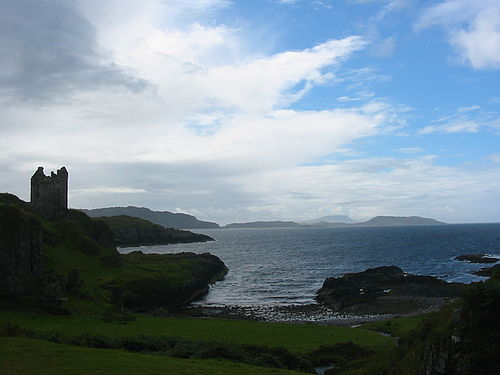
Scotland · Still standing
Blairquhan Castle
Blairquhan is a Regency-era country castle near Maybole in South Ayrshire, Scotland, rebuilt in a Tudor-revival style by William Burn and completed in 1824 for the Hunter-Blair family. The house is a Category A listed building and stands within designed estate grounds that include a walled garden and veteran trees. The estate remains an intact, privately owned house used as an events venue.
Its prime
1824
Today
Still standing
As it stood in 1824
What Blairquhan Castle looked like in its prime.
A low, three-storey, grey sandstone Tudor-revival mansion with crenellated parapets and a central projecting three-storey tower punctuated by tall rectangular chimneys and narrow crenellated turrets. The main block has a projecting arched carriage porch at centre, rows of small-pane sash windows across two main floors, and lower crenellated side ranges forming a courtyard to the right. The house sits amid closely mown lawns and parkland trees, approached by a long curved drive from the north.
Its story
The story of Blairquhan Castle.
Four Families and the Old Castle, 1346–Early 1600s
Four different families have held Blairquhan or its lands. The McWhirters built the first tower house here in about 1346. The Kennedys then inherited the estate through marriage and built the remainder of the old castle in about 1573. In the early 17th century the Whitefords took the estate over in turn.
A Bank Crash and the Hunter Blair Inheritance, 1770–1798
In 1770 Sir James Hunter Blair, 1st Baronet, married Jean Blair, heiress of John Blair of Dunskey in Wigtownshire; when Jean inherited her father's estate in 1777 the family adopted the additional surname of Blair. In 1798, suffering the effects of a bank crash, the Whitefords sold Blairquhan to Sir James's second son, Sir David Hunter Blair, 3rd Baronet, who had made some of his money in Jamaica as joint-owner of the Roselle Estate in St Thomas-in-the-East.
William Burn's Regency Rebuilding, 1820–1824
The old castle had become ruinous through earlier fires and neglect. In 1820 Sir David commissioned the Scottish architect William Burn to design a new house on the site; the old building was torn down for a Tudor-revival Regency castle, though some of its decorative mouldings and sculpted stones were built into the kitchen courtyard of the new house. The new mansion, completed in 1824, remained the Hunter-Blair Baronets' home for close to two centuries. It is protected as a Category A listed building, and its grounds are included in the Inventory of Gardens and Designed Landscapes in Scotland.
Restoration, Filming and the Sale to Ganten, 1997–2012
James Hunter Blair (1926–2004), younger brother and heir presumptive of Sir Edward Hunter-Blair, 8th Baronet, spent much of his life restoring the castle and its grounds, which include a sycamore thought to be a Dule, or gallows, tree planted early in the reign of James V; its weakened crown was heavily pruned in 1997 to save the trunk from collapse. He opened the 2,000-acre estate as a venue for weddings, corporate functions and filming to help offset running costs, and its interiors and grounds stood in for Balmoral Castle in the 2006 film The Queen. In late 2012 Sir Patrick David Hunter-Blair, 9th Baronet, sold Blairquhan to Ganten Scotland, a subsidiary of a Chinese company that bottles mineral water. The house stands intact, privately owned and run as an events venue.
Step inside
7 places to explore in 1824.
The record describes 7 distinct spots at Blairquhan Castle, including the full exterior approach. Create your own photoreal reconstruction and explore every one, more scenes means more rooms, more angles, and more of the place to stand in.
Build Your Own Castle
Recreate Blairquhan Castle with AI to explore it.
The artist rebuilds it as it stood in 1824, a photoreal reconstruction that belongs to you alone. Pay with coins, no subscription needed.
Recreate this castle →Defend this castle →Whose castle
Clans who held Blairquhan Castle.
The families that held Blairquhan Castle for a decade or more across its history, follow a name to its clan.
Whiteford
The Whitefords held Blairquhan from the early 17th century until a bank crash forced its sale in 1798.
Hunter-Blair
Home of the Hunter-Blair Baronets from 1798, when the 3rd Baronet bought it, until the 9th Baronet sold it in 2012.