
Scotland · Still standing
Cardoness Castle
Cardoness Castle is a late 15th-century Scottish tower house near Gatehouse of Fleet in Kirkcudbrightshire, originally a MacCulloch seat. The five-storey rectangular tower sits within a low walled forecourt and is now in the care of Historic Environment Scotland and open to the public.
Its prime
1490
Today
Still standing
As it stood in 1490
What Cardoness Castle looked like in its prime.
A massive rectangular five-storey tower of roughly coursed grey rubble with dressed corner stones and small, irregularly spaced vertical slit-windows and rectangular openings. A single round-arched entrance is set above ground level and is reached by a long sloping stone ramp carried over a vaulted arch; a low stone retaining wall and grassy forecourt lie before the tower. At its prime the tower carried a continuous stone parapet and intact roofs, standing amid pasture and scattered trees.
Its story
The story of Cardoness Castle.
Anwoth, Boreland and the de Kerdennes, 1170–1342
Around 1170 Malcolm IV granted the lands of Anwoth to David fitz Teri, a Cumbrian lord, who raised a motte-and-bailey castle at Boreland, close to the site of the present tower. The de Kerdenes appear in the records of the following century: in 1220 one Nicholas de Kerdenes and his wife Cicely were in dispute with the monastery at Dundrennan over Cicely's dowry, a quarrel he carried as far as an appeal to the Pope, and in 1277 Bertram de Kerdennes witnessed a charter of King Alexander III confirming Devorguilla de Balliol's grant to Glasgow Cathedral. On 18 June 1342 King David II granted Malcolm Fleming, Earl of Wigtown, a charter of the lands of Cardoness in Galloway, in excambion for the lands of Mochrum the king had given him earlier, along with further lands in Wigtownshire.
The McCullochs, the Black Loch and an English Spy, 1466–1560s
The lands of Cardoness were in McCulloch hands by 1466. Writing in 1864, Sir Andrew Agnew set down the local tradition of how they came by them: a laird of Cardoness who had exhausted his resources building his castle joined a band of border thieves, and having fathered nine daughters threatened to drown his wife and all of them in the Black Loch unless her next child was a son. A boy was born, and the laird proclaimed a great fete on the frozen loch, to which his whole family came except one daughter who was unable to join them. The ice gave way at the height of the revels and the rest of the household drowned; the surviving daughter, the tradition runs, shortly afterwards married one of the McCullochs.
It was the McCulloch lairds who built the present tower house in the late 15th century. In the 1560s an English spy reported on the castle to Elizabeth I, in preparation for a planned invasion of Scotland that never took place.
Sir Godfrey McCulloch and the Gordons, 1622–1697
In 1622 the Gordons of Ardwall acquired the mortgaged estate. The feuding between the two families came to a head in 1690, when Sir Godfrey McCulloch shot dead William Gordon of Buck o'Bield. Sir Godfrey escaped to France, but was recognised in Edinburgh in 1697 and beheaded on the Maiden, the Scottish equivalent of the guillotine.
An Empty Tower Taken into State Care, from 1697
The castle was left uninhabited after Sir Godfrey's death and passed through the hands of a number of owners before being placed in state care in 1927. It has been protected as a scheduled monument since 1928, and is maintained by Historic Environment Scotland and open to the public.
Step inside
6 places to explore in 1490.
The record describes 6 distinct spots at Cardoness Castle, including 1 interior: vaulted undercroft beneath the ramp. Create your own photoreal reconstruction and explore every one, more scenes means more rooms, more angles, and more of the place to stand in.
Build Your Own Castle
Recreate Cardoness Castle with AI to explore it.
The artist rebuilds it as it stood in 1490, a photoreal reconstruction that belongs to you alone. Pay with coins, no subscription needed.
Recreate this castle →Defend this castle →Whose castle
Clans who held Cardoness Castle.
The families that held Cardoness Castle for a decade or more across its history, follow a name to its clan.
MacCulloch
Seat of the MacCullochs of Myreton from before 1466; they built the present tower and abandoned it after Sir Godfrey McCulloch's execution in the late 17th century.
The Gordons of Ardwall acquired the mortgaged estate in 1622.
From the archive
Cardoness Castle on paper: the measured plan and period views.
The survey plan and photographs below are the ground truth this page's reconstructions are checked against, drawn and photographed while the castle was still a working garrison. Every image is public-domain or openly licensed, with its source named.
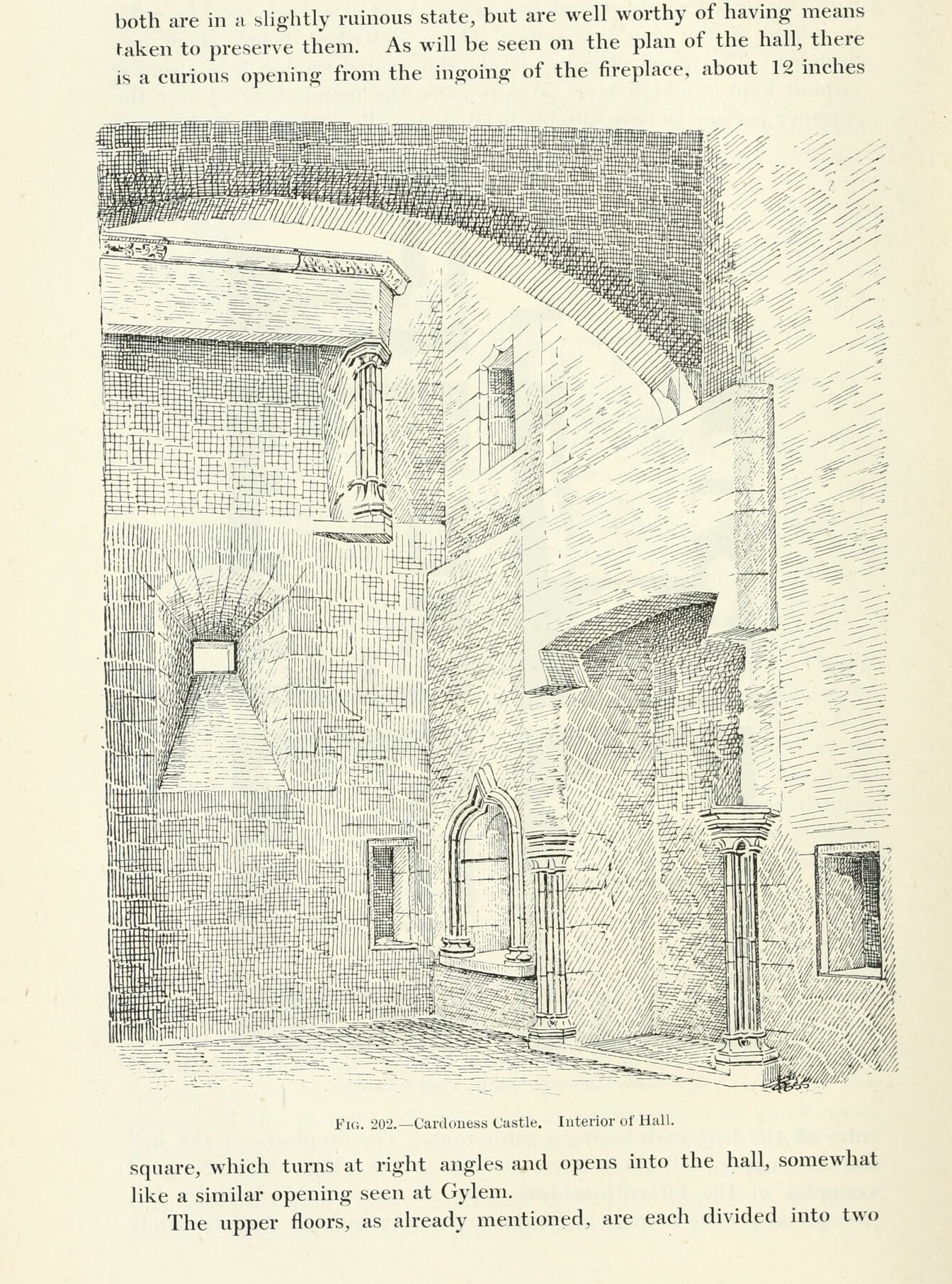
Fig. 202. Cardoness Castle. Interior of Hall.
1887 · MacGibbon & Ross, Castellated and Domestic Architecture of Scotland, vol. 1 (1887)
Public domain


