
Scotland · Ruin
Cessford Castle
Cessford Castle is a mid-15th-century L-plan fortalice near the village of Cessford in the Scottish Borders, historically the principal stronghold of the Kerr family. Built around 1450 and abandoned in 1650, the castle once comprised a main keep with a similar-sized wing, a gatehouse at the angle, and surrounding barmekin and earthworks.
Its prime
1523
Today
Ruin
As it stood in 1523
What Cessford Castle looked like in its prime.
A compact L-plan fortress of reddish-brown sandstone standing on a low grassy mound in rolling border country. The composition is a main rectangular keep paired with a wing of almost equal size forming an L, walls up to 13 feet thick pierced by small rectangular windows and narrow arrow-slits, and a single-storey defensive gatehouse closing the inner angle; at prime it rose to as many as six storeys and was surrounded by a barmekin and earthen defensive ramparts.
Its story
The story of Cessford Castle.
Andrew Ker's Castle and the Barony of Cessford
Cessford Castle was built around 1450 by Andrew Ker, near the village of Cessford midway between Jedburgh and Kelso, in the historic county of Roxburghshire and now the Scottish Borders. It is possible that the building incorporates parts of an earlier structure. The castle is the caput of the Barony of Cessford, and Andrew Ker was an ancestor of Robert Ker, 1st Earl of Roxburghe, and of the Dukes of Roxburghe; the Duke still takes his subsidiary titles from the place, as Baron Ker of Cessford and Marquess of Bowmont and Cessford.
The Kerrs, Border Reivers and Wardens of the Middle March
Cessford was the principal stronghold of the Kerr family, notorious Border Reivers, many of whom served as Wardens of the Middle March. The fortalice they held was built on an L-plan, a main keep with a wing of almost the same magnitude, rising to as many as six storeys, two of them barrel vaulted, with walls up to 13 feet thick, which made it a formidable place of defence. The angle of the building was closed by a single-storey defensive gatehouse, and the whole was ringed by a barmekin and defensive earthworks.
Northumberland's Burning and the Knighting at the Mains, 1482
After Berwick upon Tweed was captured by Richard, Duke of Gloucester in July 1482, Henry Percy, Earl of Northumberland burnt a number of places in the area. At the end of his campaign, on 22 August 1482, he knighted twenty of his soldiers at the mains of Cessford.
Surrey's Siege and the Long Abandonment
The castle was besieged in 1523 by the Earl of Surrey, whose English troops had to use an escalade to gain the castle courtyard, a record that in turn attests to the barmekin and earthworks around it. Surrey afterwards remarked that it "might never have been taken had the assailed been able to go on defending". Cessford was abandoned in 1650, and what survives is a large ruin, protected as a scheduled monument since 1936.
Step inside
7 places to explore in 1523.
The record describes 7 distinct spots at Cessford Castle, including 2 interiors: inner courtyard looking toward the gatehouse, barrel-vaulted lower chamber. Create your own photoreal reconstruction and explore every one, more scenes means more rooms, more angles, and more of the place to stand in.
Build Your Own Castle
Recreate Cessford Castle with AI to explore it.
The artist rebuilds it as it stood in 1523, a photoreal reconstruction that belongs to you alone. Pay with coins, no subscription needed.
Recreate this castle →Defend this castle →Whose castle
Clans who held Cessford Castle.
The families that held Cessford Castle for a decade or more across its history, follow a name to its clan.
Built c. 1450 by Andrew Ker; the principal stronghold of the Kerrs until its abandonment in 1650.
From the archive
Cessford Castle on paper: the measured plan and period views.
The survey plan and photographs below are the ground truth this page's reconstructions are checked against, drawn and photographed while the castle was still a working garrison. Every image is public-domain or openly licensed, with its source named.
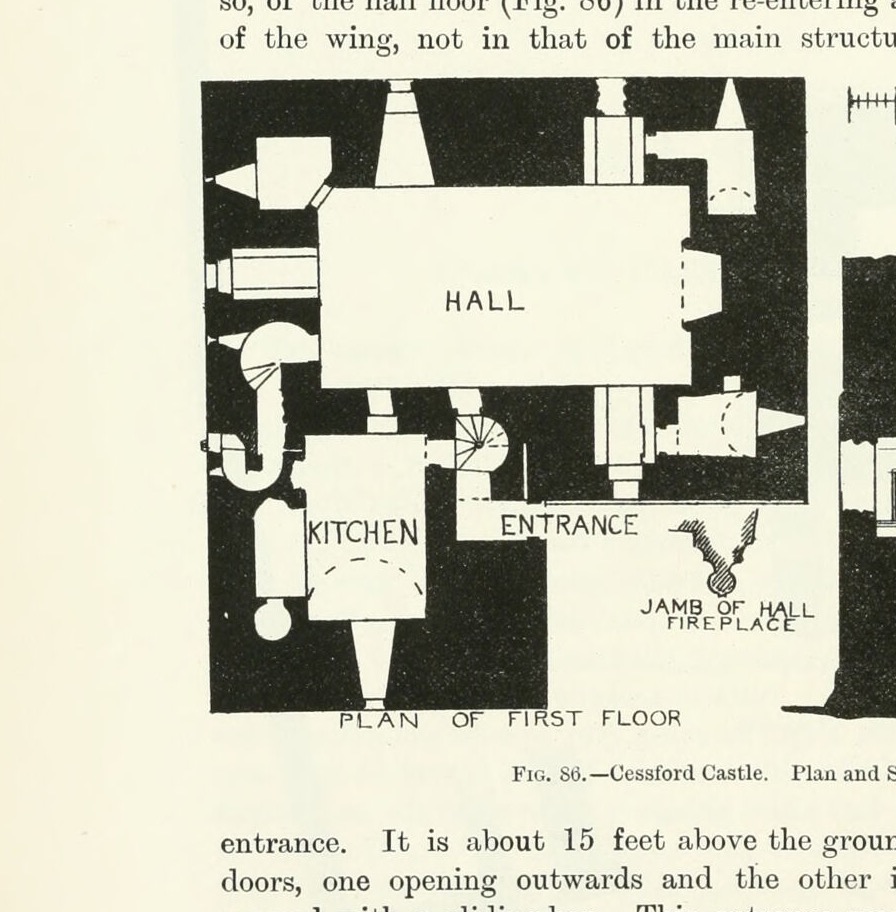
PLAN OF FIRST FLOOR
1889 · MacGibbon & Ross, vol. 3 (1889)
Public domain
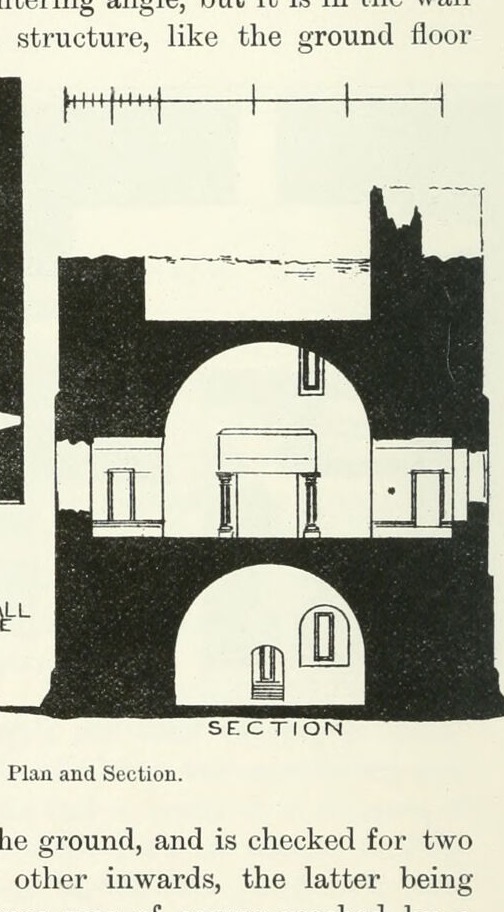
SECTION
1889 · MacGibbon & Ross, vol. 3 (1889)
Public domain
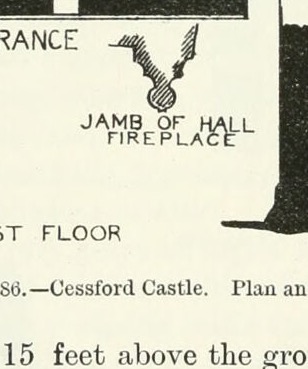
JAMB OF HALL FIREPLACE
1889 · MacGibbon & Ross, vol. 3 (1889)
Public domain


