
Scotland · Restored
Cluny Castle
Cluny Castle is a large 17th‑century Scottish baronial country house near Monymusk in Aberdeenshire, built around 1604 and substantially remodelled and extended in the 19th century. The granite pile has multiple round and square towers, crenellated parapets and is set within landscaped policies; it remains privately owned and has been restored and used as a filming and event venue.
Its prime
1870
Today
Restored
As it stood in 1870
What Cluny Castle looked like in its prime.
A massive grey granite baronial pile with paired cylindrical corner towers and a taller square tower on the west, all topped by corbelled crenellated parapets. The symmetrical three‑storey frontage has rows of sash windows in dressed surrounds and a recessed entrance with a three‑arched porch; smooth ashlar walls rise from broad lawns into parkland. The roofline is varied with round turrets, hood‑moulded arched windows at ground level and clean, pale granite surfaces.
Its story
The story of Cluny Castle.
Bruce's Grant, the Barony and the Building of 1604
On a date now unknown but before 1325, Robert the Bruce granted the lands of Cluny to Alexander Fraser, husband of his sister Mary. They descended through Adam Gordon of Huntly and the Earls of Huntly to John Gordon, a younger son of the 3rd Earl, and it was John's son Sir Thomas Gordon (d. 1607) who replaced the earlier house or peel tower with a castle. A commemorative stone records the work: “Thom. Gordon a Cluny miles me fecit 1604”. The master mason Ian Bell, credited with nearby Castle Fraser, is held to have built it, though MacGibbon and Ross argued for an earlier date, seeing in its Z-plan a kinship with Claypotts Castle.
Cluny was the caput baroniæ of one of the principal baronies of Aberdeenshire, and tradition holds that the baron's court convened not in the great hall but at the “justice stone” on the estate: a practice a King's Counsel writing for the Spalding Club called almost, but not quite, unique in Scotland.
Debt, Creditors and the '45
Building it broke the family. Sir Thomas's son Alexander, fourth laird and second baronet, inherited, but by 1636 the cost of the castle together with other difficulties forced the lands out of his hands. A succession of owners followed, probably creditors, until 1680, when Cluny became the property of Robert Gordon of the Gordonstoun branch. That line held it until the mid-18th century, when the Gordons of Cluny were implicated in the Jacobite rising of 1745 and, burdened again by debt, lost the castle to a third branch of the family around 1753.
The new proprietor, John Gordon (1695–1769), was an Edinburgh merchant of obscure origins and factor to the 3rd Duke of Gordon. His son Cosmo (1736–1800), a politician and co-founder of the Royal Society of Edinburgh, commissioned redesigns from Robert Adam in 1790 and from his brother James in 1793; neither was carried out. Cosmo died without issue and was succeeded by his brother Charles, whom the architectural historian H. Gordon Slade called “eccentric and excessively penurious”; nothing was spent on the estate in his years. When Charles died on 8 May 1814 his eldest son John inherited Cluny and £30,000.
Colonel Gordon's Granite, 1820–1840s
Colonel John Gordon, later a member of Parliament, had money where his father had none: a fortune from an uncle who had been a merchant in the West Indies, which he enlarged by buying North and South Uist, Benbecula and Barra. From about 1820 he set John Smith, Aberdeen's city architect, to rebuild Cluny on a scale that took two decades. The old castle was cocooned in granite so that it merged with the new work, and a clone of it went up to the east. The house was unfit to live in until 1832, and the work was not finished until the early 1840s.
When the Colonel died in 1858 The Times put his assets at £2–3 million and called him “without doubt the richest commoner in Scotland”.
The Captain, the Codicil and the Chapel
Gordon never married. Of four illegitimate children only the eldest, John, survived him, and after litigation running twenty years he took the estates in 1858. Captain Gordon of the Aberdeenshire Militia carried on his father's building and reshaped the policies with artificial lakes and woodland. The private chapel, finished in 1870 and intricately decorated by the artist Daniel Cottier, was described by the British press as “one of the first and most beautiful oratories in the kingdom”.
The Captain also died without issue, in 1878, and his second wife Emily Pringle later married Sir Reginald Cathcart. The Colonel's will reached beyond his own lifetime: a codicil of 21 June 1852 bound every heir to bear the surname Gordon and the designation “Gordon of Cluny”. When Lady Cathcart died in 1932 the estate passed to the Captain's cousin Charles Arthur, who duly took the name Linzee Gordon.
Fire in the Servants' Hall, September 1926
The fire began in the Servants' Hall kitchens. It tore through two wings and consumed the chapel with Cottier's decoration in it, though the main house escaped; the Aberdeen Journal reckoned repairs at between £60,000 and £70,000. The chapel was rebuilt to resemble its former state, but without the artistry of Cottier, by then dead.
Slade's verdict on Smith's Victorian work was brutal in 1978 (“the most shocking misuse of architectural effort and granite in the north-east of Scotland”), but by 1981 he had recanted, allowing that once regret at the loss of the old Cluny was set aside the new deserved its approbation. Historic Scotland listed the castle Category A in April 1971; it passed to Cosmo Linzee Gordon when he turned eighteen in 2010, and further renovation followed in 2016 and 2017.
Step inside
11 places to explore in 1870.
The record describes 11 distinct spots at Cluny Castle, including 7 interiors: recessed three‑arched entrance and entrance hall, main stairway, gallery corridor linking the wings and more. Create your own photoreal reconstruction and explore every one, more scenes means more rooms, more angles, and more of the place to stand in.
Build Your Own Castle
Recreate Cluny Castle with AI to explore it.
The artist rebuilds it as it stood in 1870, a photoreal reconstruction that belongs to you alone. Pay with coins, no subscription needed.
Recreate this castle →Defend this castle →Whose castle
Clans who held Cluny Castle.
The families that held Cluny Castle for a decade or more across its history, follow a name to its clan.
Held by the Gordons of Cluny through three branches of the family over the centuries; still owned by Cosmo Linzee Gordon of Cluny.
From the archive
Cluny Castle on paper: the measured plan and period views.
The survey plan and photographs below are the ground truth this page's reconstructions are checked against, drawn and photographed while the castle was still a working garrison. Every image is public-domain or openly licensed, with its source named.
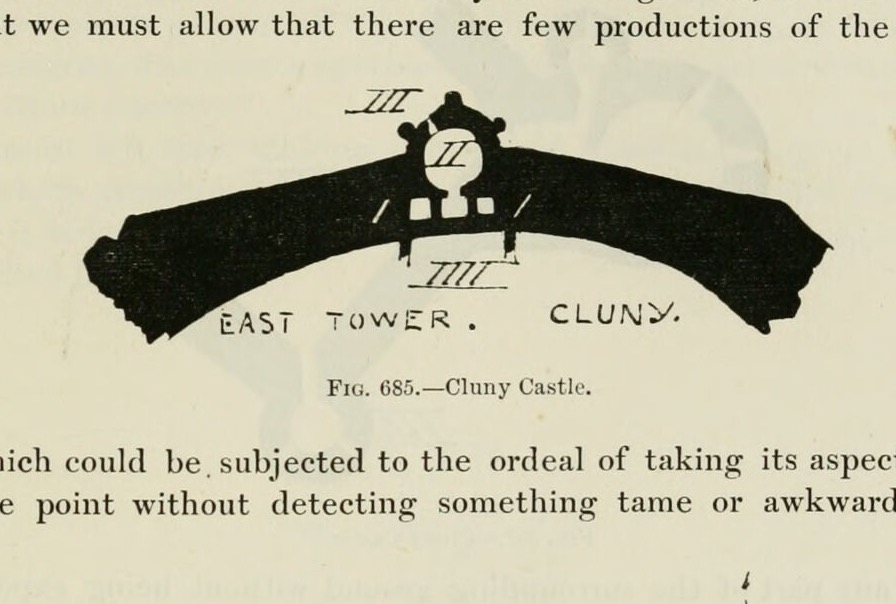
Fig. 685. Cluny Castle.
1887 · MacGibbon & Ross, vol. 2 (1887)
Public domain
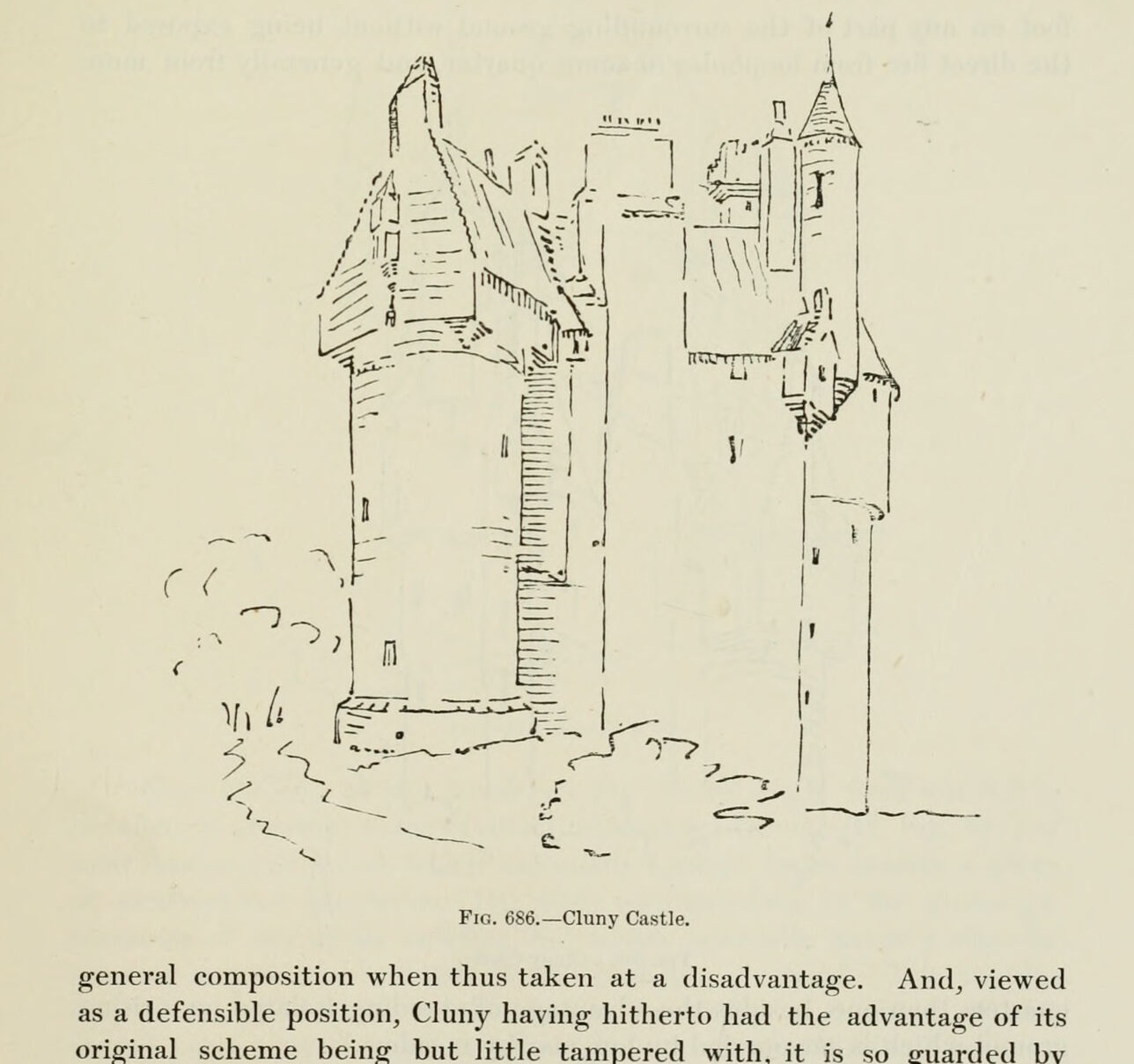
Fig. 686. Cluny Castle.
1887 · MacGibbon & Ross, vol. 2 (1887)
Public domain
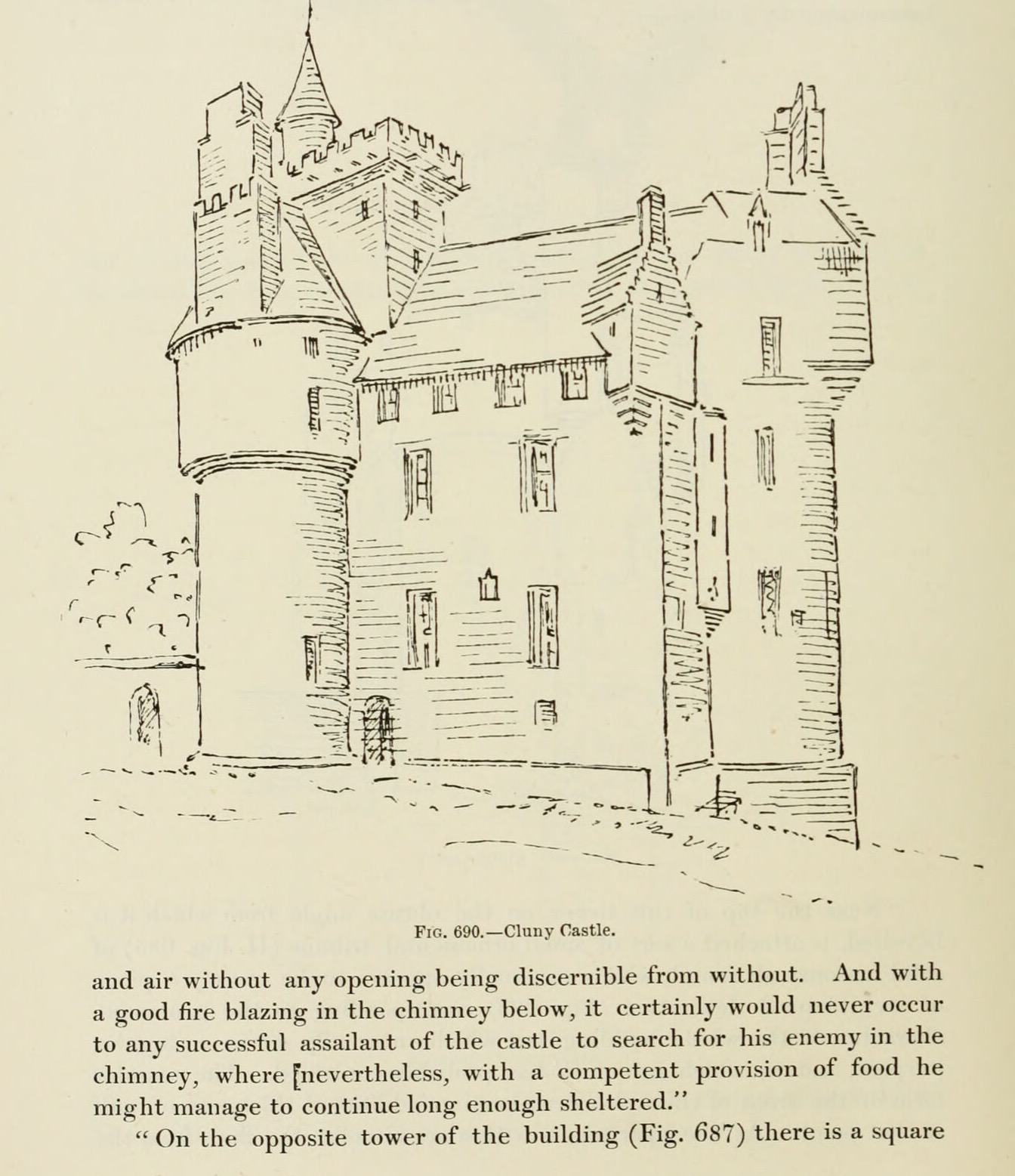
Fig. 690. Cluny Castle.
1887 · MacGibbon & Ross, vol. 2 (1887)
Public domain


