
Scotland · Restored
Corgarff Castle
Corgarff Castle is a whitewashed Scottish tower house and surrounding low-walled courtyard standing near the Lecht road in Aberdeenshire. Built around 1530 and altered as a government barracks in the 18th century, it sits in open moorland and is now in state care and open to the public.
Its prime
1748
Today
Restored
As it stood in 1748
What Corgarff Castle looked like in its prime.
A tall, plain rectangular whitewashed tower rises from the centre of a single-storey, whitewashed enclosed courtyard; both tower and outbuildings have steep slate roofs and simple square chimneys. The tower has regularly spaced small multi-pane windows on its façades and a narrow projecting stair or service projection on one corner. The enclosing curtain wall is low, also whitewashed, punctured by a regular row of rectangular musket-slits. The group sits on grassy moorland beside a road with rolling heather-covered hills beyond.
Its story
The story of Corgarff Castle.
An Elphinstone Tower and the Burning of 1571
Corgarff was built around 1530 by the Elphinstone family and leased to the Forbes of Towie, by the Lecht road that crosses the pass between Strathdon and Tomintoul in Aberdeenshire. In 1571 the Forbes' enemy Adam Gordon of Auchindoun burned it. Margaret Campbell, Lady Forbes, her children and others died in the fire, twenty-six people in all, and the killing probably gave rise to the ballad Edom o Gordon.
Hammers at the Gate, 1607-1645
In May 1607 the castle was taken from Alexander, 4th Lord Elphinstone by Alexander Forbes of Towie and his companions, among them a piper called George McRobie. They broke down the gate with hammers and battering rams, then fortified the house with a garrison described as "Highland thieves and limmers". In 1626 Corgarff was acquired by the Earl of Mar, and in 1645 the troops of the Marquis of Montrose used it as an assembly point.
Jacobite Burnings and Forfeiture, 1689-1745
Jacobite supporters burned Corgarff in 1689 and again in 1716. The Forbes family resettled it in 1745, but had to forfeit it for their Jacobite leanings.
A Government Barracks After 1748
In 1748 the British government bought the castle and rebuilt and extended it as a barracks, stationing a detachment of government troops on the military road that ran from Braemar Castle to Fort George at Inverness. Military use continued as late as 1831, after which the tower was used to suppress illegal whisky distilling in the surrounding country.
Delnadamph, the Lonach Society and State Care
Corgarff was designated a scheduled monument in 1936. It remained part of the Delnadamph estate belonging to the Stockdale family until 1961, when they passed the castle into state care and gave its ownership to the Lonach Highland and Friendly Society. It is now looked after by Historic Environment Scotland and opens to the public for seasonal periods.
Step inside
6 places to explore in 1748.
The record describes 6 distinct spots at Corgarff Castle, including the full exterior approach. Create your own photoreal reconstruction and explore every one, more scenes means more rooms, more angles, and more of the place to stand in.
Build Your Own Castle
Recreate Corgarff Castle with AI to explore it.
The artist rebuilds it as it stood in 1748, a photoreal reconstruction that belongs to you alone. Pay with coins, no subscription needed.
Recreate this castle →Defend this castle →Whose castle
Clans who held Corgarff Castle.
The families that held Corgarff Castle for a decade or more across its history, follow a name to its clan.
Elphinstone
Built around 1530 by the Elphinstones; captured from the 4th Lord Elphinstone in 1607.
Leased to the Forbes of Towie from about 1530; the family resettled Corgarff in 1745 but forfeited it for Jacobite leanings.
Stockdale
Part of the Stockdale family's Delnadamph estate until passed into state care in 1961.
From the archive
Corgarff Castle on paper: the measured plan and period views.
The survey plan and photographs below are the ground truth this page's reconstructions are checked against, drawn and photographed while the castle was still a working garrison. Every image is public-domain or openly licensed, with its source named.
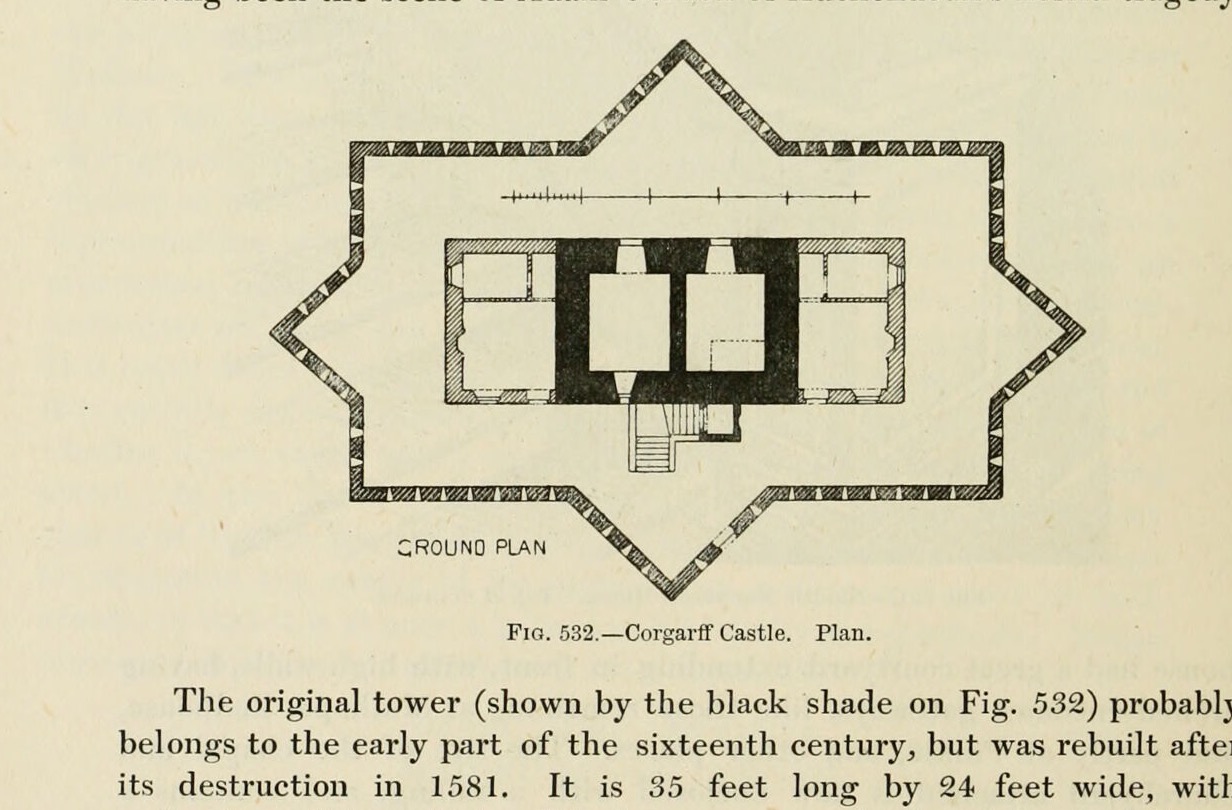
GROUND PLAN. Fig. 532. Corgarff Castle. Plan.
1887 · MacGibbon & Ross, vol. 2 (1887)
Public domain
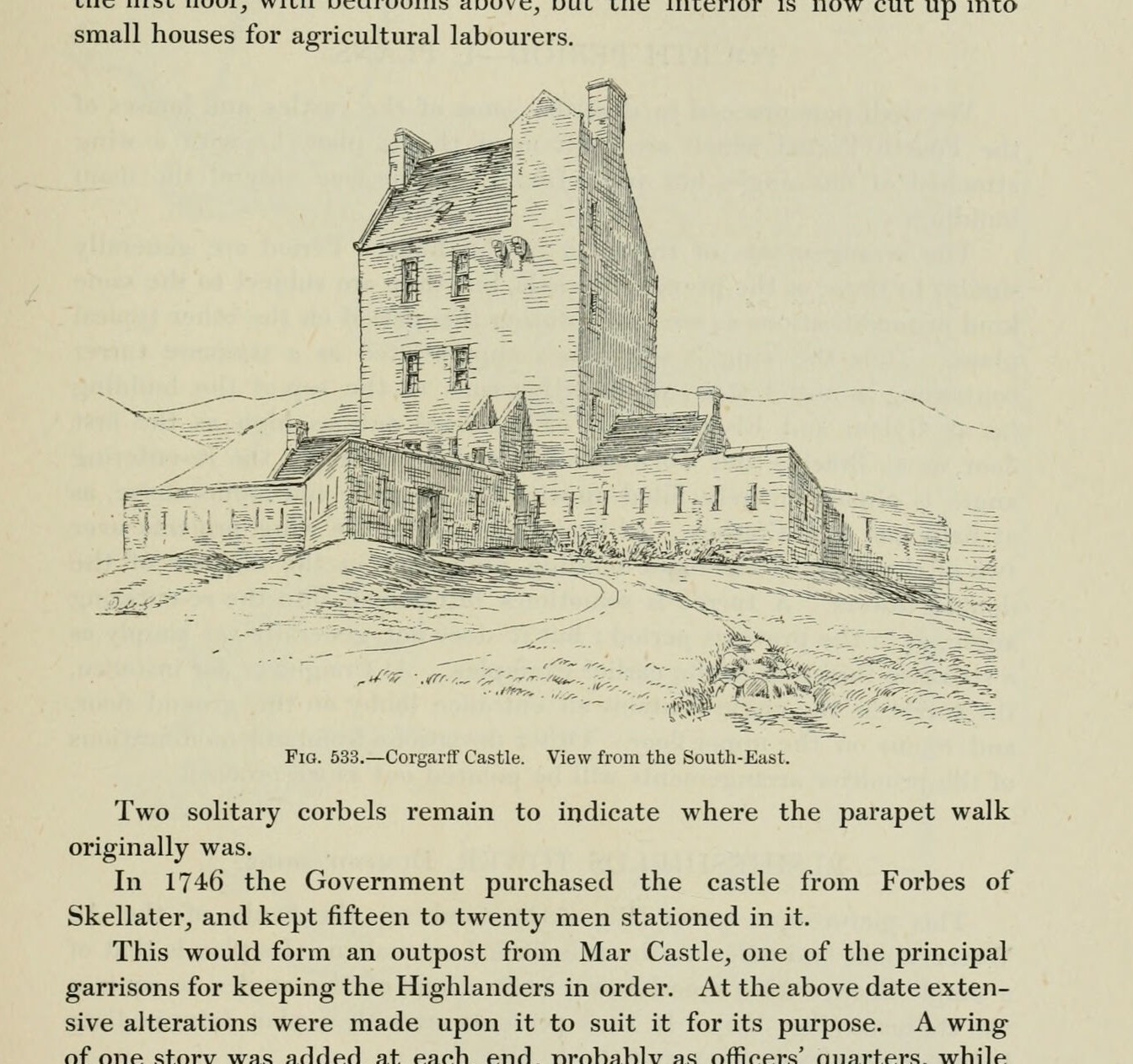
Fig. 533. Corgarff Castle. View from the South-East.
1887 · MacGibbon & Ross, vol. 2 (1887)
Public domain


