
Scotland · Restored
Craignish Castle
Craignish Castle is a historic tower house on the Craignish peninsula in Argyll, western Scotland, incorporating a 16th-century tower that was extended in the 19th century. The estate served as the Campbell seat and later received Victorian-era additions and internal fittings; in the 20th century it was restored and divided into private apartments. It is a category B listed building known also historically as Loch Beag.
Its prime
1907
Today
Restored
As it stood in 1907
What Craignish Castle looked like in its prime.
A compact, rectangular 16th-century tower house of roughly 12.7 by 10.2 metres stands attached to a larger 19th-century three-storey wing. The tower rises in plain harled (light-grey) masonry with narrow vertical windows and a corbelled parapet beneath a steep slate roof; the later extension has gabled dormers, regular sash windows and a small porch. The composition sits on a grassy rise and is framed by mature deciduous trees on the Craignish peninsula. At its prime both tower and Victorian wing are complete.
Its story
The story of Craignish Castle.
The present Craignish Castle incorporates a 16th-century tower house, seat of the Campbell family of Craignish and Jura. The Campbells of Craignish claimed descent from Dugal Maul Campbell, first Laird of Craignish (1156–1190), second son of Sir Archibald Gillespic Campbell, ancestor of the Dukes of Argyll, and the chiefs of Clan Campbell retained the superiority, with a condition that the lands would revert to the Argyll family if the direct male line failed.
After an incident that forced Charles Campbell to flee to Lochtayside in Perthshire under the protection of the Breadalbane family, he was prevented from claiming the estate, and the castle fell into the hands of the Earls, later Dukes, of Argyll. His descendants at Killin were recognised by the Lord Lyon as Chieftains of the Clan Tearlach branch of Clan Campbell, and from them descended the Campbells of Inverneill.
In the 19th century the castle was sold to Frederick Trench-Gascoigne and his wife Isabella, heiress of the Gascoigne family of Parlington Hall in Yorkshire, who built a large extension onto the tower. In the later 20th century the house was restored, parts of the Victorian extension were demolished, and the building was divided into apartments, one of them owned in the 1980s by a grandson of Duncan Campbell, 8th of Inverneill.
Step inside
8 places to explore in 1907.
The record describes 8 distinct spots at Craignish Castle, including 4 interiors: the celtic room (interior), kitchen with hatch to the dungeon, bottle dungeon cut from rock and more. Create your own photoreal reconstruction and explore every one, more scenes means more rooms, more angles, and more of the place to stand in.
Build Your Own Castle
Recreate Craignish Castle with AI to explore it.
The artist rebuilds it as it stood in 1907, a photoreal reconstruction that belongs to you alone. Pay with coins, no subscription needed.
Recreate this castle →Defend this castle →Whose castle
Clans who held Craignish Castle.
The families that held Craignish Castle for a decade or more across its history, follow a name to its clan.
Seat of the Campbells of Craignish and Jura; later held by the Earls, then Dukes, of Argyll.
Trench-Gascoigne
Bought the castle in the 19th century and built the large extension to the tower.
From the archive
Craignish Castle on paper: the measured plan and period views.
The survey plan and photographs below are the ground truth this page's reconstructions are checked against, drawn and photographed while the castle was still a working garrison. Every image is public-domain or openly licensed, with its source named.
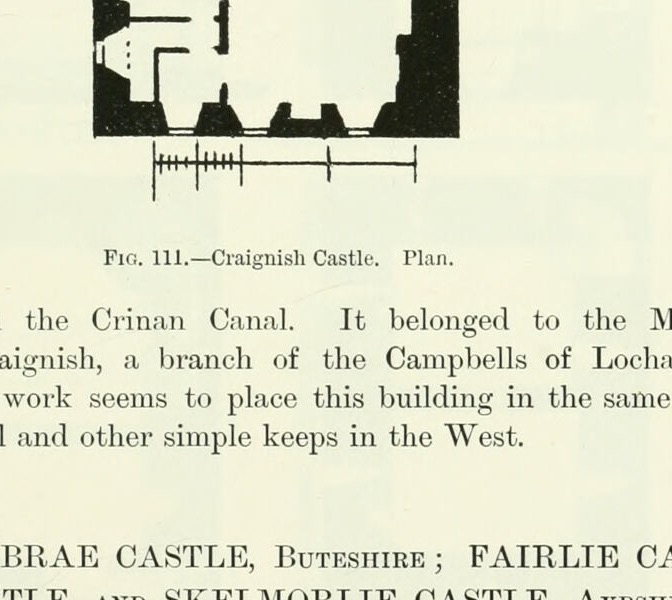
Fig. 111. Craignish Castle. Plan.
1889 · MacGibbon & Ross, vol. 3 (1889)
Public domain


