Scotland · Partial ruin
Dirleton Castle
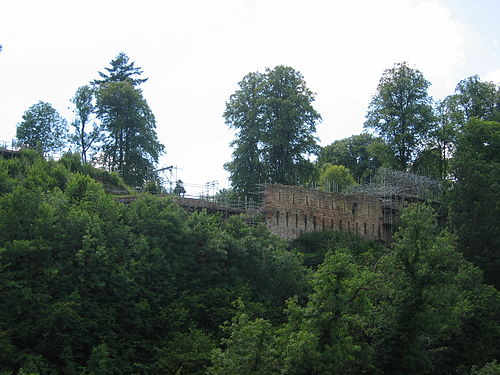
Dirleton Castle is a medieval fortress on a rocky outcrop in Dirleton, East Lothian, Scotland, begun about 1240 and altered across the 14th–16th centuries. The surviving fabric includes a 13th-century donjon (keep), a 16th-century house attached to the castle, a substantial gatehouse and curtain walls; it was abandoned in the 17th century and is now a cared-for ruin with historic gardens.
Its prime
1585
Today
Partial ruin
Ranked among Europe’s castles
As it stood in 1585
What Dirleton Castle looked like in its prime.
Sits on a rocky outcrop with broad, rounded drum towers and a high rectangular gatehouse built in golden-brown sandstone; a continuous circuit of curtain wall links the towers and the 16th-century house range, with multiple tall chimney stacks and window openings visible above. The principal entrance is reached by a timber bridge across the lowered ground, and at its prime the keep, house and east range formed a continuous, roofed complex opening onto enclosed gardens.
Its story
The story of Dirleton Castle.
The de Vaux Castle, Bishop Bek's Siege and the Slighting by 1314
The de Vaux were a Norman family of Rouen, among the Anglo-Norman knights David I invited north and endowed with land in the 12th century, Hubert to Gilsland in Cumbria, John to the barony of Dirleton. A later John de Vaux succeeded in the 1220s and began a stone castle on a rocky outcrop guarding the coastal approach to Edinburgh; a "castellum" is recorded here in 1225, though that may describe an earlier timber structure. Appointed seneschal in 1239 to Marie de Coucy on her marriage to Alexander II, he probably took her father's Château de Coucy in Picardy as his model. The result, a "cluster keep" of two round towers joined by a square one, is the earliest dated Scottish castle with round towers projecting beyond the curtain wall.
Peace ended in 1296. In the summer of 1298 English forces under Antony Bek, Bishop of Durham, besieged the castle; it held out for months until the English victory at Falkirk freed large siege engines to be brought up, and was soon reduced. The English garrisoned it, but the Scots had it back by 1306, when Aymer de Valence, Earl of Pembroke, captured it once more; they retook it before 1314 and slighted it so it could not be used against them again.
The Haliburtons, 1350–1515
The castle passed to the Berwickshire family of Haliburton when John Haliburton married the de Vaux heiress shortly before 1350. It had been repaired by 1363, when William Douglas seized it during a brief rebellion against David II. Sir Walter Haliburton stood hostage in the 1420s for James I's release, became Treasurer of Scotland in 1439, and the family took the title Lord Dirletoun in the 1440s. They heightened the original towers, built a new gatehouse to the south-east, and in the 15th century added the great hall and tower house of the east range, of which only the basement survives. Patrick, the last Haliburton of Dirleton, died in 1505, and in 1515 his eldest daughter Janet married William Ruthven, 2nd Lord Ruthven, carrying the lordship to his family.
Ruthven Plots and the Gowrie Conspiracy, 1515–1600
Janet's son Patrick, 3rd Lord Ruthven, helped lead the murder of Mary, Queen of Scots' secretary David Riccio in 1566, and fled to England, where he died. His son William, created Earl of Gowrie in 1581, led the Raid of Ruthven in August 1582, seizing the 16-year-old James VI and ruling in his name while the king was captive. Pardoned the following year, Gowrie was executed in 1584 for a further plot to seize Stirling Castle, and his lands were forfeited. He is thought to have laid out Dirleton's gardens.
His widow Dorothea Stewart was ordered to surrender Dirleton, and James VI granted it to the Earl of Arran, who entertained the king there for twelve days in 1585. Restored to Dorothea in 1586, the castle had passed by 1600 to her second son John, 3rd Earl of Gowrie. That August John and his brother Alexander were killed at Gowrie House in the affair called the Gowrie Conspiracy, and Dirleton went to Thomas Erskine in November 1600, a reward some have read as blood money.
Witch Trials and Cromwell's Mortars, 1649–1650
In 1649–50 almost 600 people, mostly women, were accused of witchcraft in south and east Scotland; six were from Dirleton. Agnes Clarkson, a widow, confessed under interrogation in June 1649 and named others she said had met the devil on the green of Dirleton, among them Patrick Watson and his wife Manie Halieburton, on whom the witch-pricker John Kincaid claimed to find "the divellis marke". The trials were held in the castle's great hall; the sentences do not survive, though those accused were usually executed.
Cromwell's army invaded Scotland in 1650 and beat the Scots Royalists at Dunbar on 3 September, but Royalist moss-troopers kept harrying English supply lines; one band was based at Dirleton. Cromwell ordered Generals Monck and Lambert against it with 1,600 troops, and the castle fell on 10 November, its drawbridge and inner gate destroyed by mortar fire. The captain of the moss-troopers was hanged from the walls with two of his comrades; the castle was slighted once more and, after brief use as a field hospital, left to decay.
Nisbet, Archerfield and State Care
In 1663 the lawyer John Nisbet bought castle and estate from the widowed Countess of Dirletoun. As a judge he took the title Lord Dirleton, and built a new house at Archerfield; the Nisbets kept the gardens as part of its park. It passed into state care in the 1920s and is maintained by Historic Environment Scotland; it is a scheduled monument, the castle, doocot and boundary walls are Category A listed, and the gardens are on the Inventory of Gardens and Designed Landscapes in Scotland.
Step inside
9 places to explore in 1585.
The record describes 9 distinct spots at Dirleton Castle, including 4 interiors: gatehouse passage toward the inner courtyard, basement of the 13th-century donjon (keep), great hall of the east range and more. Create your own photoreal reconstruction and explore every one, more scenes means more rooms, more angles, and more of the place to stand in.
Build Your Own Castle
Recreate Dirleton Castle with AI to explore it.
The artist rebuilds it as it stood in 1585, a photoreal reconstruction that belongs to you alone. Pay with coins, no subscription needed.
Recreate this castle →Defend this castle →Whose castle
Clans who held Dirleton Castle.
The families that held Dirleton Castle for a decade or more across its history, follow a name to its clan.
Halyburton
Held by the Halyburtons, 14th–15th centuries.
Ruthven
Passed to the Ruthvens until their fall in 1600.
From the archive
Dirleton Castle on paper: the measured plan and period views.
The survey plan and photographs below are the ground truth this page's reconstructions are checked against, drawn and photographed while the castle was still a working garrison. Every image is public-domain or openly licensed, with its source named.
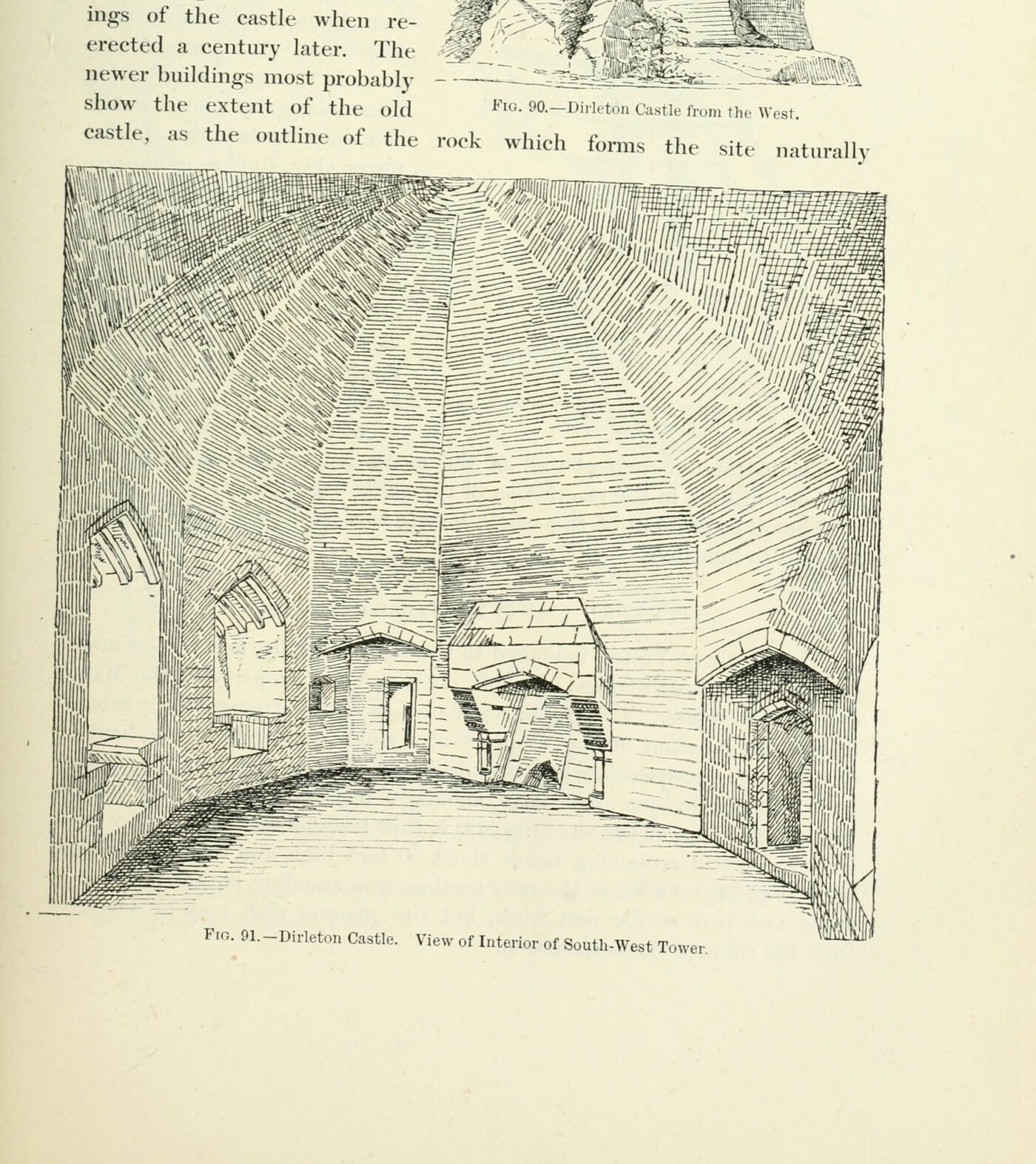
Fig. 90. Dirleton Castle from the West.
1887 · MacGibbon & Ross, Castellated and Domestic Architecture of Scotland, vol. 1 (1887)
Public domain
Fig. 91. Dirleton Castle. View of Interior of South-West Tower.
1887 · MacGibbon & Ross, Castellated and Domestic Architecture of Scotland, vol. 1 (1887)
Public domain
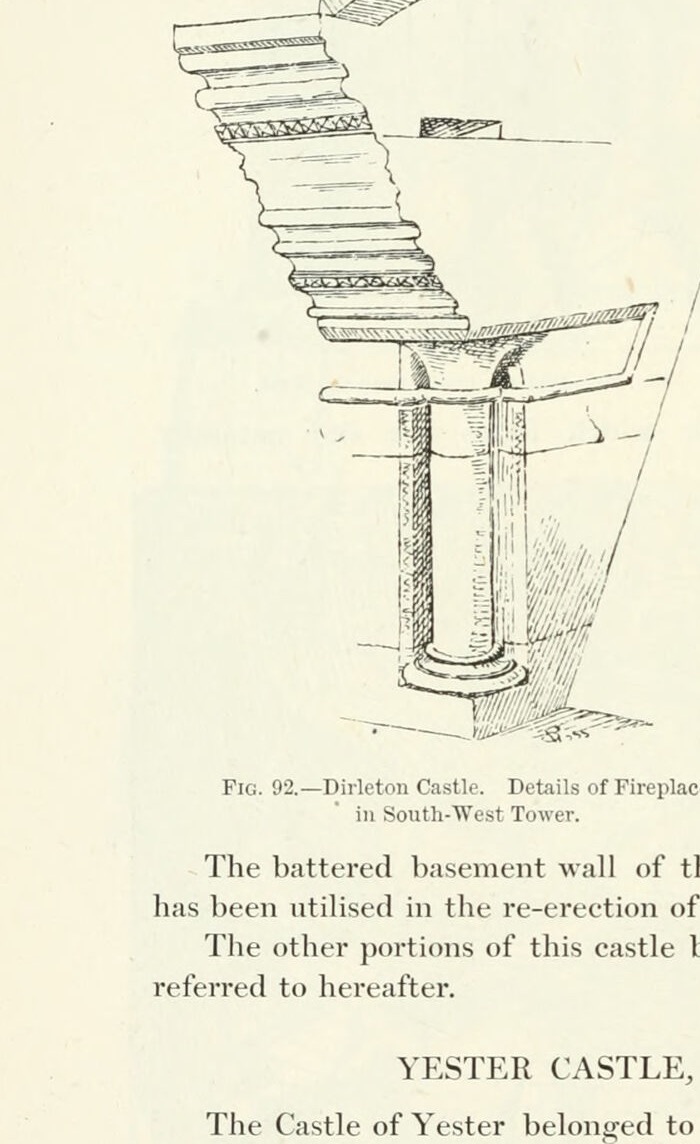
Fig. 92. Dirleton Castle. Details of Fireplace in South-West Tower.
1887 · MacGibbon & Ross, Castellated and Domestic Architecture of Scotland, vol. 1 (1887)
Public domain
Nearby