Clan Rising
Drumlanrig Castle today

Scotland · Still standing

Drumlanrig Castle

Drumlanrig Castle is a late 17th‑century pink sandstone country house and fortress on the Queensberry Estate in Dumfries and Galloway, Scotland, and is the historic seat of the Dukes of Buccleuch and Queensberry. Built 1679–1689 in a Renaissance-influenced style, the building contains a large private art collection and is surrounded by formal gardens, walled enclosures and service yards.

Photograph via Wikimedia Commons

Its prime

1689

Today

Still standing

As it stood in 1689

What Drumlanrig Castle looked like in its prime.

A broad, symmetrical pink sandstone mansion with a rectangular main block flanked by four large square towers and numerous rounded turrets capped with lead domes; the central façade displays a raised arched loggia at ground level and a prominent central entrance reached by twin sweeping stone staircases. The roofline is punctuated by tall clustered chimneys and small cupolas. A balustraded forecourt and low stone walls enclose a gravel approach and formal terraces set above the Nith valley.

Its story

The story of Drumlanrig Castle.

The Ridge Called Drumlangryg

The name is first recorded in 1374, spelled Drumlangryg. It may combine the Cumbric drum, a ridge, with lanerc, a small area of cleared woodland, though the first element may equally be the Gaelic druim and the second the Scots lang-rigg, long ridge. In 1984 aerial photography picked out the outline of a substantial Roman fort some 350 yards south-east of the castle; it was partially excavated in 2004 by the Time Team television programme.

The Pink Palace of the First Duke, 1679–1689

The 'Pink Palace' of Drumlanrig was built between 1679 and 1689 in distinctive pink sandstone for William Douglas, first Duke of Queensberry, on the site of an ancient Douglas stronghold overlooking the Nith valley. An example of late 17th-century Renaissance architecture, it runs to 120 rooms, 17 turrets and four towers.

Bruce's Formal Garden and the Dutch Gardener

A formal garden was created between 1675 and 1697 to the principles of the architect Sir William Bruce. Stone walls enclosed it, six stone pavilions carried lead ogee roofs matching the main building, and the water features included a 'clanging clock'. When the second duke inherited in 1695 he took on James Wood, son of Hew Wood of Hamilton, as gardener and sent him to London in 1696 for further training; Wood never returned, and a Dutch gardener, Cornelius van Nerven, was engaged instead. A summer house and water cascades followed in 1698.

David Low held the post from 1714 to 1747 under the third duke, a period that brought further landscape features and a bowling green, an early example of one, while Sir John Clerk of Penicuik designed the cascades added between 1728 and 1732. After Low's death the staff fell to eight or ten men under a head gardener paid less than he had been, maintenance slipped, and by 1810 the decision had been taken to remove the formal gardens.

The Madonna of the Yarnwinder, Stolen 2003

The castle holds part of the Buccleuch art collection, including Rembrandt's An Old Woman Reading and Leonardo da Vinci's Madonna of the Yarnwinder. The Leonardo was stolen in 2003 and returned in 2007 after being found in Glasgow; it is now on loan to the Scottish National Gallery. Drumlanrig is the Dumfriesshire home of the Duke of Buccleuch and Queensberry.

Step inside

11 places to explore in 1689.

The record describes 11 distinct spots at Drumlanrig Castle, including 2 interiors: stableyard and service court, interior: gallery for the buccleuch collection. Create your own photoreal reconstruction and explore every one, more scenes means more rooms, more angles, and more of the place to stand in.

Forecourt approach and balustradeArched ground-floor loggia / courtyardGrand double staircaseCorner turret rooftopBalustraded terrace and east–west rangesStableyard and service courtWalled formal gardenStone garden pavilion with lead ogee roofWater cascades and summerhouseBowling green and surrounding lawnInterior: gallery for the Buccleuch collection

Build Your Own Castle

Recreate Drumlanrig Castle with AI to explore it.

The artist rebuilds it as it stood in 1689, a photoreal reconstruction that belongs to you alone. Pay with coins, no subscription needed.

Recreate this castle →

Castle Siege

Play Castle Siege at Drumlanrig Castle.

A strategy game played on Drumlanrig Castle’s real ground plan: the same surveyed walls shown in the archive below. Post your finite garrison on the battlements between assaults, then hold out as rams, siege towers, trebuchets and sappers arrive in ever-worse waves.

Sign in free to see the garrison muster. One castle costs 150 Clan Coins and is yours forever.

Sign in to take command →

See every castle’s leaderboard →

From the archive

Drumlanrig Castle on paper: the measured plan and period views.

The survey plan and photographs below are the ground truth this page's reconstructions are checked against, drawn and photographed while the castle was still a working garrison. Every image is public-domain or openly licensed, with its source named.
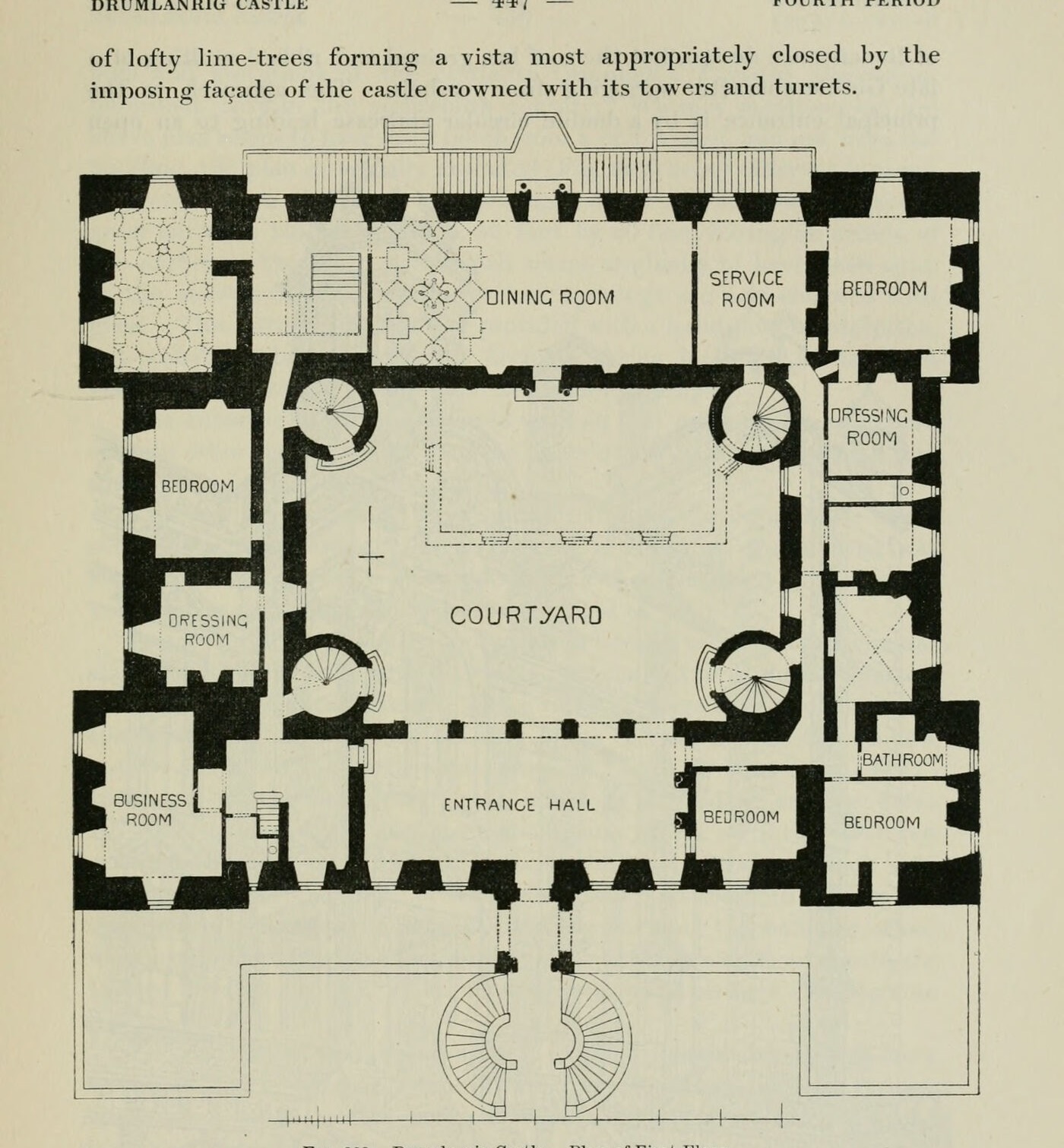
Fig. 882. — Drumlanrig Castle. Plan of First Floor., Drumlanrig Castle

Fig. 882. — Drumlanrig Castle. Plan of First Floor.

1887 · MacGibbon & Ross, vol. 2 (1887)

Public domain

Questions about Drumlanrig Castle

What is the history of Drumlanrig Castle?

Drumlanrig Castle was built in the late 17th century for William Douglas, 1st Duke of Queensberry, on the site of an ancient Douglas stronghold above the Nith. Constructed between 1679 and 1689 in pink sandstone, it became the historic seat of the Dukes of Buccleuch and Queensberry. Its art collection includes works by Rembrandt and Leonardo da Vinci, whose Madonna of the Yarnwinder was stolen in 2003 and returned in 2007.

What is inside Drumlanrig Castle?

Inside Drumlanrig Castle are a gallery for the Buccleuch collection, the Stableyard and the service court. The art collection includes Rembrandt's An Old Woman Reading, Leonardo da Vinci's Madonna of the Yarnwinder, paintings, tapestries and other objects of art. The Madonna of the Yarnwinder is currently on loan at the Scottish National Gallery.

Why was Drumlanrig Castle built?

Drumlanrig Castle was built as a country house and fortress for William Douglas, 1st Duke of Queensberry, on the site of an ancient Douglas stronghold overlooking the Nith Valley. Its scale and Renaissance design also served as a grand residence and dynastic seat, with 120 rooms, 17 turrets and four towers. It remains a home of the Dukes of Buccleuch and Queensberry and houses part of their art collection.

Does anyone live at Drumlanrig Castle?

Yes, Drumlanrig Castle remains a home of the Dukes of Buccleuch and Queensberry. It is also open to the public during very limited times of the year, while the stableyard and surrounding attractions have wider public access. The castle holds part of the Buccleuch art collection.

Where is Drumlanrig Castle?

Drumlanrig Castle is on the Queensberry Estate in Dumfries and Galloway, overlooking the Nith Valley. It stands in the former county of Dumfriesshire, within the gardens and grounds of the estate. The surrounding area includes the stableyard, formal gardens, walking routes and cycling routes.

When was Drumlanrig Castle built?

Drumlanrig Castle was built between 1679 and 1689, placing it in the late 17th century. Construction used distinctive pink sandstone and followed a Renaissance-influenced style. The first raised year is not recorded, but 1689 is given as its prime year.

What did Drumlanrig Castle look like in its prime?

Drumlanrig Castle is a broad, symmetrical pink sandstone mansion with a rectangular main block, four large square towers and numerous rounded turrets capped with lead domes. Its central façade has a raised arched loggia and an entrance reached by twin sweeping stone staircases. Tall clustered chimneys, small cupolas, a balustraded forecourt and formal terraces complete the exterior.

Is Drumlanrig Castle still standing?

Drumlanrig Castle is still standing and intact, rather than a ruin. The late 17th-century building survives as a pink sandstone country house and fortress with four towers, 17 turrets and 120 rooms. Its gardens, stableyard, service court and surrounding estate also remain part of the site.

Who built Drumlanrig Castle?

William Douglas, 1st Duke of Queensberry, had Drumlanrig Castle built. Construction took place between 1679 and 1689 on the site of an ancient Douglas stronghold. The supplied material does not name an architect, but describes the finished building as an example of late 17th-century Renaissance architecture.

Can you visit Drumlanrig Castle?

Drumlanrig Castle is open to the public during very limited times of the year. The stableyard and adventure playground are open nearly all year round, and walking, hiking and cycling routes are open all year unless officially closed. The castle is a category A listed building.
All castles of Scotland · Castles of Europe · the best castles in Europe · explore the finished reconstructions.