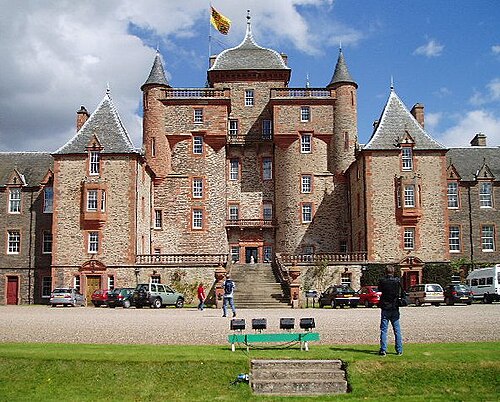
Scotland · Ruin
Dunfermline Palace
Lùchairt Dhùn Phàrlain
Dunfermline Palace is a former Scottish royal palace attached to Dunfermline Abbey in Fife. Once altered and used by successive monarchs, most of the surviving fabric today is ruined, with the palace occupying the site between the abbey and the deep gorge to the south.
Its prime
1600
Today
Ruin
As it stood in 1600
What Dunfermline Palace looked like in its prime.
A long, coursed stone range of warm honey and grey sandstone running beside the abbey, dominated by a high south wall pierced by tall, pointed-arched window openings and void tracery; to the left a broad arched pend or gateway runs under the building, and behind the range the abbey's tower and spire rise. Masonry alternates ashlar and rubble courses, with evidence of tall stair-towers and battlements in historical records; in prime the walls would be roofed and windows glazed.
Its story
The story of Dunfermline Palace.
Malcolm III's Capital and the Abbey Guest House
Dunfermline was a favourite residence of many Scottish monarchs. Documented royal residence begins in the 11th century with Malcolm III, who made it his capital, though his seat was the nearby Malcolm's Tower, a few hundred yards west of the later palace. David II and James I of Scotland were both born at Dunfermline. The palace itself is attached to Dunfermline Abbey, connected to the former monastic quarters by a gatehouse above a pend, and occupies what was originally the guest house of the abbey.
Few records survive of the conversion of monastic buildings to royal use. Timber was bought for the royal lodgings in 1429, and the existing remains largely reflect the remodelling carried out by James IV around 1500, who came to the palace and tipped the masons and craftsmen in 1507. William Schaw worked on the building in 1590, preparing it for Anne of Denmark.
Margaret Tudor's Plague Scare and Mary's Diamond
James IV and Margaret Tudor stayed frequently. In November 1504, with the king away in the north of Scotland, two people in Dunfermline were suspected of having plague, and the queen left for Edinburgh with her household servants, including African women known as the 'More lasses', who went first to Inverkeithing. It proved a false alarm.
James V and Mary of Guise also used the palace, and on 14 June 1562, after dinner at Dunfermline, Mary, Queen of Scots produced a gold ring set with a heart-shaped diamond and declared she would send it to Queen Elizabeth with verses she had written herself in Italian, a gesture made while a meeting of the two queens was under discussion.
Anne of Denmark's Wedding Present, 1589
In 1589 James VI gave the palace to his bride Anne of Denmark as a wedding present, compensating the Master of Gray, who held rights to the commendatorship of Dunfermline, with 12,000 merks from a subsidy paid by Elizabeth I. Anne became 'Lady of Dunfermline' in charters of the abbey lands, and in February 1596 Alexander Seton, Lord Urquhart, was appointed her Bailie, Keeper and Constable of the palace.
Anne gave birth to three of the royal children here (Elizabeth in 1596, Charles in 1600 and Robert in 1602) attended by her German physician Martin Schöner, with the nursery managed by Margaret Stewart, Mistress of Ochiltree. In 1600 she completed a new cruciform building known as the 'Queen's House', a tall structure with a driveway or pend running through its basement, a feature compared with the Queen's House at Greenwich, likewise built over a roadway. There was a tennis court in the old abbey cloister. During a plague scare in Edinburgh in 1602, the Privy Council was anxious that contagion should not reach the 'ordinary place of residence' of the queen and the royal children, and ferry crossings to Dunfermline were suspended except for councillors and servants with a clean bill of health.
A Nursery for Prince Charles
After the Union of Crowns in 1603 the court removed to London and monarchs rarely visited, but Prince Charles, a sickly child, stayed at Dunfermline for a year under the guardianship of Alexander Seton and his wife Grissal Leslie. Marion Hepburn was in charge of rocking his cradle, and the prince, slow to learn to walk, was given an oak stool on wheels, in Scots, a 'tymber stule with rynand quheillis to gang in'. By July 1604 Dr Henry Atkins could report from Dunfermline that Charles walked the length of the great chamber several times daily without a stick, 'like a gallant soldier all alone'. He began his journey to England on 17 July 1604, crossing the Forth.
Charles II, Pitreavie and the Unroofing
When Anne of Denmark died in 1619 the palace passed to Prince Charles, who sent £500 sterling in aid after fire devastated the town on 25 May 1624. As Charles I he returned to Scotland for his coronation in 1633 but made only a brief visit to his birthplace. The last monarch to occupy the palace was Charles II, who stayed in 1650 just before the Battle of Pitreavie. During the Cromwellian occupation that followed, the building was abandoned, and by 1708 it had been unroofed. Anne's 'Queen's House' of 1600 was demolished in 1797, leaving of the palace only the kitchen, its cellars, and the great south wall above the Firth of Forth.
Step inside
10 places to explore in 1600.
The record describes 10 distinct spots at Dunfermline Palace, including 5 interiors: the great chamber (the 'longest chamber'), anne of denmark's bedchamber and external stair, palace kitchen and more. Create your own photoreal reconstruction and explore every one, more scenes means more rooms, more angles, and more of the place to stand in.
Build Your Own Castle
Recreate Dunfermline Palace with AI to explore it.
The artist rebuilds it as it stood in 1600, a photoreal reconstruction that belongs to you alone. Pay with coins, no subscription needed.
Recreate this castle →Defend this castle →From the archive
Dunfermline Palace on paper: the measured plan and period views.
The survey plan and photographs below are the ground truth this page's reconstructions are checked against, drawn and photographed while the castle was still a working garrison. Every image is public-domain or openly licensed, with its source named.
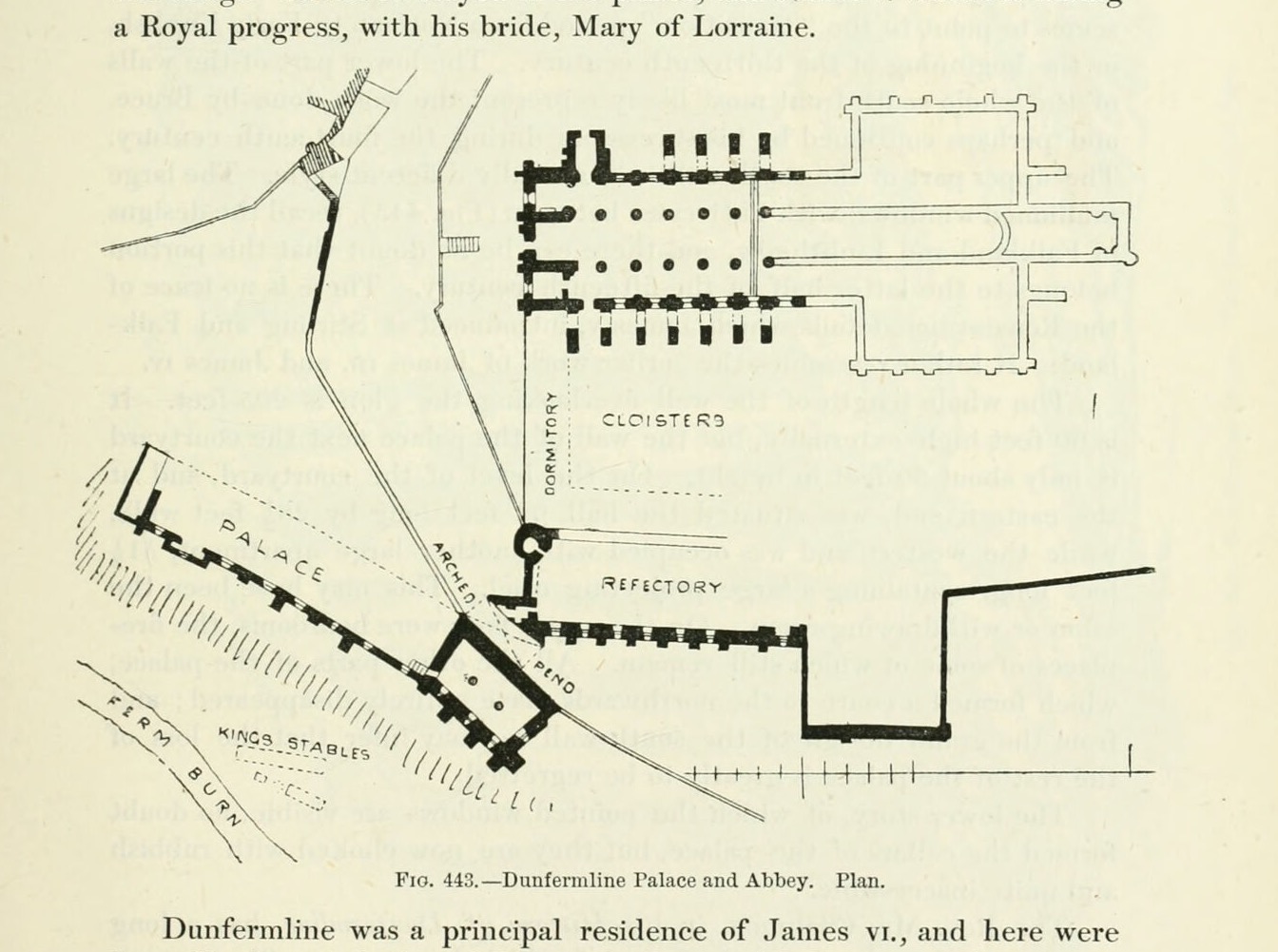
Fig. 443. Dunfermline Palace and Abbey. Plan.
1887 · MacGibbon & Ross, Castellated and Domestic Architecture of Scotland, vol. 1 (1887)
Public domain
Nearby