Scotland · Ruin
Duntulm Castle
Caisteal Dhùn Tuilm
Duntulm Castle is a ruined medieval stronghold on a basalt promontory on the north coast of the Trotternish peninsula, Isle of Skye, Scotland. Built from the 14th century and improved through the 16th–17th centuries, it was the 17th‑century seat of the chiefs of Clan MacDonald of Sleat and is a scheduled monument.
Its prime
1650
Today
Ruin
As it stood in 1650
What Duntulm Castle looked like in its prime.
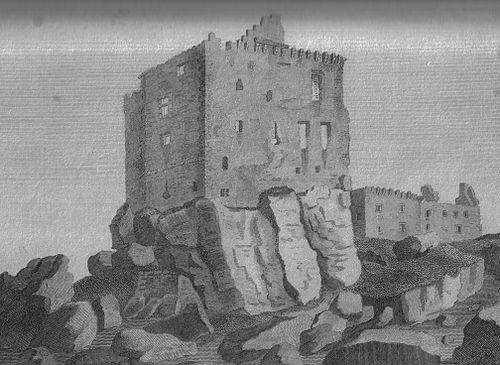
Duntulm occupies a narrow basalt promontory projecting into the sea, with an irregular low curtain wall clustered along the cliff edge. Remains of a former tower survive as vaulted lower walls once rising to four storeys; a small rectangular stone house sits within the inner ward. A defensive ditch cuts the landward neck of the headland and the only access is through a narrow cleft in the sea cliff. Dark basalt stone and grassy slopes surround the exposed seaward face and rocky foreshore below.
Its story
The story of Duntulm Castle.
The Trotternish Promontory and the MacLeod-MacDonald Feuds
Duntulm stands on a basalt promontory above the sea on the north coast of Trotternish, on the Isle of Skye, defended by a ditch along the landward side, its only entrance a narrow cleft in the sea cliff. A broch or dun known as Dun Dhaibhidh is believed to have stood on the headland in prehistoric times, though no archaeological evidence for such a predecessor has been found.
The castle was built in the 14th and 15th centuries, when the area was subject to feuds between the rival MacLeod and MacDonald clans. Its defences were improved in the 16th century, and by the early 17th century the MacDonalds had gained the upper hand in the area.
Donald Gorm Og's Charter of 1618 and the Peak around 1650
Through the 17th century Duntulm was the seat of the chiefs of Clan MacDonald of Sleat. In 1618 the Privy Council and Sir Donald MacDonald of Sleat, "Donald Gorm Og", the ninth chief, signed a charter requiring him to repair Duntulm. The work was carried out and a second tower added. The castle's importance peaked around 1650, when further improvements were made and a rectangular house was built inside the curtain wall.
Abandoned for Monkstadt, c.1732-1992
Around 1732 the castle was abandoned when Sir Alexander MacDonald built a new residence, Monkstadt House, five miles to the south, robbing much of Duntulm's stone as building material. One local legend gives a different reason for the departure: that the infant son of the chief then living there, in the charge of a nursemaid, fell from a window and was dashed on the rocks below, and that the nursemaid was set adrift on the North Atlantic in a small boat as punishment.
What remains is the vaults of a tower that once stood four storeys, ringed by an irregular curtain wall, with the later house, some ten metres by five, alongside. The ruins are in very poor condition, with major falls of masonry as recently as 1990. The site has been a scheduled monument since 1992.
Step inside
7 places to explore in 1650.
The record describes 7 distinct spots at Duntulm Castle, including 2 interiors: tower vaults (ground level), later rectangular house within the ward. Create your own photoreal reconstruction and explore every one, more scenes means more rooms, more angles, and more of the place to stand in.
Build Your Own Castle
Recreate Duntulm Castle with AI to explore it.
The artist rebuilds it as it stood in 1650, a photoreal reconstruction that belongs to you alone. Pay with coins, no subscription needed.
Recreate this castle →Defend this castle →Whose castle
Clans who held Duntulm Castle.
The families that held Duntulm Castle for a decade or more across its history, follow a name to its clan.
Seat of the chiefs of Clan MacDonald of Sleat in the 17th century; abandoned around 1732 for Monkstadt House.
From the archive
Duntulm Castle on paper: the measured plan and period views.
The survey plan and photographs below are the ground truth this page's reconstructions are checked against, drawn and photographed while the castle was still a working garrison. Every image is public-domain or openly licensed, with its source named.
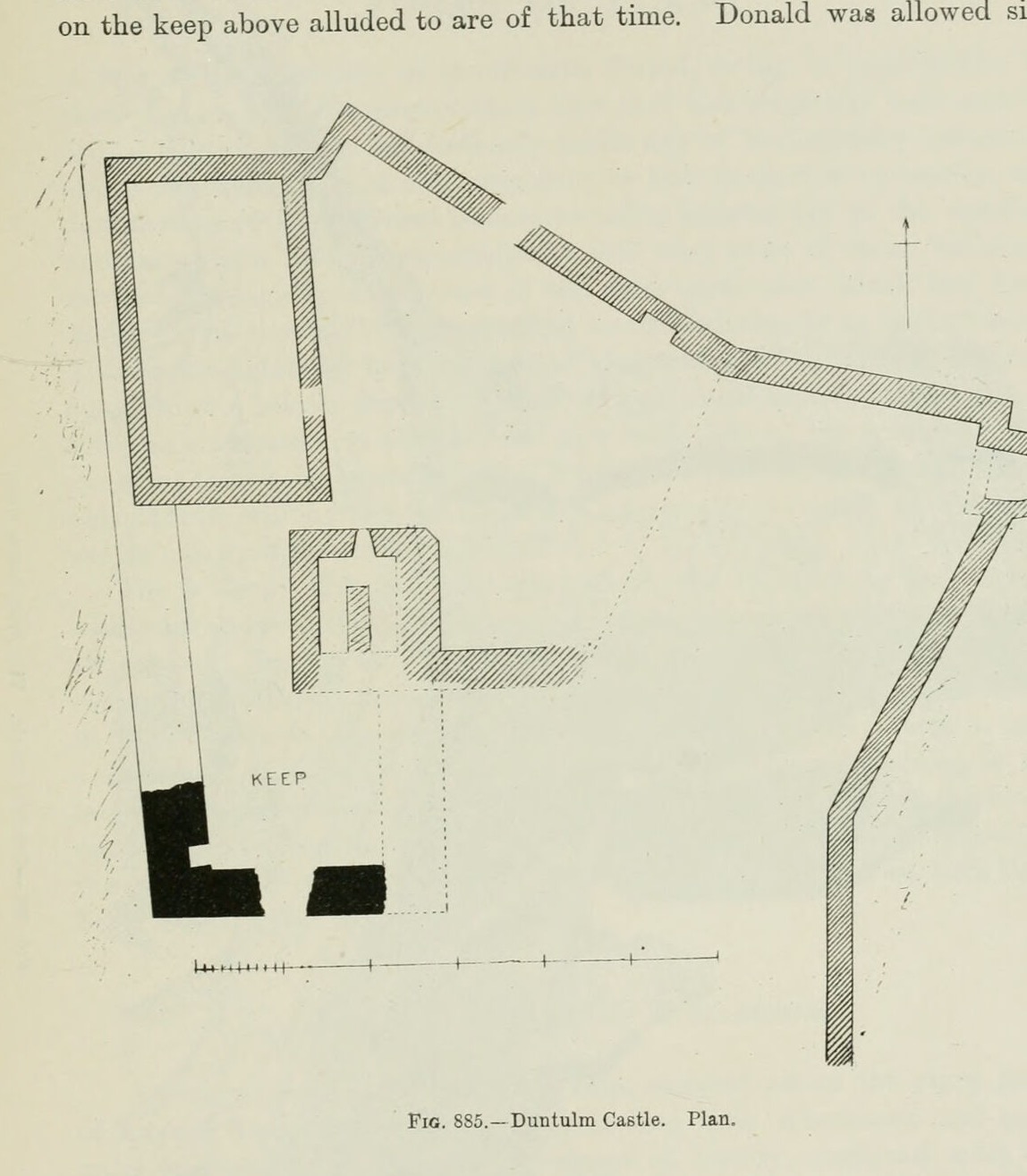
Fig. 885. Duntulm Castle. Plan.
1892 · MacGibbon & Ross, vol. 4 (1892)
Public domain