Scotland · Ruin
Dunure Castle
Dunure Castle is a medieval stronghold on a rocky promontory on the Carrick coast of South Ayrshire, Scotland. The surviving fabric dates chiefly from the 15th and 16th centuries; by the late 17th century it had been largely ruined and today stands as a coastal ruin beside Dunure harbour.
Its prime
1563
Today
Ruin
As it stood in 1563
What Dunure Castle looked like in its prime.
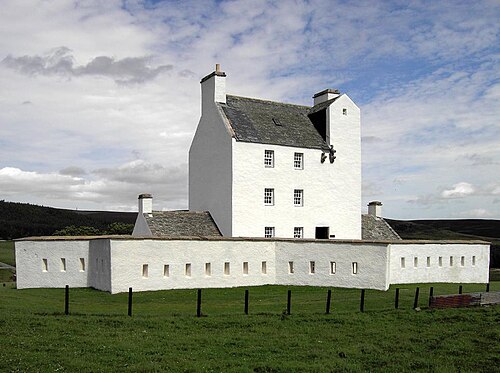
A multi-storey, irregularly shaped stone keep set atop a precipitous sandstone promontory with thick masonry walls and a crenellated parapet; narrow vertical arrow-slits and larger, rectangular glazed window openings puncture the elevations. A lower east–northeast range of service buildings with regular rectangular windows runs down the slope toward the shore. Massive natural boulders and a sheer cliff base surround the castle; roofs in the prime would have been pitched and slate-covered, and cellars and barrel-vaulted basements lay within the rock.
Its story
The story of Dunure Castle.
The Fort of the Yew Tree and the Kennedys of Carrick
The earliest charter for the lands of Dunure dates from 1256 and the site from the late 13th century, though the standing fabric is of the 15th and 16th centuries. Excavation in the 1990s showed that a hall house had been built across the 13th-century court in the following century. Tradition variously holds that the castle was built by the Danes, or that the Mackinnons held it from Alexander III as a reward for their valour at the Battle of Largs. The Celtic name Dunure, or Dunoure, is said to derive from the hill or fort of the yew tree.
The lands were granted to the Kennedys in 1357, and Dunure is the point of origin of the Kennedys of Carrick, who once ruled over much of south-western Scotland. Sir James Balfour described it as "a grate and pleasand stronge housse, the most ancient habitation of the surname of Kennedy, Lairds of Dunure, now Earles of Cassiles".
The Killing of John Mor MacDonald, 1429
In 1429 James Campbell, acting for King James I, met John Mor MacDonald, who came to Dunure representing the Lord of the Isles. Violence broke out and MacDonald was killed. The king executed Campbell in an attempt to contain the outrage of the Lords of the Isles, but that did not prevent a subsequent uprising by them.
Gilbert Kennedy and the Commendator of Crossraguel, 1563–1570
For three days from 4 August 1563 Mary, Queen of Scots, stayed at Dunure as the guest of Gilbert Kennedy, 4th Earl of Cassillis, on her royal tour down the west coast towards Glenluce Abbey and Whithorn Priory.
In 1570 the Earl fell into dispute with Allan Stewart, the succeeding lay Commendator of Crossraguel Abbey, over the ownership of some of the abbey lands and their rental income. The Earl's uncle Quintin Kennedy had been the last true abbot of Crossraguel; Gilbert had expected to secure the commendatorship himself, but Stewart obtained it through the influence of his relative Captain James Stewart of Cardonald. Gilbert took sixteen men, caught Stewart in Crossraguel Woods while he was a guest of the Laird of Bargany, and tricked him into travelling to Dunure, where he was deprived of his horse and weapons and guarded by six of the Earl's men.
Stewart was left for two days to consider his position, and because he refused to sign over the lands and rentals he was tortured twice, his feet and body roasted and basted over a brazier in the Black Vault of the castle by the Earl with his cook, baker and pantrymen. After the sessions of 1 and 7 September 1570 the lands were signed over. The Laird of Bargany, Stewart's brother-in-law, came with a body of men, first hiding in the chapel and then storming the castle to free him. A short siege in 1570 is the only relatively late military action recorded at Dunure. Stewart was taken to the Cross of Ayr, where he denounced the Earl of Cassillis, and the rights to the abbey lands were settled partly by the Earl providing him with funds enough to live "comfortably" for the rest of his life. The Earl was never fully brought to book by the Privy Council. Allan Stewart never walked again.
Wholly Ruined by 1694
The castle and estate, together with Dalquharran, were bought by Sir Thomas Kennedy of Kirkhill in the late 17th century. Dunure's demise had begun in the mid-17th century, and by 1694 it was described as "wholly ruined". Whether that can be linked to the Civil War period is not clear, though local tradition holds that the castle had been burnt or blown up, and a major collapse of the south-eastern part of the keep might be connected with such activity. The recovery of building materials for the Cromwellian citadel at Ayr may also account for the ruination.
Much of the evidence points to systematic dismantling for recoverable materials: slates, stone and glass taken off in orderly fashion, and the windows comprehensively stripped of their lead. Remains of a localised fire with associated deposits of coal suggest the lead was smelted inside one of the rooms, and those taking the castle apart seem to have occupied part of the structure while they worked.
Fishermen's Rooms to Scheduled Monument, c. 1860–1994
The ruin afterwards saw periodic robbing of its sandstone dressings, but a range of castle buildings to the south remained in occupation until about 1860. Census records and the reuse of some rooms show that some of the occupants were fishermen; a large midden of mussel shell gave evidence for the baiting of cod lines.
The castle has since been excavated and consolidated, making public access to the area safe, and it dominates Kennedy Park. In October 1994 the ruin above the small harbour of Dunure, five miles south of Ayr, was designated part of a scheduled monument.
Step inside
12 places to explore in 1563.
The record describes 12 distinct spots at Dunure Castle, including 6 interiors: great hall / hall house, black vault (basement chamber), main kitchen (castle) and more. Create your own photoreal reconstruction and explore every one, more scenes means more rooms, more angles, and more of the place to stand in.
Build Your Own Castle
Recreate Dunure Castle with AI to explore it.
The artist rebuilds it as it stood in 1563, a photoreal reconstruction that belongs to you alone. Pay with coins, no subscription needed.
Recreate this castle →Defend this castle →Whose castle
Clans who held Dunure Castle.
The families that held Dunure Castle for a decade or more across its history, follow a name to its clan.
Point of origin of the Kennedys of Carrick, granted the lands in 1357.
From the archive
Dunure Castle on paper: the measured plan and period views.
The survey plan and photographs below are the ground truth this page's reconstructions are checked against, drawn and photographed while the castle was still a working garrison. Every image is public-domain or openly licensed, with its source named.
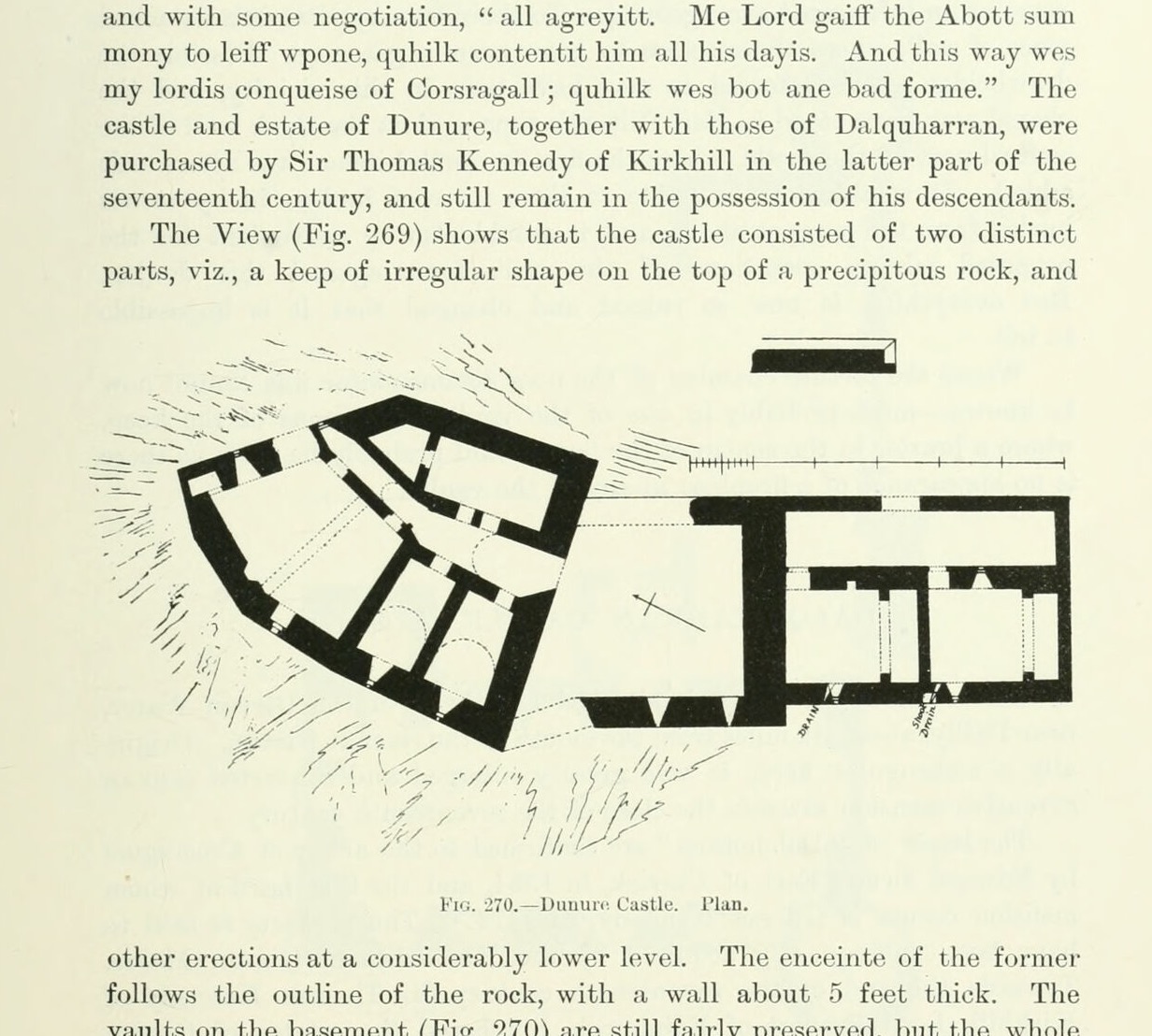
Fig. 270. Dunure Castle. Plan.
1889 · MacGibbon & Ross, vol. 3 (1889)
Public domain