
Scotland · Restored
Fairburn Tower
Fairburn Tower is a 16th-century Scottish tower house near Inverness, believed built for Murdo Mackenzie around 1545. It stands on a low hill above the River Orrin and has characteristic features such as bartizans, ground-floor shot-holes and a vaulted ground-floor chamber; a 17th-century stair wing later provided a ground-level entrance. The tower is Category A listed and has been restored by the Landmark Trust for holiday use.
Its prime
1680
Today
Restored
As it stood in 1680
What Fairburn Tower looked like in its prime.
A compact, tall harled tower house of rough pink render set on a low hill above the River Orrin, with steeply pitched slate roofs and prominent rectangular chimneys. The silhouette is defined by stepped gable ends, narrow square and small rectangular windows with deep embrasures and iron grilles, and a projecting round bartizan on a corner with a conical slate cap. Ground walls show small gun-loops at low level; a 17th-century stair wing provides a ground-floor entrance, and the original ground floor is a vaulted stone chamber.
Its story
The story of Fairburn Tower.
A Groom of the Bedchamber to James V, 1538-1542
Murdo Mackenzie, who died in 1590, was a son of Roderick, or Rory, Mackenzie and probably a nephew of John Mackenzie of Kintail. Rory held nearby farms or townships at Comrie, Scatnell and Acheleis and the mill at Contin, and was himself a nephew of Thomas Fraser, 2nd Lord Lovat. By one account Murdo was sent into the royal household after his father impressed the king in a wrestling match.
From 1538 he served James V as a groom or valet of the bedchamber, and in 1540 he appears in the king's company at Stirling Castle, Falkland Palace and Dudhope Castle. On 30 April that year the king's pursemaster, John Tennent, gave him 22 shillings to buy gunpowder in Dundee for the royal handguns. He and three fellow grooms of the chamber, Alexander Kemp, Sandy Whitelaw and Andrew Drummond, drew money for livery clothes in 1540 at an increased allowance, and in June 1542 Mackenzie was given a gift of composition worth 113 pounds.
The Fairburn Charter, 1542-1590
On 1 April 1542 Murdo Mackenzie was granted the lands of Fairburn and other farms, owing for the hearth of each homestead the feudal duty of a hen, called a "reik hen", and was instructed to build a new house with orchards and a garden. The tower on its hill above the River Orrin, in the parish of Urray near Muir of Ord, is believed to have been built for him in 1545. After his marriage to Mariobelle, or Margaret, Urquhart, Mary, Queen of Scots gave him further land in the parish in 1549; a translation of his charter is printed in the Origines Parochiales. The adjacent lands of Wester Fairburn went to Andrew Keith, Lord Dingwall, in March 1584. Mackenzie died on 20 December 1590, wishing to be buried with his forebears in Beauly Priory.
Gun-Loops and the 17th-Century Stair Wing
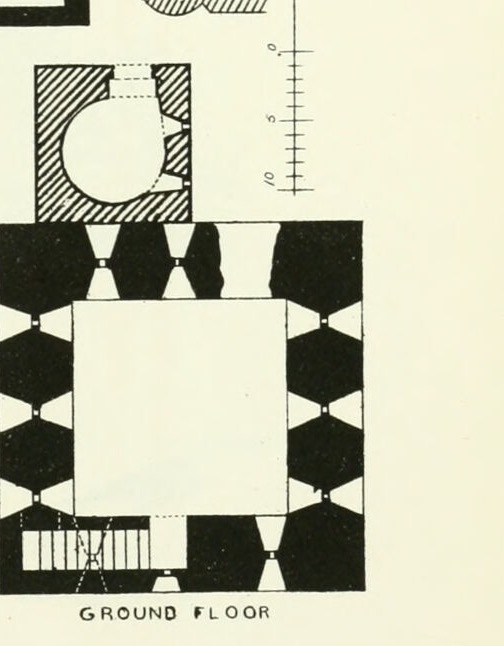
The tower was entered at first-floor level, an internal stair giving the only access to the vaulted chamber on the ground floor. Shot-holes or gun-loops pierce the walls at ground level, and bartizans stand at the wall heads. In the 17th century a wing carrying a stair was added to the older tower, opening a ground-floor entrance.
The Brahan Seer and the Calf of 1851
The tower and the Mackenzie family were named in the prophecies of the Brahan Seer, Kenneth Ower or Coinneach Odhar, who was executed for witchcraft at the Chanonry of Ross in 1578. The prophecies foretold the end of the family, the ruin of the building, and the apparition of a cow that would calve in the seòmar uachdarach, an upper chamber of the tower. A cow had a calf at the castle in 1851.
Abandonment and the Landmark Trust Restoration, 1780-2025
The tower was abandoned around 1780, and in 1803 a gale brought down its roof of oak shingles. Hugh Miller, who heard stories of the Mackenzies from a woman called Isobel, known as "Mad Bell", described the ruin as a "ghastly spectre of the past".
Fairburn Tower has been Category A listed since March 1971 and is held by the Landmark Trust, which restored it for holiday rental. In May 2025 the tower was named one of the winners of the annual Royal Incorporation of Architects in Scotland awards, and thereby longlisted for its Best Building in Scotland Award; the judges called the restoration "beautifully accomplished, while also delivering characterful holiday accommodation".
Step inside
6 places to explore in 1680.
The record describes 6 distinct spots at Fairburn Tower, including 2 interiors: vaulted ground-floor chamber, original first-floor entrance and stair passage. Create your own photoreal reconstruction and explore every one, more scenes means more rooms, more angles, and more of the place to stand in.
Build Your Own Castle
Recreate Fairburn Tower with AI to explore it.
The artist rebuilds it as it stood in 1680, a photoreal reconstruction that belongs to you alone. Pay with coins, no subscription needed.
Recreate this castle →Defend this castle →Whose castle
Clans who held Fairburn Tower.
The families that held Fairburn Tower for a decade or more across its history, follow a name to its clan.
Built about 1545 for Murdo Mackenzie, granted the lands of Fairburn in 1542.
From the archive
Fairburn Tower on paper: the measured plan and period views.
The survey plan and photographs below are the ground truth this page's reconstructions are checked against, drawn and photographed while the castle was still a working garrison. Every image is public-domain or openly licensed, with its source named.
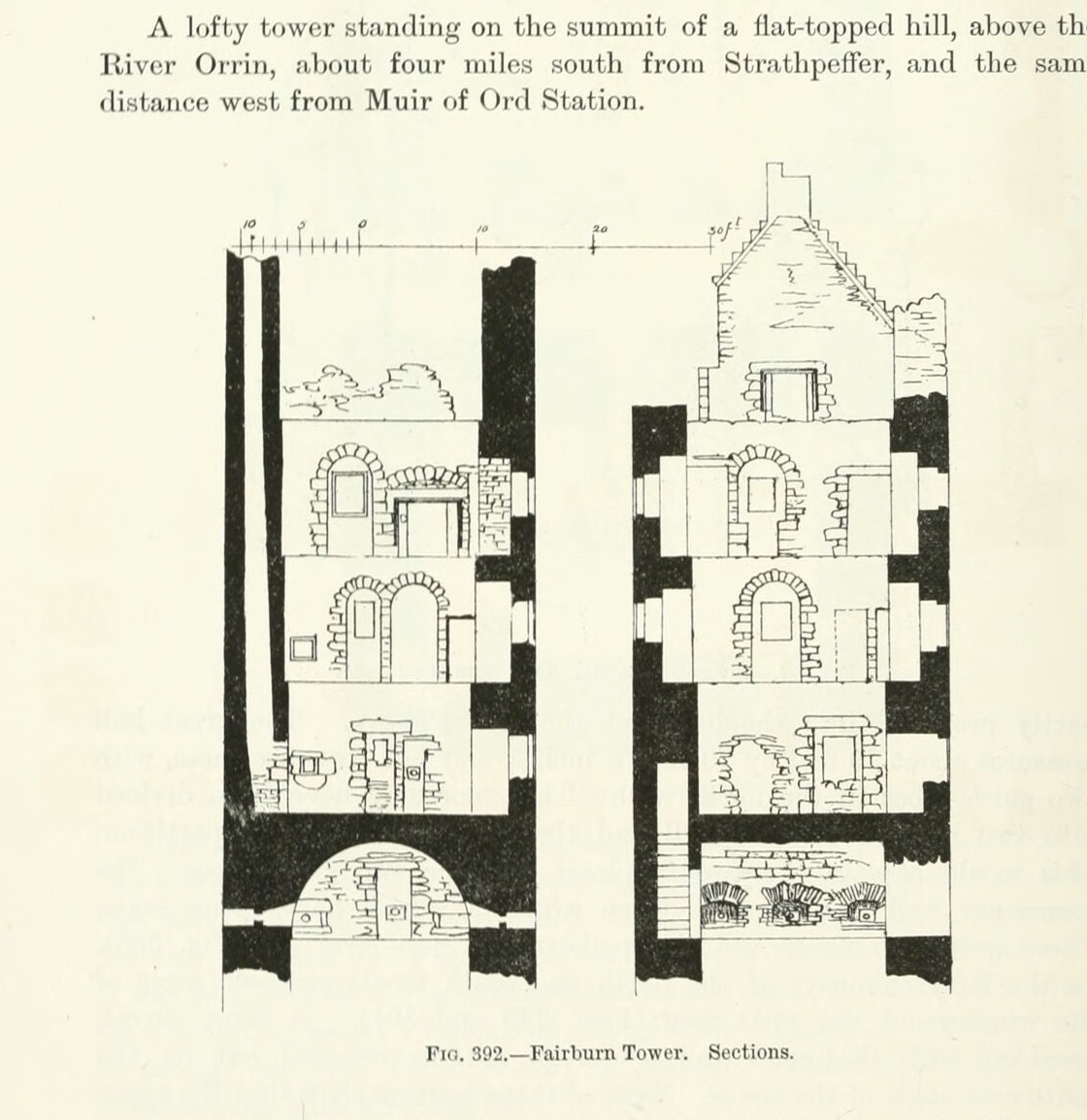
Fig. 392. Fairburn Tower. Sections.
1889 · MacGibbon & Ross, vol. 3 (1889)
Public domain
FOURTH FLOOR
1889 · MacGibbon & Ross, vol. 3 (1889)
Public domain
THIRD FLOOR
1889 · MacGibbon & Ross, vol. 3 (1889)
Public domain


