Scotland · Restored
Falkland Palace
Lùchairt Fhàclann
Falkland Palace in Falkland, Fife, is a former royal palace of the Scottish kings transformed in the 16th century into a Renaissance-style royal residence and hunting retreat. It served as a favored residence for Stewart monarchs, accommodated royal apartments, a Chapel Royal, a great hall, stables and a royal tennis court, and was set within managed parkland used for hunting.
Its prime
1541
Today
Restored
As it stood in 1541
What Falkland Palace looked like in its prime.
A long ashlar stone palace set on a slight hill within parkland, composed of several rectangular ranges and a taller crenellated block to the rear. The south-facing façade has multiple rows of tall rectangular mullioned windows and a low central range with steep slate roofs; a cylindrical corner tower with a conical roof projects at one end. Numerous tall stone chimneys punctuate the roofline. At prime the ranges are fully roofed and occupied, with formal gardens and a serviced close to the north.
Its story
The story of Falkland Palace.
The MacDuff Earls and the Crown, 1371-1462
A royal hunting lodge stood here in the late 12th century, on a slight hill that could be defended, and in the 13th century it was enlarged to work as a castle held by the Earls of Fife of Clan MacDuff. Around it lay Falkland Park, a managed forest ringed by a pale meant to keep game inside for the royal hunt.
In 1371 Isabella MacDuff, Countess of Fife, acknowledged Robert Stewart, son of Robert II, as her heir and made him keeper of the castle and forest. In 1402 Stewart, by then Duke of Albany, imprisoned his nephew and rival David Stewart, Duke of Rothesay, at Falkland, where the duke died of neglect and starvation; one chronicle claimed he had eaten his own hands. Parliament exonerated Albany, though suspicion persisted. After ordering the execution of Albany's son Murdoch in 1424, James I took Falkland for the crown.
James II granted the place to his queen consort, Mary of Guelders, and in widowhood she rebuilt there in 1461-2, adding a "galry" of two rooms that appears to be the earliest use in Britain of the French-derived word gallery.
James V's French Renaissance and the King's Death, 1542
Between 1497 and 1541 James IV and James V turned the old castle and royal lodgings into a renaissance palace. The teenage James V was held at Falkland by the Earl of Angus and, according to Robert Lindsay of Pitscottie, announced an early-morning deer hunt and then rode out in the middle of the night dressed as a stable hand, escaping to his mother at Stirling. From 1537 he extended his father's buildings in the French renaissance manner, work that may connect with Nicolas Roy, a French mason sent to Scotland in March 1539 by Mary of Guise's mother, Antoinette of Bourbon. The masons John Brownhill and Henry Bawtie finished the fore entry and tower in 1541, the year the king also arranged a royal tennis court in the garden; it is the world's oldest tennis court still in use.
James V died at Falkland in December 1542, of an illness brought on by the shock and grief of his army's defeat at Solway Moss; some said he grieved too that his wife had given him no male heir but the future Mary, Queen of Scots. His body lay in the Chapel Royal for almost a month, draped in black, until on 4 January 1543 the gentlemen of Fife were ordered to carry the king to North Queensferry on his way to Holyrood Abbey.
Mary, Queen of Scots at Falkland, 1561-1564
Mary returned from France in September 1561, and Falkland became one of her favourite places, a refuge from the turmoil of her times. In March 1562 she kept her "Skyris Thurisday" ceremony there, washing the feet of nineteen young women, a number matching her age. At Easter that year James Hamilton, 3rd Earl of Arran, brought word that James Hepburn, 4th Earl of Bothwell, meant to seize the queen and the Earl of Moray from the deer park; both earls were imprisoned, and Arran was held to be mentally ill. She returned for Easter in 1563 and 1564, and was said to have scandalised Scotland by playing tennis in men's breeches.
The Raid of Falkland, 28 June 1592
Francis Stewart, Earl of Bothwell, crossed the Forth at Queensferry on 27 June 1592 with 400 men and, for five hours the next morning, tried to take the palace and with it James VI and Anne of Denmark. The king had been warned: Bothwell's plans had reached the English ambassador Robert Bowes, and word went to the court that the king should "look narrowly about him", so he stayed at Falkland rather than ride to Perth as planned. The attackers battered at the back gate and were driven off by gunfire before midnight on the 27th; James withdrew to the gatehouse tower while his guard shot at them, though James Melville reckoned the defenders who favoured Bothwell loaded their guns with paper rather than bullets. Bothwell gave up at seven in the morning and rode off with the king's horses; nine of his men were taken in the chase and five hanged in Edinburgh's Canongate.
Cromwell's Fire and the Bute Restoration
Charles I and Charles II both came to Falkland; the accounts for Charles II's stay in July 1650 record proclamations against the prices the village charged for lodgings and horse-hire. Fire partly destroyed the palace during the occupation by Oliver Cromwell's troops that followed, and it fell quickly into ruin.
In 1887 John, 3rd Marquis of Bute, bought the Falkland estates and began a twenty-year restoration under two architects, John Kinross and Robert Weir Schultz; the palace then stood without windows or doors. His excavations uncovered the foundations of the old castle and the north range. In 1952 the Hereditary Keeper, Major Michael Crichton Stewart, appointed the National Trust for Scotland as Deputy Keeper.
Step inside
10 places to explore in 1541.
The record describes 10 distinct spots at Falkland Palace, including 4 interiors: chapel royal (interior), great hall (interior), queen's chamber with doorway to the pleasance (interior) and more. Create your own photoreal reconstruction and explore every one, more scenes means more rooms, more angles, and more of the place to stand in.
Build Your Own Castle
Recreate Falkland Palace with AI to explore it.
The artist rebuilds it as it stood in 1541, a photoreal reconstruction that belongs to you alone. Pay with coins, no subscription needed.
Recreate this castle →Defend this castle →From the archive
Falkland Palace on paper: the measured plan and period views.
The survey plan and photographs below are the ground truth this page's reconstructions are checked against, drawn and photographed while the castle was still a working garrison. Every image is public-domain or openly licensed, with its source named.
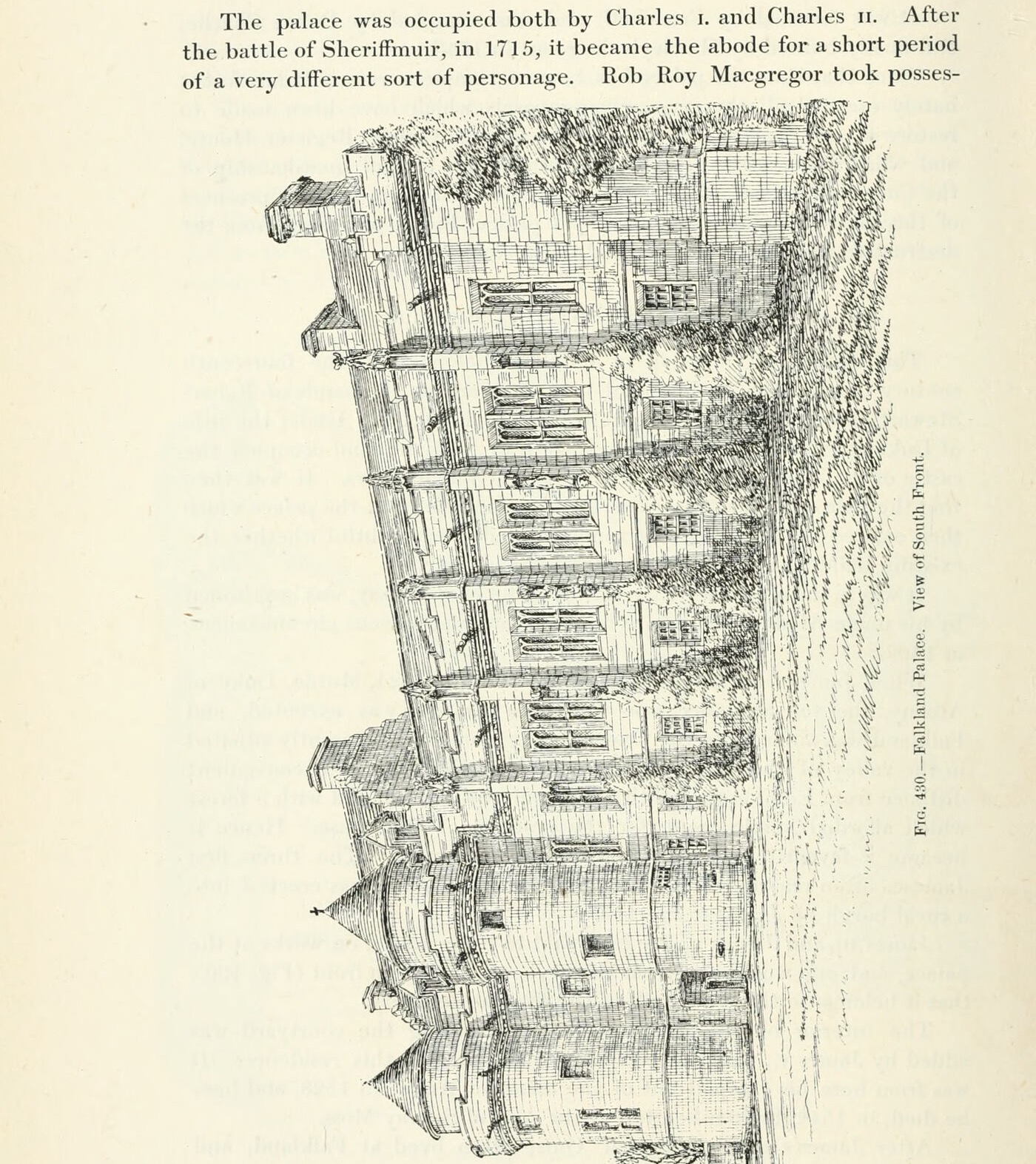
Fig. 430. Falkland Palace. View of South Front.
1887 · MacGibbon & Ross, Castellated and Domestic Architecture of Scotland, vol. 1 (1887)
Public domain
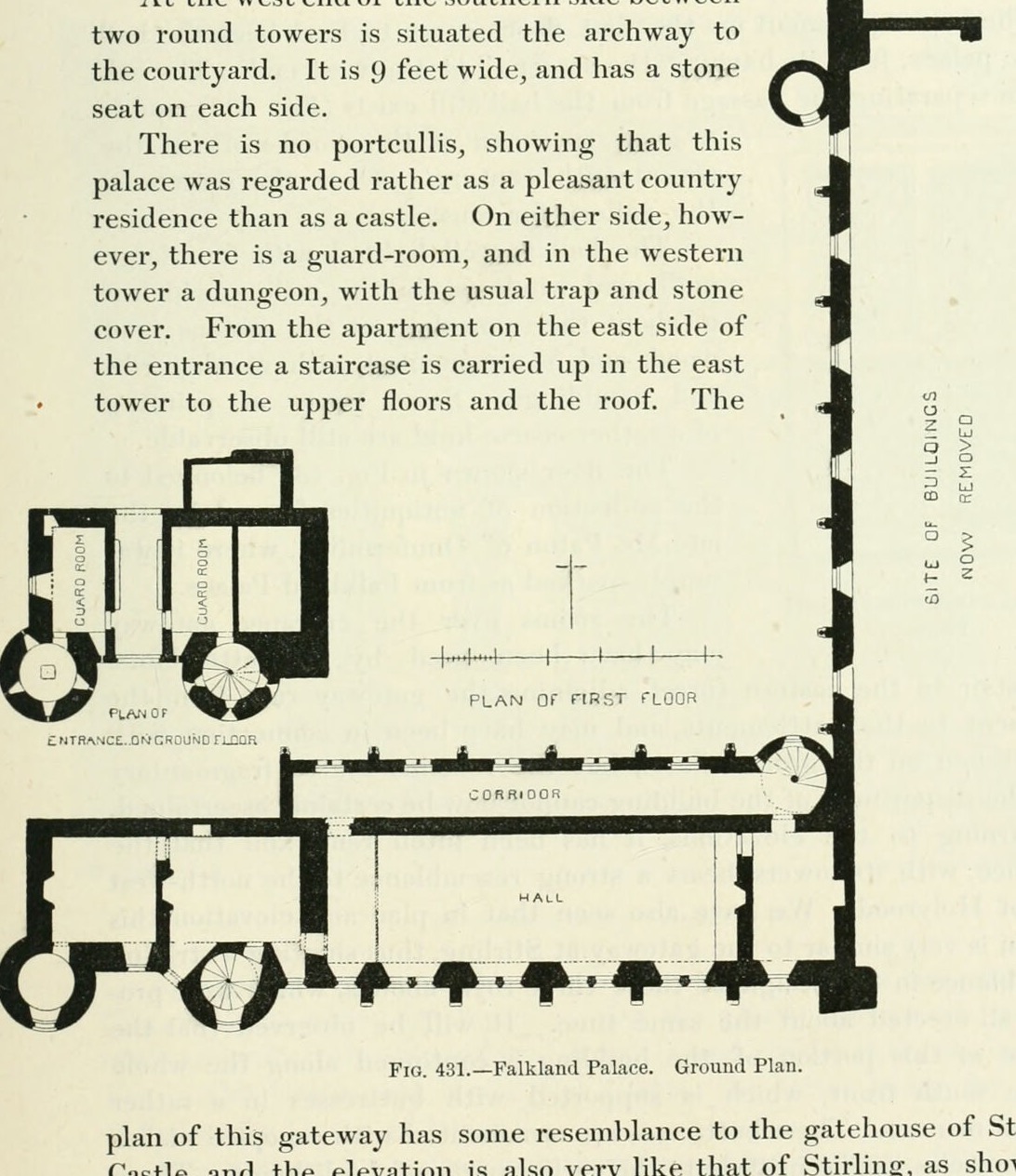
Fig. 431. Falkland Palace. Ground Plan.
1887 · MacGibbon & Ross, Castellated and Domestic Architecture of Scotland, vol. 1 (1887)
Public domain
Nearby