Scotland · Restored
Hume Castle
Hume Castle sits on a prominent grassy mound above the village of Hume in Berwickshire, Scotland. Originating in the late 12th or early 13th century, its medieval keep and enceinte were later slighted and partly rebuilt; the present dramatic crenellated silhouette dates from an 18th-century restoration. It is a Scheduled Ancient Monument and is open to the public under the care of a trust.
Its prime
1794
Today
Restored
As it stood in 1794
What Hume Castle looked like in its prime.
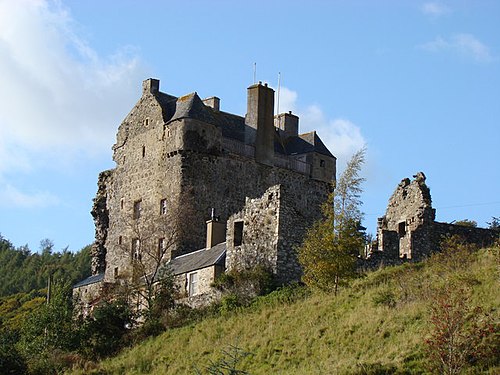
Perched atop a rounded, steep grassy mound, the castle presents a continuous grey-stone curtain wall topped by very large, rectangular crenellations. Two higher wall-stubs rise above the parapet, remnants of an inner keep; a flagstaff stands at one end. The masonry is rough local stone, with no roofs visible and open battlements. The mound is surrounded by green farmland and hedgerows, with a solitary mature tree on the forward slope beneath the walls.
Its story
The story of Hume Castle.
William de Home and the Road to Roxburgh
Hume Castle stands on a height above its castleton in Berwickshire, commanding the Merse with views to the English border at Carter Bar; it was used historically as a beacon to warn of invasion. What survives is the heavily modified remnant of a castle of enceinte of the late 12th or early 13th century, held by the Hume or Home family, Wardens of the Eastern March and later Lords Home and Earls of Home.
William de Home, son of Sir Patrick de Greenlaw, acquired the lands of Home in the early 13th century by marrying his cousin Ada, a daughter of Patrick I, Earl of Dunbar, and is assumed to have built the first stone fortifications here. James II stayed at Home on his way to the siege of Roxburgh Castle, where he was killed by the explosion of an early bombard.
Albany Takes Hume and Lord Hume Dams the Well, 1515
In August 1515 the Governor, Regent Albany, moving against the Humes on the Borders, imprisoned members of the family at Dunfermline along with Adam Tinmo, Constable of Hume Castle, and captured the castle. By the report of William Frankelayn, Chancellor of Durham, Lord Hume, the Lord Chamberlain, retook it on 26 August 1515 and kept Albany's captain prisoner. Lord Hume then slighted his own castle, razed the walls, "and dammed the well for ever more".
The Rough Wooing: Lady Home's Barmkin, 1547–1549
Before artillery, Hume was considered almost impregnable. Regent Arran sent twelve gunners to hold it in August 1547, and George Home, 4th Lord Home, was injured at the Battle of Pinkie and his son Alexander captured. How the castle then passed to the Lord Protector Somerset is told two ways: that it fell after stout resistance by Mariotta Haliburton, Lady Home, or, as the English reported it, that she negotiated its rendering once the English army encamped at the Hirsel, the guns laid but no shot fired by either side. Sir Edward Sutton received the keys as Captain of Hume on 22 September 1547.
Lady Home protested to Somerset that November that she could hardly have held the "sober barmkin" of Hume against the English army when all the nobles of Scotland could not keep the field. The English garrison nearly lost the castle in February 1548, when its Spanish mercenaries plotted to change sides and loyal men fired the beacon. In December 1548 Alexander, 5th Lord Home, whose father had died a captive in the Tower of London, recaptured Hume in a night assault with his brother Andrew, and Sutton was blamed for losing it by negligence. An English attempt to retake the castle failed in February 1549, and by that March Lady Home was installed again, sharing it with a French and Spanish garrison.
Sussex's Battery to Fenwick's Slighting, 1570–1651
In April 1570 the Earl of Sussex besieged Hume during his raid into Scotland in the Marian Civil War; the defenders capitulated within twelve hours, in awe of his superior numbers and the firepower of "three battery pieces and two sakers" brought from Wark Castle.
The Earls of Home had other seats by then, at Dunglass and by 1611 at The Hirsel, and the 17th century saw the end of Hume as a habitable fortress. James, 3rd Earl of Home, was a prominent member of the Kirk Party, and in 1651, after taking Edinburgh Castle, Cromwell sent Colonel George Fenwick with two regiments to besiege the Earl's castle. The governor, Colonel John Cockburn, refused to deliver it, claiming that the castle stood on a rock, and sent Fenwick a note of doggerel beginning "I, Will of the Wastle, Am King of my castle". Once the bombardment began there was no option but submission: Cockburn and his men were given quarter for life only, and Fenwick slighted the fortification.
Marchmont's Folly, the Great Alarm and the Clan Home Trust
In the early 18th century Hume came to the Earls of Marchmont, cadets of the main line; the castle was by then level with the ground it stood on. Before his death in 1794, Hugh Hume-Campbell, 3rd Earl of Marchmont, restored it as a folly on the original foundations of the curtain wall, adorning the wall tops with enormous crenellations "more picturesque than practical". The beacon served again in the Napoleonic Wars: on the night of 31 January 1804 a sergeant of the Berwickshire Volunteers mistook charcoal burners' fires on Dirrington Great Law for a warning and lit it, turning out 3,000 volunteers in what became known as the Great Alarm.
The state bought Hume in 1929, and it was scheduled as a monument in 1958. In 1985 the Berwickshire Civic Society, funded by the Scottish Office, began a restoration programme, and the castle reopened to the public in 1992; in 2006 the Society handed it to a charitable trust run by the Clan Home Association, under the auspices of Historic Scotland.
Step inside
7 places to explore in 1794.
The record describes 7 distinct spots at Hume Castle, including 1 interior: interior of the central keep remnants. Create your own photoreal reconstruction and explore every one, more scenes means more rooms, more angles, and more of the place to stand in.
Build Your Own Castle
Recreate Hume Castle with AI to explore it.
The artist rebuilds it as it stood in 1794, a photoreal reconstruction that belongs to you alone. Pay with coins, no subscription needed.
Recreate this castle →Defend this castle →Whose castle
Clans who held Hume Castle.
The families that held Hume Castle for a decade or more across its history, follow a name to its clan.
Home
Held by the Hume or Home family, Wardens of the Eastern March, later Lords Home and Earls of Home, from the early 13th century.