
Scotland · Ruin
Inverlochy Castle
Caisteal Inbhir Lòchaidh
Inverlochy Castle is a 13th-century quadrangular enceinte on the south bank of the River Lochy near Fort William in the Scottish Highlands. The castle survives as a ruin that has changed little since it was built and is now a scheduled monument in the care of Historic Environment Scotland.
First raised
1270
Its prime
1280
Today
Ruin
As it stood in 1280
What Inverlochy Castle looked like in its prime.
A compact quadrangular castle of coarse grey-brown rubble stone sited on the south bank of the River Lochy. The plan is roughly 31 by 27 metres, enclosed by a continuous curtain wall up to 2.7 m thick with round towers at each corner, the largest being the circular Comyn Tower about 6.1 m across internally. At its prime the walls rose to around 7.6 m with crenellated parapets; the north side faced the river while the other sides were protected by a water-filled ditch.
Its story
The story of Inverlochy Castle.
John Comyn's Castle at the Foot of the Great Glen, c.1270-1280
Inverlochy Castle was built around 1270-1280 by John "the Black" Comyn, Lord of Badenoch and Lochaber and chief of Clan Comyn, on the south bank of the River Lochy at the strategically important entrance to the Great Glen. It may stand on the site of an earlier Pictish fortification and settlement, which the historian Hector Boece recorded as a "city" destroyed by Vikings.
It is a castle of enceinte: a quadrangular courtyard 31 by 27 metres, ringed by a curtain wall up to 2.7 metres thick and 7.6 metres high, with a round tower at each corner - the largest, the Comyn Tower, serving as the donjon. One side was defended by the river; the other three were originally protected by a water-filled ditch.
Robert the Bruce's Burning, 1307
After Robert the Bruce succeeded to the Scottish throne in 1306, he captured and burned Inverlochy the following year. The Comyns, dispossessed, left the ruined castle unoccupied for a time.
The First Battle of Inverlochy and the Gordons of Huntly, 1431-1513
In 1431, clansmen of Alexander MacDonald, Lord of the Isles, defeated King James I's larger army in the first Battle of Inverlochy, fought close by the castle. Clan Cameron held the castle after that until 1501.
In 1505 the partially ruined castle was granted to Alexander Gordon, 3rd Earl of Huntly, whom King James IV charged with repairing it for use as a Royal garrison. His brother William Gordon, Laird of Gight, became master of Inverlochy, and was killed commanding the Camerons at the Battle of Flodden.
Montrose's Campaign and the Second Battle of Inverlochy, 1645
In 1645 the castle served as a stopping-off point for the royalist army of James Graham, 1st Marquess of Montrose, during his campaign against the Covenanter forces of the Marquess of Argyll. The campaign culminated in a royalist victory at the second Battle of Inverlochy, fought on 2 February 1645.
Baron Abinger's Restoration and Queen Victoria's Visit, 1873
In the 19th century the estate was bought by James Scarlett, 1st Baron Abinger, who built a Scottish baronial mansion to the north-west - now the Inverlochy Castle Hotel - and restored loops and battlements on the medieval castle ahead of a visit by Queen Victoria in 1873. The castle itself has remained largely unaltered since the reign of Alexander III, and is a scheduled monument in the care of Historic Environment Scotland.
Step inside
7 places to explore in 1280.
The record describes 7 distinct spots at Inverlochy Castle, including 4 interiors: south gate and entrance passage, comyn tower (donjon) interior, quadrangular courtyard and more. Create your own photoreal reconstruction and explore every one, more scenes means more rooms, more angles, and more of the place to stand in.
Build Your Own Castle
Recreate Inverlochy Castle with AI to explore it.
The artist rebuilds it as it stood in 1280, a photoreal reconstruction that belongs to you alone. Pay with coins, no subscription needed.
Recreate this castle →Defend this castle →Whose castle
Clans who held Inverlochy Castle.
The families that held Inverlochy Castle for a decade or more across its history, follow a name to its clan.
Comyn
Built circa 1270–1280 by John "the Black" Comyn, Lord of Badenoch and Lochaber, chief of Clan Comyn.
Under the control of Clan Cameron until 1501.
Granted in 1505 to Alexander Gordon, 3rd Earl of Huntly, charged with repairing it as a Royal garrison.
Scarlett
Estate bought in the 19th century by James Scarlett, 1st Baron Abinger, who restored the ruin before Queen Victoria's 1873 visit.
From the archive
Inverlochy Castle on paper: the measured plan and period views.
The survey plan and photographs below are the ground truth this page's reconstructions are checked against, drawn and photographed while the castle was still a working garrison. Every image is public-domain or openly licensed, with its source named.
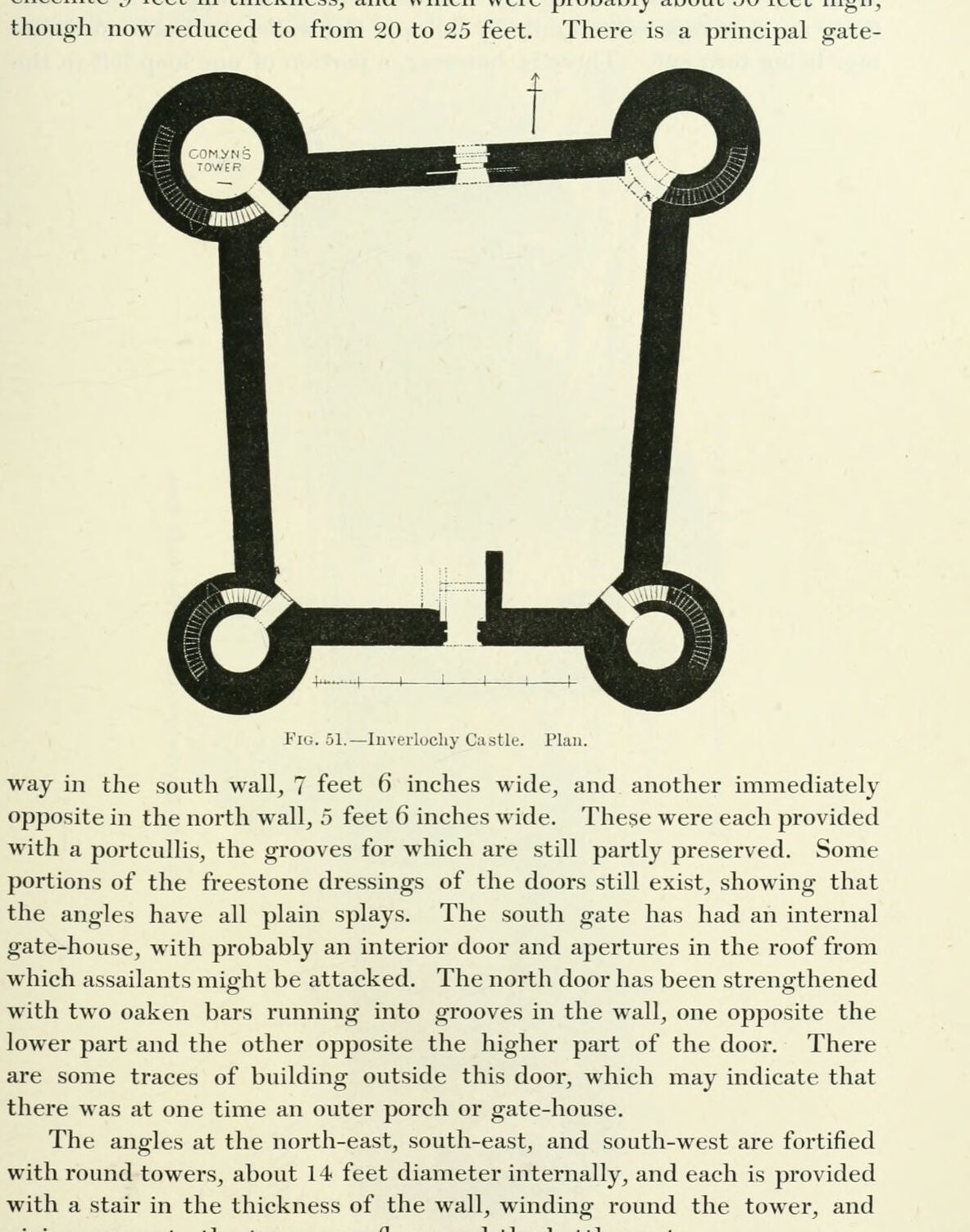
Fig. 51. Inverlochy Castle. Plan.
1887 · MacGibbon & Ross, Castellated and Domestic Architecture of Scotland, vol. 1 (1887)
Public domain


