
Scotland · Ruin
Knock Castle
Knock Castle is an early 17th-century four‑storey Scottish tower house on a small knoll in Royal Deeside near Ballater, Aberdeenshire. Today the external rubble walls survive but the tower is roofless and the interior largely ruined; it is a category B listed site cared for by Historic Environment Scotland.
Its prime
1600
Today
Ruin
As it stood in 1600
What Knock Castle looked like in its prime.
A compact four‑storey rectangular tower (about 27 by 22 feet) of coarse multicoloured rubble masonry with thicker 4‑foot walls and pinkish sandstone dressings around narrow window slits. The tower rises straight from a grassy knoll, with small, regularly spaced vertical windows and gabled cap-house above the stair; the building would have been fully roofed in timber and slate. Numerous angled pistol shot‑holes sit directly beneath many windows; lichen and weathering mark the stone surface.
Its story
The story of Knock Castle.
Knock Castle was granted to the Gordons of Abergeldie by the 4th Earl of Huntly after the battle of Corrichie, fought on 28 October 1562 between George Gordon, 4th Earl of Huntly, and the forces of Mary, Queen of Scots commanded by James Stewart, 1st Earl of Moray. A short distance west, a motte marks Old Castle Knock, a possible 12th-century timber stronghold of the Earls of Mar, destroyed in 1590 by Clan Chattan.
In 1592 a feud with the neighbouring Clan Forbes intensified when Henry Gordon, 2nd Laird of Knock, was murdered during a cattle raid by Forbes and Clan Chattan men. His brother Alexander succeeded him and may have rebuilt or remodelled the castle; the story is told that Alexander's seven sons, sent out to cut peat for the winter store, strayed unawares onto Forbes land.
The four-storey tower, dating from about 1600, resembles Birse Castle and the pele towers of the Borders. Its walls, some four feet thick, survive intact though roofless, with a vaulted basement kitchen, a spiral turnpike stair topped by a gabled cap house, and an unusual defence of three pistol shot holes angled at the ground beneath each window. A category B listed building, it is in the care of Historic Environment Scotland.
Step inside
8 places to explore in 1600.
The record describes 8 distinct spots at Knock Castle, including 3 interiors: vaulted basement (kitchen), turnpike spiral staircase, gabled cap house (top of stair). Create your own photoreal reconstruction and explore every one, more scenes means more rooms, more angles, and more of the place to stand in.
Build Your Own Castle
Recreate Knock Castle with AI to explore it.
The artist rebuilds it as it stood in 1600, a photoreal reconstruction that belongs to you alone. Pay with coins, no subscription needed.
Recreate this castle →Defend this castle →Whose castle
Clans who held Knock Castle.
The families that held Knock Castle for a decade or more across its history, follow a name to its clan.
Granted to the Gordons of Abergeldie by the 4th Earl of Huntly after the battle of Corrichie in 1562.
From the archive
Knock Castle on paper: the measured plan and period views.
The survey plan and photographs below are the ground truth this page's reconstructions are checked against, drawn and photographed while the castle was still a working garrison. Every image is public-domain or openly licensed, with its source named.
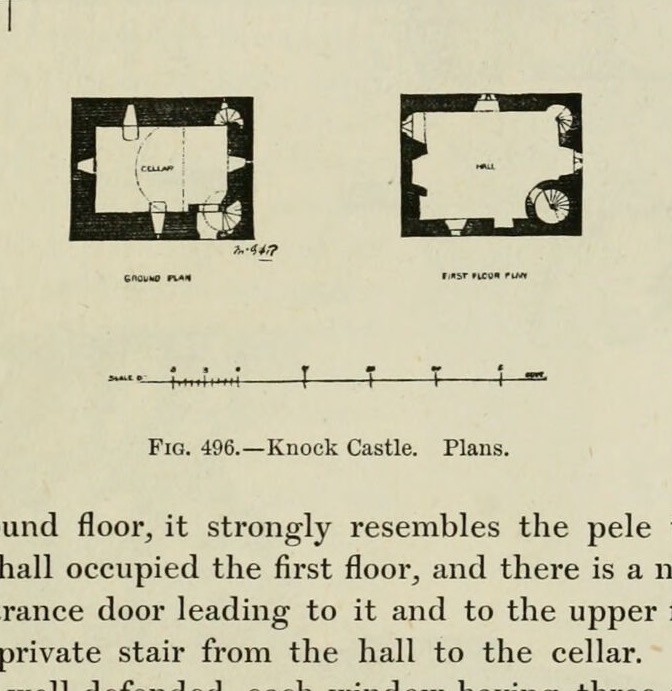
Fig. 496. Knock Castle. Plans.
1887 · MacGibbon & Ross, vol. 2 (1887)
Public domain


