Clan Gordon
The Cocks of the North, Earls and Dukes of Aberdeenshire.
- Origin
- Grampian & the North-East, Scotland
- Motto
- Bydand
- Famous bearer
- George Gordon, 4th Earl of Huntly
- Register
- Scottish clan
Ranked of all time
The 10 Most Powerful Scottish Clans of All Time
The Gordon arms, crest badge, tartan and country

Crest badgeClan member crest badge - Clan GordonCeltus · CC BY-SA 3.0 
TartanGordon Dress tartanThe dress sett: the same pattern rewoven with a white ground, worn for dancing and evening wear.Micheletb · CC BY-SA 4.0 
TartanGordon tartanSMcCandlish, made with the old Windows program Textile32 · CC0 
Coat of armsArms of GordonBorne by the Gordon line, one branch of the name rather than all of it.Sodacan · CC BY-SA 4.0 
Coat of armsCoat of arms of Gordon, Marquesses of Aberdeen and TemairBorne by the Marquesses of Aberdeen and Temair: the ennobled line of the name, not the name at large.CC BY-SA 4.0


- Crest badge: The chief's crest inside a belt and buckle: the badge a clansman wears to show whose following he is in.
- Tartan: The checked cloth the family is known by.
- Coat of arms: Granted to an individual and inherited down that one documented line. These are the arms of particular families of the name, not of everyone who shares the surname.
What is the Gordon clan tartan?
Two Gordon setts are shown above, one of them the dress sett, rewoven on a lighter ground. They are not rival claims to be picked between; they are different records, and different weaves, of the same family cloth. A sett is the block of coloured bands the cloth is built from, repeated in both directions; the whole plaid is that one square enlarged.
Gordon is a north-eastern name, and Aberdeenshire and Moray sit across the Highland line (Gaelic up the straths, Scots along the coast), so the tartan story runs both ways at once. Highland dress was proscribed from 1746 until 1782, and when it returned it returned as ceremony rather than everyday cloth. The surname-to-sett map was fixed after that break, by the Bannockburn weavers’ pattern books, the royal visit to Edinburgh in 1822, and the Vestiarium Scoticum of 1842, and whether the Gordons wore tartan before it depended on which side of the line the branch farmed. Nobody polices any of it. Wearing the Gordon sett declares allegiance to the name, not descent from any particular line of it.
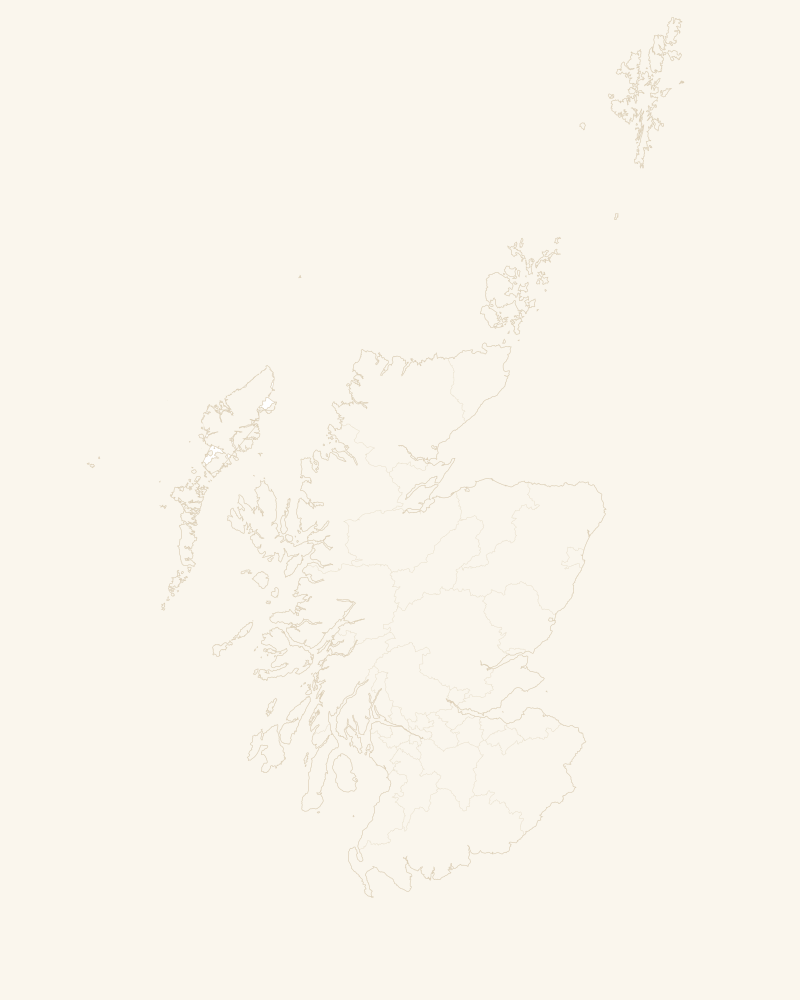
The seat of Clan Gordon
Seat vacantChief
No one leads the Clan Gordon community yet. When the movement opens, you can stand for its leadership, or help elect whoever does.
Current mission
No shared goal set yet. Once Clan Gordon has leadership, it sets the public focus: a restoration, a gathering, a real-world project that helps its own.
The Gordon clan is being rebuilt. Join the waiting list for the movement today, and you help decide who leads it and what it does.
Help rebuild the Gordon clan →Motto
Bydand
“Remaining (steadfast)”
What does the Gordon name mean?
From the lands of Gordon in Berwickshire, granted to Adam, ancestor of the family, in the 12th century. The name is of disputed origin, possibly from Welsh 'gor dun' (great fort) or a Gaelic personal name.
The history of Clan Gordon
The knight of the Merse and the lands called Gordon
The surname begins as a place. The lands of Gordon lie in the Merse, the low arable country of Berwickshire in the Scottish Borders, and the first man the record can name is Richard of Gordon, previously of Swinton, Lord of the Barony of Gordon in the Merse. He probably died around 1200. Somewhere between 1150 and 1160 he granted a piece of his estate to the monks of St Mary at Kelso, and his son Thomas Gordon confirmed the grant. That charter, a strip of Border ground signed away to an abbey, is the oldest hard evidence the family has. Everything before it is tradition.
And there is a great deal of tradition. Richard was said to be the grandson of a famous Norman knight who slew some monstrous animal in the Merse in the time of King Malcolm III of Scotland. That is a founding legend of the kind powerful houses acquire, not something a charter records, and it deserves to be read as what it is. From the same early period comes Bertram de Gordon, remembered for wounding King Richard of England with an arrow at Châlons.
The meaning of the name is genuinely disputed. One reading takes it from Welsh gor dun, a great fort, describing the ground itself; another from a Gaelic personal name; a third points across the Channel to a similarly named place in Normandy, while the English form of the surname is traced instead to Gourdon in Saône-et-Loire, from the Gallo-Roman personal name Gordus. Any of these can be argued and none proved. What is certain is that the Scottish family took its name from the Berwickshire barony, and then carried it far away from it.
The early line ran through an heiress, a pattern this family repeats to an unusual degree. Alicia Gordon, fourth of the family, married her cousin Adam Gordon, a soldier whom King Alexander III of Scotland sent with King Louis of France to Palestine. One tradition holds that every Gordon in Scotland descends from Adam's grandson, Sir Adam, a claim of a single stem for a name now carried by hundreds of thousands, and one to treat with the care any such claim deserves.
Wallace, Bruce, and the road north to Strathbogie
In 1297 Adam Gordon supported Sir William Wallace in the recapture of the castle of Wigtown from the English, and was made its Governor. During the Wars of Scottish Independence Sir Adam Gordon renounced his subsequent acceptance of the claims of Edward I of England and became a staunch supporter of Robert the Bruce. That was the decision on which the whole later history of the name rests, and at the moment it was made it was a gamble against the largest army in the islands.
It paid in land, and the land was not in Berwickshire. As a result of supporting Bruce the Gordons were given lands in Strathbogie in Aberdeenshire, and Huntly Castle is recorded as granted by Bruce to Sir Adam Gordon of Huntly. The accounts do not agree on the mechanism: one tells it as Bruce's reward to Sir Adam, another has the lands passing from the Setons to the Gordons in the fourteenth century. What is not in doubt is the result. A Border family became a north-eastern one, roughly a hundred and fifty miles from the ground that gave it its name.
The old seat did not vanish at once (a Gordon castle stood north of the village of Gordon in Berwickshire from the twelfth century, though its exact site is now uncertain), but the future was in Aberdeenshire. A mile from Strathbogie stood Huntly, where the Gordons also had a castle, and it was Huntly that gave its name to the greater stronghold: the property was renamed from Strathbogie to Huntly in 1506, and the chiefs took their title from it.
The century that followed cost the family three chiefs in three generations, all killed facing England. Adam was killed leading the Gordons at the Battle of Halidon Hill in 1333; his son Sir Alexander Gordon escaped that field and was the first Gordon to be designated of Huntly. Chief Sir John Gordon was killed leading the clan at the Battle of Otterburn in 1388, a battle the Scots won. His son, Chief Sir Adam Gordon, was killed leading the clan at the Battle of Homildon Hill, also known as Humbleton Hill, on 14 September 1402.
The heiress who kept the name alive
The chief who died at Homildon Hill left one child, a daughter, Elizabeth Gordon. She married Alexander Seton, son of Sir William Seton, chief of Clan Seton. By the ordinary working of inheritance that should have ended the Gordons as a name of consequence: the lands would have gone on under a Seton lord.
Instead the name was chosen over the blood. Alexander Seton, 1st Earl of Huntly, eldest son of Elizabeth Gordon and Alexander Seton, Lord Gordon, changed the family name from Seton to Gordon. The sources put the change at 1449 and at about 1457 and do not agree on the year; the earldom of Huntly itself dates from 1445. His male heirs through his third wife, Elizabeth Crichton, continued to bear the name of Gordon and continued as chiefs of Clan Gordon. The chiefly line is, in the strict male sense, Seton, and it has borne the Gordon name for close to six hundred years by deliberate choice.
The arms still carry the joins. The chief's coat is quartered: first, three boars' heads for Gordon; second, three lions' heads for the Lordship of Badenoch; third, three crescents within a royal tressure for Seton; fourth, three fraises for Fraser, from the acquisition of the Aboyne lands. Four families in one shield: a family tree in paint.
This bears directly on what a Gordon surname does and does not prove. Scottish clanship was organised around chiefs, branches, kindred, lordship, clientage and territorial dependence, not descent alone. As fixed surnames spread, tenants and followers could assume, or be given, the name of a dominant clan without originally sharing kinship with it; the Scottish Parliament's 1587 act on Highland and Border clans described some followers as depending upon chiefs by pretence of blood or place of their dwelling. A Gordon in Ohio or Otago may descend from the chiefly house, from a cadet branch, or from a tenant on Gordon ground.
Cock o' the North: the Douglas wars and a northern power
The fifteenth-century crisis in Scotland was the crown against the Douglases, and the Gordons chose the crown. It was not a safe choice. When Gordon moved his forces south, the Earl of Moray, an ally of the Douglases, devastated the Gordon lands and burned Huntly Castle: the original castle was torched in 1452 and had to be rebuilt. The Gordons came back and beat their enemies, and the rebuilt castle became the seat of the most powerful family in the north.
The battles came in quick order. At the Battle of Brechin in 1452, Alexander Lindsay, 4th Earl of Crawford, chief of Clan Lindsay, was badly defeated by the Gordons and the Ogilvys under Alexander Gordon, 1st Earl of Huntly, the same man who had been Alexander Seton. In 1454 the Douglases broke out in rebellion again and, confronted by the king in the south and Huntly in the north, were soundly defeated, effectively ending the confederacy of Douglases, Rosses and Crawfords. For those services the 1st Earl was styled Cock o' the North, a designation accorded to the heads of Clan Gordon ever since and borne by the chief still. It was not bloodless. At the Battle of Arbroath, Patrick Gordon (a cousin of the Earl of Huntly, called of Methlic in one account and of Haddo in another, the year given as 1445 in one source and 1446 in the other) was killed fighting Clan Lindsay. From him the Earls of Aberdeen descend, and Haddo had been held by Gordons from 1429.
What followed was not mainly conquest but marriage, and the Gordons were exceptionally good at it. Aboyne came in 1449, when Joan Keith married Alexander Gordon, 1st Earl of Huntly. Dunrobin passed to the Gordons in 1512 through the marriage of Elizabeth, Countess of Sutherland, and in 1515 the title of Earl of Sutherland and the chiefship of Clan Sutherland passed by right of marriage to Adam Gordon, a younger son of George Gordon, 2nd Earl of Huntly. In 1557 John Gordon, 11th Earl of Sutherland, and his heirs were gifted the hereditary constableship of the Palace of Dornoch. Kenmure, near New Galloway, was originally held by the Balliols and passed to the Gordons of Lochinvar in about 1297.
The building followed the marrying. Gordon Castle in Moray, east of Elgin, was built from 1479 by George Gordon, 2nd Earl of Huntly, and became the principal residence of the Dukes of Gordon. Abergeldie stood on grounds acquired in 1482, the castle built about 1550 by Sir Alexander Gordon of Midmar. Inverlochy was granted in 1505 to Alexander Gordon, 3rd Earl of Huntly, charged with repairing it as a royal garrison; Auchindoun near Dufftown, originally Ogilvy, passed to the Gordons in 1535; Glenbuchat was built in 1590 for John Gordon of Cairnbarrow. For two centuries from the mid-fifteenth, Clan Gordon and Clan Campbell controlled the north-east and the west of Scotland respectively, the two magnate houses straddling the divide between Highlands and Lowlands.
The Catholic earls: Corrichie, the Forbes feud and Glenlivet
In 1513 the Gordons, led by Alexander Gordon, 3rd Earl of Huntly, fought at Flodden, where William Gordon of Gight was among the dead. George Gordon, 4th Earl of Huntly, served as General of the forces on the Borders opposing Henry VIII of England and had many victorious encounters, beating an English army at Haddon Rig in 1542; five years later the Gordons were part of the Scottish army destroyed at Pinkie Cleugh, where James Gordon of Abergeldie was killed. Then the family turned its strength against its own monarch's government, and lost. The 4th Earl was killed at the Battle of Corrichie in 1562, fighting the forces of James Stuart, Earl of Moray, half-brother to Mary, Queen of Scots, and his son Sir John and other members of the family were afterwards executed at Aberdeen. Mary may have stayed at Rothiemay Castle during that rising; six years later the Galloway Gordons welcomed her at Kenmure, and that castle was torched for it in 1568. Corrichie is the point at which the Gordons stopped being simply the crown's northern arm and became a power the crown had to reckon with.
Running underneath all of it was the feud with Clan Forbes, and it is the worst thing in the family's history. In the 1520s there were murders by both sides; among the most prominent killed by the Forbeses was Seton of Meldrum, a close connection of the Earl of Huntly. The sixth Lord Forbes was heavily implicated, and Huntly moved against his son: the Master of Forbes was accused of conspiring to assassinate James V in 1536 by shooting at him with a cannon, was tried and executed, and days later his conviction was reversed and the family restored to favour. The Reformation then hardened a land quarrel into a religious one. The Gordons remained Catholic and the Forbeses turned Protestant; the Leslies, Irvines and Setons sided with the Gordons, and the Keiths, Frasers and Crichtons with the Forbeses.
In 1571 it came apart entirely. Twenty Gordons were killed at a banquet held at the Forbes seat of Druminnor Castle. The feud climaxed in the Battle of Tillieangus and the Battle of Craibstone, and Druminnor was plundered. The Gordons followed with the massacre of twenty-seven Forbeses of Towie at Corgarff Castle: Adam Gordon of Auchindoun led the party that torched it, and Margaret Campbell, wife of Forbes of Towie, died there with her family and retainers. In the same quarrel seven sons of Gordon of Knock were murdered by Forbes of Strathgirnock, and Forbes was in turn executed by Gordon of Abergeldie. It took two Acts of Parliament to force the clans to put down their arms. Corgarff should not be softened in the telling: it was a massacre of non-combatants carried out in the family's name.
The last acts of the century were as violent. In 1592 James Stewart, 2nd Earl of Moray, was murdered at Donibristle by Gordon, Marquess of Huntly, and Sir Patrick Gordon of Auchindoun; Auchindoun was sacked in reprisal, and Abergeldie was burnt by the Mackenzies the same year. In 1594 Archibald Campbell, 7th Earl of Argyll, was granted a royal commission against George Gordon, 6th Earl of Huntly, and was defeated at the Battle of Glenlivet, where Sir Patrick Gordon of Auchindoun was killed; Glenbuchat was seized by James VI during Huntly's rising of the same year. By 1680 there were fewer than sixteen thousand Catholics in all Scotland, confined to parts of the aristocracy and to Gaelic-speaking clans, and the Gordons were the greatest of the northern houses that had held to the old faith.
Covenant, king, and the Gordon Horse
The early seventeenth century shows the family at its most local and least admirable. The register of the Privy Seal records that in 1615 Alexander Leask complained that Adam Gordon, brother of the Laird of Gight, had put violent hands upon him at the Yet of Leask and wounded him grievously; later that year the Gordons set upon a son of the Leask chief, for which George Gordon was outlawed, and in 1616 William Leask of that Ilk was accosted by John Gordon of Ardlogy with a party carrying pistolets and hagbuts. The Gight branch had a reputation: the seventh Gordon laird there was a tax collector who virtually plundered the town of Banff and kept the money.
Alongside the violence ran alliance. Clan Gordon had strong bonds of marriage and friendship in the north-east, none closer than with the Burnetts of Leys: the Gordon crest is still emblazoned in plasterwork on the ceiling of the great hall of Muchalls Castle, built by Alexander Burnett. The darkest episode of the period is Frendraught, where in 1630 William Gordon of Rothiemay and others were burnt to death in suspicious circumstances. James Crichton of Frendraught had not been on good terms with Rothiemay but was cleared of involvement; Lady Rothiemay, unsatisfied, employed Highlanders to attack Crichton's property and was imprisoned for it in 1635 before being released.
When the Wars of the Three Kingdoms came, the Gordons went with the king, but not all of them, and not neatly. At the Battle of Aberdeen in 1644 there were Gordons on both sides: Lord Lewis Gordon led his forces for the Covenanters while Sir Nathaniel Gordon led his for the Royalists. In the same year Alexander Bannerman of Pitmedden fought a duel with his cousin Sir George Gordon of Haddo and wounded him. Sir John Gordon of Haddo, made a Baronet of Nova Scotia in 1642, actively supported James Graham, 1st Marquess of Montrose, and was captured after being besieged in his own house.
The second Marquess of Huntly was a fierce royalist, and his followers have passed into history as the Gordon Horse, figuring very prominently in Montrose's campaigns. Gordon cavalry fought for the Royalists at Auldearn in 1645, helping to defeat the Covenanters of Lord Seaforth, and at Alford later that year the Gordons were victorious under George Gordon, 2nd Marquess of Huntly, whose eldest son, George Gordon, fell in the battle. Also in 1645 Lewis Gordon, chief and 3rd Marquess of Huntly, burned Brodie Castle. The reckoning followed: Kenmure, whose lord Sir John Gordon had been made Viscount of Kenmure in 1633, was burned by Oliver Cromwell in 1650 because the Gordons had supported Charles I. Private quarrels outlasted the public ones: in 1682 William Gordon of Cardoness was killed in a fight with Sir Godfrey McCulloch, who fled Scotland, returned, and was apprehended and executed in 1697.
Two risings, and a house divided against itself
The Gordons fought on both sides in both Jacobite risings, and this is not a footnote; it is the shape of the family in the eighteenth century. The second Duke of Gordon followed the Jacobites in 1715 and fought at the Battle of Sheriffmuir. William Gordon, sixth Viscount Kenmure, was captured at the Battle of Preston in 1715 and beheaded in the Tower of London; the Kenmure title then descended under attainder through four more holders before being restored in 1824. General Wade's report on the Highlands in 1724 estimated the clan's strength at a thousand men.
In 1745 the split ran through a single household. Cosmo Gordon, 3rd Duke of Gordon, supported the British Government; his brother, Lord Lewis Gordon, raised two Jacobite regiments against the Hanoverians. The chief pledged for the government and the clan largely did not follow him. The Gordon Jacobites fought at the Battle of Inverurie in 1745 and at Falkirk and Culloden in 1746. Brigadier-General John Gordon of Glenbuchat fought in both risings and led the Gordons and the Farquharsons at Culloden; he escaped to Norway and died in France. Huntly Castle, by then abandoned as a residence, was garrisoned by Hanoverian soldiers, and Glenbuchat Castle was already a ruin by 1738 and sold to the Duff Earl of Fife.
What came after Culloden was aimed at the whole system the Gordons had lived inside. The Heritable Jurisdictions Act extinguished the right of chiefs to hold their own courts; the Dress Act of 1746 banned Highland dress and was repealed in 1782. Historians now put less weight on the punitive legislation and more on a slower change begun long before: the 1609 Statutes of Iona obliged chiefs to spend much of the year in Edinburgh and to educate their heirs in the English-speaking Lowlands, expensive in a largely non-cash economy, pushing them towards commercial exploitation of their lands, chronic debt, and eventually the sale of the great Highland estates.
The consequence for ordinary Gordons was the same as for ordinary Highlanders everywhere. From the 1770s the tacksmen (the middle tier who managed the land, allocated the runrig strips, lent seed-corn and mobilised the clan host) were squeezed out as landowners restricted subletting to capture more rent, and many of them, with the wealthier farmers, emigrated. The clearances and the emigrations that followed carried the name to Canada, Australia and the United States, which is why so many of the people reading this page carry it and have never seen Aberdeenshire.
Bydand: the regiment, and the many roads the name travelled
Two regiments have carried the family name. The first was the 81st Regiment of Foot, the Aberdeenshire Highland Regiment, formed in 1777 by the Hon. Colonel William Gordon, son of the Earl of Aberdeen, and disbanded in 1783. The second was the 92nd Regiment of Foot, raised in 1794 by Alexander, 4th Duke of Gordon, which became one of the most famous regiments in the British army; tradition holds that its recruiting was helped along by the kisses of Jane, Duchess of Gordon. The 92nd formally became the Gordon Highlanders in 1881, amalgamated in 1994 into the Highlanders, Seaforth, Gordons and Camerons, and survives now as the Highlanders, 4th Battalion, Royal Regiment of Scotland. The regimental tartan, on which the main clan tartan is based, is the Black Watch sett with a yellow over-check added. The family motto travelled with it: Bydand, remaining, steadfast.
The name went further than the regiment. Charles Gordon, a Royal Engineer, led the Ever Victorious Army that put down the Taiping rising, broke the slave routes of the Sudan, and held Khartoum to the very last, in the defence that made his name a byword for steadfastness. Not every famous Gordon is a source of pride: Lord George Gordon (1751–1793), president of the Protestant Association, gave his name to the London riots of 1780. Catherine Gordon of Gight married John Byron, known as Mad Jack, and their son was the poet Lord Byron; the Gight estate went in 1787, sold to the 3rd Earl of Aberdeen once debt overtook the family, and the Aberdeen branch held Fyvie Castle from 1733 to 1889. The dukedom of Gordon was created once in the Peerage of Scotland, George Gordon, 4th Marquess of Huntly (1649–1716) being the 1st Duke, and again in the Peerage of the United Kingdom for the Gordon-Lennox Dukes of Richmond and Lennox.
A reader named Gordon should also know that the name has several unrelated sources. The Scottish Gordon comes from the Berwickshire barony, or possibly from a like-named place in Normandy; the English surname from Gourdon in Saône-et-Loire. In Ireland the name is partly Scottish, carried over during the seventeenth-century plantation era and written de Górdún in Irish, and partly a native anglicisation of Mag Mhuirneacháin, a patronymic from muirneach, beloved, or of Mórbhoirneach. The Jewish Gordon is likely from the city of Grodno in Belarus, an origin completely unrelated to the British surname though spelt the same in English. The Spanish and Galician Gordón comes from like-named places or from the nickname gordo, fat, and there is a Basque Gordon too. There is also a British Romany Gordon of the Scottish-English border, taken up in the seventeenth and eighteenth centuries by Gypsy families who changed their surnames to blend into the societies they lived among. Sept lists carry a related warning: they largely date from the nineteenth century, when clan societies and tartan manufacturers linked as many surnames as possible to particular clans regardless of any historical connection, and there is no official list. Clan tartans were mostly defined in the same period, after George IV's visit to Scotland in 1822, and many derive from the Vestiarium Scoticum, a nineteenth-century forgery whose designs remain in use. Neither fact makes the clan less real; both are worth knowing before anyone spends money on cloth.
The chief today is Granville Charles Gomer Gordon, 13th Marquess of Huntly, Earl of Enzie, Earl of Aboyne, Lord Gordon of Badenoch, Lord Gordon of Strathavon and Glenlivet, Baron Meldrum of Morven (the Cock o' the North), and the clan is seated at Aboyne Castle in Aberdeenshire, held by Gordons since Joan Keith's marriage in 1449. Huntly Castle stands as a ruin, a large rectangular block with a substantial round tower at one end, still showing the decorative stonework and three oriel windows of the family at its height; some of its materials were used to build what is now the Huntly Castle Hotel. Gordon Castle in Moray was sold to the government in 1936, decayed through the Second World War, was bought back by the Gordon-Lennox family and then largely demolished but for a six-storey block and two wings. Kenmure was sold in 1923 and stripped after a fire in 1950. Cluny is still owned by Cosmo Linzee Gordon of Cluny, and Abergeldie was in Gordon hands for six hundred years. Bydand: remaining.
Champions of the Gordon name
The bearers whose lives are inseparable from this surname. Each has their own page, biography, achievements, geography, connection to the family.
Castles the Gordon held
Strongholds this name held for a decade or more, look one up, or rebuild it to explore.
- Dunrobin Castle
Passed to the Gordons in 1512 through the marriage of Elizabeth, Countess of Sutherland.
- Gordon Castle
Built from 1479 by George Gordon, 2nd Earl of Huntly; principal residence of the Dukes of Gordon.
- Fyvie Castle
Held Fyvie after the Prestons and Setons, among the prominent families who shaped the castle.
- Abergeldie Castle
In Gordon hands for 600 years; built c. 1550 by Sir Alexander Gordon of Midmar on grounds the family acquired in 1482.
- Huntly Castle
Granted by Robert the Bruce to Sir Adam Gordon of Huntly; ancestral home of the chiefs of Clan Gordon, Earls of Huntly.
- Aboyne Castle
Held by the Gordons since 1449, when Joan Keith married Alexander Gordon, 1st Earl of Huntly; the present owner is the Marquess of Huntly.
- Kenmure Castle
Seat of the Gordons of Lochinvar, later Viscounts of Kenmure, from 1297 until the estate was sold in 1923.
- Cluny Castle
Held by the Gordons of Cluny through three branches of the family over the centuries; still owned by Cosmo Linzee Gordon of Cluny.
- Inverlochy Castle
Granted in 1505 to Alexander Gordon, 3rd Earl of Huntly, charged with repairing it as a Royal garrison.
- Gight
Held by the Gordons of Gight until Catherine Gordon Byron sold the castle in 1787 to the 3rd Earl of Aberdeen.
- Auchindoun Castle
Held by Clan Gordon from 1535; the Gordons added the 16th-century extension before the Ogilvys reclaimed the castle in 1594.
- Cardoness Castle
The Gordons of Ardwall acquired the mortgaged estate in 1622.
- Dornoch Castle
Gifted in 1557 to John Gordon, 11th Earl of Sutherland, and his heirs as hereditary constables of the Palace of Dornoch.
- Knock Castle
Granted to the Gordons of Abergeldie by the 4th Earl of Huntly after the battle of Corrichie in 1562.
- Colliston Castle
Colliston passed to the Gordon family in the late 17th century.
- Glenbuchat Castle
Built in 1590 for John Gordon of Cairnbarrow; the family sold Glenbuchat in 1738.
- Park House
Bought by Sir Adam Gordon of Clan Gordon in 1605; later forfeited.
- Finavon Castle
Later held by the Gordon Earls of Aboyne.
Landmarks the Gordon held
Palaces, houses and great buildings tied to this name, look one up, or rebuild it to explore.
- Balmoral Castle
Tenanted by Alexander Gordon, second son of the 1st Earl of Huntly; the Gordons built a tower house on the estate.
Castles that share the Gordon name
The same name on the map, look one up, see what it looked like in its prime, and recreate it to explore.

All castles in Scotland → · Strongest castles in Scotland → · Castles of Europe
Play As Your Clan
Hold a real castle against whatever you choose to send at it, take a ship out in her own service years, or stand at the shoulder of someone the record remembers. The chronicler sets the scene; the deeds are yours.
Notable bearers of the Gordon name
- George Gordon, 4th Earl of Huntly
- Jane, Duchess of Gordon
- Lord George Gordon (1751–1793), president of the Protestant Association