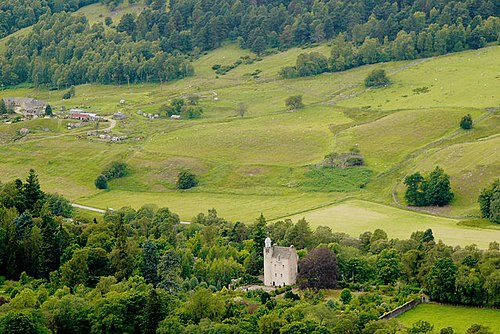
Palace · Scotland · Still standing
Balmoral Castle
Caisteal Bhaile Mhorail
Balmoral Castle is a large Scottish baronial estate house in Aberdeenshire that has served as a private residence of the British royal family. The present granite house was completed in 1856 and consists of two main blocks arranged around courtyards, with a prominent clock tower and turrets overlooking extensive lawns and managed grounds.
First raised
1390
Its prime
1856
Today
Still standing
As it stood in 1856
What Balmoral Castle looked like in its prime.
A pale grey granite baronial house of two main blocks around courtyards, with steep slate roofs, conical turrets and an 80-foot clock tower topped with crenellations and a flying flag. The long three-storey façade is punctuated by regular tall sash windows, chimneys and an arched stone entrance; sections of the frontage are clothed in green ivy. The building stands behind a broad, neatly mown forecourt lawn with wooded hills beyond, and a small green-domed turret rises near the tower.
Its story
The story of Balmoral Castle.
From Royal Hunting Ground to Farquharson Estate, 1390–1830
King Robert II of Scotland kept a hunting lodge in the area, and records show a house at Balmoral was built by Sir William Drummond in 1390. The estate was later tenanted by Alexander Gordon, second son of the 1st Earl of Huntly, whose family built a tower house there. In 1662 it passed to Charles Farquharson of Inverey, brother of John Farquharson, the "Black Colonel"; the Farquharsons were Jacobites, and James Farquharson of Balmoral, who fought in the 1715 and 1745 risings and was wounded at Falkirk in 1746, saw the estates forfeited.
James Duff, 2nd Earl Fife, acquired Balmoral in 1798 and leased out the castle. Sir Robert Gordon took the lease in 1830 and had architect John Smith add baronial extensions to the old building.
Victoria and Albert's Purchase, 1842–1852
Victoria and Albert first visited Scotland in 1842, returning in 1844 to Blair Castle and in 1847 to Ardverikie House on Loch Laggan; heavy rain there led the queen's doctor to recommend Deeside's drier climate instead. Sir Robert Gordon died in 1847 and his lease reverted to Lord Aberdeen; in February 1848 Albert arranged to take over the remaining lease, sight unseen. The couple arrived on 8 September 1848; Victoria recorded the house as "small but pretty" and found the hills reminiscent of Albert's native Thuringia.
The house soon proved too small. John and William Smith were commissioned that year to design new offices and cottages, while Albert, after seeing a corrugated-iron cottage at the Great Exhibition of 1851, ordered a prefabricated iron building as a temporary ballroom, in use by October 1851. The estate was bought outright from the Fife family in June 1852 for £32,000, with the neighbouring Birkhall estate and a lease on Abergeldie Castle.
Building William Smith's Castle, 1852–1857
William Smith, Aberdeen's city architect from 1852, was commissioned to design a new house; his rival William Burn complained to the prince that Smith had once plagiarised his work, without success. Albert amended the designs himself, taking a close interest in the turrets and windows. Building began in mid-1853 on a site north-west of the old castle, and Victoria laid the foundation stone on 28 September 1853.
By autumn 1855 the royal apartments were ready, though the tower was unfinished and servants still lodged in the old house; word of the fall of Sevastopol, ending the Crimean War, reached the estate that season. Built of granite quarried on the estate, the castle was completed in 1856, and the old castle later demolished. A Dee bridge designed by Isambard Kingdom Brunel linked Crathie and Balmoral by autumn 1857.
A Highland Retreat and Victoria's Widowhood, 1857–1901
The adoption of Scottish baronial style and Highland dress at Balmoral fed a wider revival of Highland culture; historian Michael Lynch has written that "the Scottishness of Balmoral helped to give the monarchy a truly British dimension for the first time." Albert oversaw new plantations and began a model dairy in 1861, the year he died; Victoria completed it and built memorials to him, including a cairn on Craig Lurachain in 1862 and a statue unveiled in 1867.
After Albert's death Victoria spent up to four months a year at Balmoral and grew close to her servant John Brown, a local ghillie from Crathie. Princess Beatrice's daughter Victoria Eugenie, later queen of Spain, was born there in 1887, and Victoria hosted Nicholas II and Alexandra of Russia in 1896. She made her last visit in 1900, three months before her death in January 1901.
Ownership Since Victoria and the Death of Elizabeth II
Balmoral is private property, not part of the Crown Estate, so its revenues do not pass to the public purse. Edward VIII inherited it, with Sandringham, on his 1936 accession and kept both after abdicating; George VI, his brother and successor, later bought them from him. Elizabeth II inherited Balmoral from her father, and after her death it passed to Charles III, run by trustees. It is a category A listed building, and its gardens have been open to the public each spring and summer since 1931; in 2024 parts of the interior opened to visitors for the first time since completion.
Elizabeth II had been at Balmoral since July 2022 for her summer holiday and was receiving medical care there when, because of concerns about her mobility, she appointed Liz Truss prime minister at the castle on 6 September rather than at Buckingham Palace, a break with tradition. She died there two days later, aged 96, the first monarch to die at Balmoral, and the first to die in Scotland since James V in 1542. Her coffin lay in the ballroom for three days before being taken to the Palace of Holyroodhouse on 11 September.
Step inside
9 places to explore in 1856.
The record describes 9 distinct spots at Balmoral Castle, including 2 interiors: royal apartments (main rooms in the southwestern block), service wings and northeastern courtyard. Create your own photoreal reconstruction and explore every one, more scenes means more photos, more angles and more of the immersive experience.
Build Your Own Castle
Recreate Balmoral Castle with AI to explore it.
The artist rebuilds it as it stood in 1856, a photoreal reconstruction that belongs to you alone. Pay with coins, no subscription needed.
Recreate Palace to Explore →Whose seat
Families who held Balmoral Castle.
The families tied to Balmoral Castle across its history, follow a name to its page.
Farquharson
Held the Balmoral estate and its original castle until their sale to Prince Albert in 1852.
Tenanted by Alexander Gordon, second son of the 1st Earl of Huntly; the Gordons built a tower house on the estate.
Nearby