Clan Leslie
Soldiers of fortune, Scots field-marshals across Europe.
- Origin
- Grampian & the North-East, Scotland
- Motto
- Grip fast
- Famous bearer
- Alexander Leslie, 1st Earl of Leven (c.1582–1661), Field Marshal
- Register
- Scottish clan
The Leslie arms, crest badge, tartan and country

Crest badgeClan member crest badge - Clan LeslieCeltus · CC BY-SA 3.0 
TartanLeslie tartanMicheletb · CC BY-SA 4.0 
TartanLeslie Hunting tartanThe hunting sett: the same pattern in muted browns and greens, worn in the field where the brighter colours would show.Micheletb · CC BY-SA 4.0 
Coat of armsArms of LeslieBorne by the Leslie line, one branch of the name rather than all of it.Sodacan · CC BY-SA 4.0 
Coat of armsArms of Leslie, Earl of RothesBorne by the Earl of Rothes: the ennobled line of the name, not the name at large.Sodacan · CC BY-SA 4.0


- Crest badge: The chief's crest inside a belt and buckle: the badge a clansman wears to show whose following he is in.
- Tartan: The checked cloth the family is known by.
- Coat of arms: Granted to an individual and inherited down that one documented line. These are the arms of particular families of the name, not of everyone who shares the surname.
What is the Leslie clan tartan?
Two Leslie setts are shown above, one of them the hunting sett, in muted browns and greens. They are not rival claims to be picked between; they are different records, and different weaves, of the same family cloth. A sett is the block of coloured bands the cloth is built from, repeated in both directions; the whole plaid is that one square enlarged.
Leslie is a north-eastern name, and Aberdeenshire and Moray sit across the Highland line (Gaelic up the straths, Scots along the coast), so the tartan story runs both ways at once. Highland dress was proscribed from 1746 until 1782, and when it returned it returned as ceremony rather than everyday cloth. The surname-to-sett map was fixed after that break, by the Bannockburn weavers’ pattern books, the royal visit to Edinburgh in 1822, and the Vestiarium Scoticum of 1842, and whether the Leslies wore tartan before it depended on which side of the line the branch farmed. Nobody polices any of it. Wearing the Leslie sett declares allegiance to the name, not descent from any particular line of it.
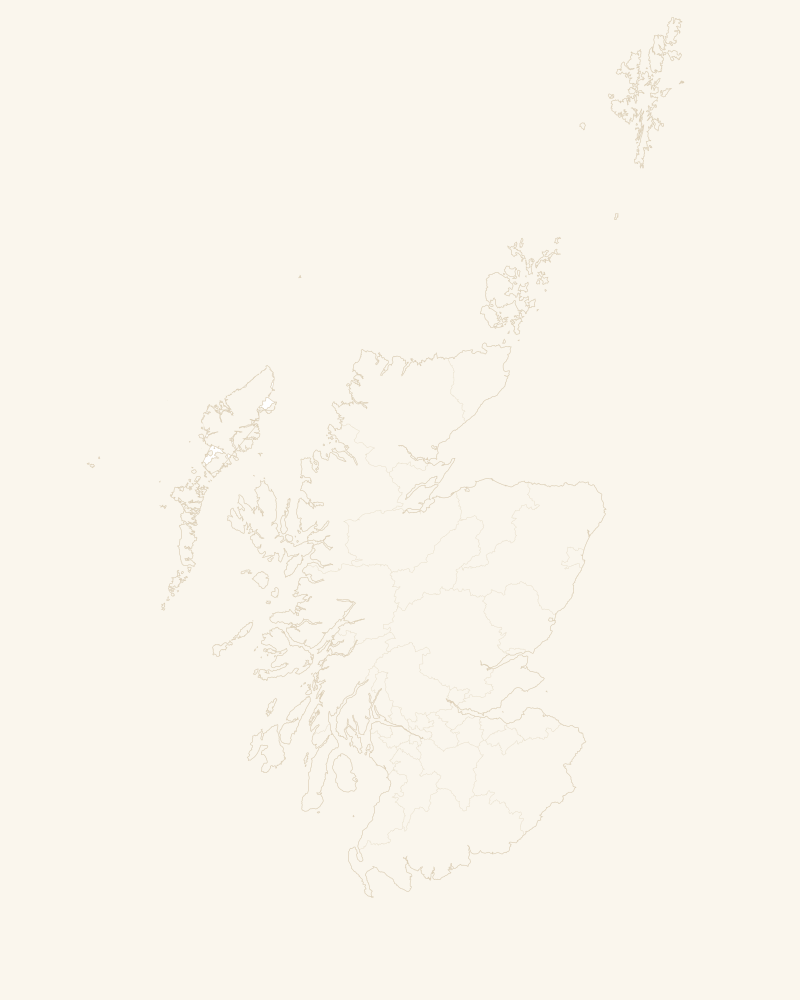
The seat of Clan Leslie
Seat vacantChief
No one leads the Clan Leslie community yet. When the movement opens, you can stand for its leadership, or help elect whoever does.
Current mission
No shared goal set yet. Once Clan Leslie has leadership, it sets the public focus: a restoration, a gathering, a real-world project that helps its own.
The Leslie clan is being rebuilt. Join the waiting list for the movement today, and you help decide who leads it and what it does.
Help rebuild the Leslie clan →Motto
Grip fast
What does the Leslie name mean?
From Leslie in Aberdeenshire, where the family was firmly established by the 12th century.
The history of Clan Leslie
Lesselyn in the Garioch, and the queen told to grip fast
The Leslies take their name from a place in Aberdeenshire, and the place took its name from the family's first castle. The tradition, written down long after the event, brings the progenitor Bartolf to Scotland in 1067, a nobleman out of Hungary travelling in the retinue of Edgar the Aetheling, brother of the Margaret who became queen to Malcolm III. Bartolf is said to have married Malcolm's sister, Princess Beatrix, to have been made governor of the royal castle of Edinburgh, and to have been granted estates in Fife, Angus, the Mearns and Aberdeenshire. He settled in the Garioch district of Aberdeenshire, at a place then called Lesselyn, and built his castle there. From Lesselyn came Leslie.
The same tradition explains the two words on the chief's arms. Bartolf, it is said, carried the queen across a dangerous river on horseback and told her to grip fast, and Grip Fast has been the family motto ever since. None of that can be documented, and it is best read as the story a family told about itself rather than as a charter. What can be documented is the form the name takes in the earliest record: not Leslie but De Lesselyn, the style borne by the men who held the constableship of Inverurie in the 12th and 13th centuries.
Constables of the Bass, and Bruce's men at Bannockburn
The family's first hard footing in the record is a castle mound. The Bass of Inverurie is what survives of the motte-and-bailey castle that served as the administrative centre of the Garioch in the 12th and 13th centuries, and the hereditary constables of it in that period were members of the De Lesselyn, or Leslie, family. The first Leslie in Aberdeenshire was Alexander, appointed constable of the Bass in 1080 on behalf of the king, his brother-in-law. The motte is a natural mound, scarped on its sides and ditched around them, and it still stands about 12 metres high; to the east the Little Bass, an oval mound roughly 30 by 23 metres, marks where the bailey was.
Nineteenth-century excavation on the motte turned up the remains of an oaken gangway, and medieval pottery has come out of the surrounding ditch, including fragments of a 14th-century face-mask jug. The earthworks now stand inside Inverurie Cemetery, protected as a scheduled monument. Bartolf's son Malcolm is recorded as constable of the royal castle of Inverurie, and Malcolm's great-grandson, Sir Norman Leslie, acquired the lands of Fythkill in Fife about 1282. Fythkill was renamed Leslie after its new owners, which is why the family has two homelands and two Leslies on the map of Scotland.
In the wars that followed the Leslies chose the winning side and were paid for it. They stood with Robert the Bruce, first against the Comyns in Buchan and then against Edward I, and were rewarded with further tracts of Aberdeenshire; they fought at Bannockburn in 1314. In 1320 Sir Andrew de Leslie put his name to the Declaration of Arbroath and was among those sent to the Pope in 1320 to assert that the Scots would never be subject to English rule. His grandson Walter died at the Battle of Harlaw in 1411, together with six of his cousins from Balquhain, seven men of one name lost in one battle.
The son who came home from the Crusades
The chiefship of the Leslies turned on a report from the Holy Land that proved to be wrong. In 1391 Sir Norman Leslie, believing his only son David had been killed on crusade, made over his estates to his cousin, Sir George Leslie. Sir George duly took possession of the castle and lands. Then in 1398 David came home, alive, and claimed his inheritance from a kinsman who was lawfully seised of it. The family settled the matter between themselves without bloodshed, which in late 14th-century Scotland was an achievement in itself, and the consequence was permanent: the chiefly line passed to the junior branch, and it is from Sir George that the Earls of Rothes descend.
That branch rose quickly. In 1445 Sir George's grandson, another George, was created a Lord of Parliament as Lord Leslie of Leven, and all his lands were united into the single barony of Ballinbreich. He was then advanced to an earldom, and the sources do not agree on the year: the family's own record gives 1447, while the surviving evidence establishes only that the title was in place at some point before 1458. Either way the outcome is the fixed point of everything that follows: from 1457 onward the chief of Clan Leslie has also been the Earl of Rothes, and the two dignities have travelled together ever since.
Flodden, a French marriage, and Queen Mary's bishop
The 16th century cost the house of Rothes dearly at the start and tested it politically at the end. The 2nd Earl of Rothes was killed at the Battle of Flodden in 1513, and his son was killed alongside him, father and heir lost in the same battle.
Later in the century the family was at the centre of the biggest constitutional question in Scotland. George Leslie, 4th Earl of Rothes, was one of the Scottish commissioners who went to France in 1558 for the marriage of Mary, Queen of Scots, to the Dauphin. The commissioners were asked to agree that the crown of Scotland be settled on the Dauphin, and Rothes was one of those who refused: a small clause in a marriage negotiation, and the whole of Scottish independence in miniature.
The most articulate Leslie of the age was a churchman. John Leslie, Bishop of Ross, was born in 1526 and became the most loyal of Queen Mary's supporters through the turbulent politics of 1562. He was also her historian: it was John Leslie who wrote for the queen the History of Scotland, the work that carries his name still.
Balquhain, Fetternear and the branches of the Garioch
While the chiefs went south and east into Fife, a second Leslie house stayed put and became the strongest family presence in the Garioch. The Leslies of Balquhain held their lands from 1340 and built their stronghold there in the 15th century, a plain rectangular tower measuring 13.75 by 8.75 metres, set inside a barmkin wall four kilometres west of Inverurie. It was sacked in 1526 during the family's feud with the Forbeses, a dispute serious enough that it was eventually settled by James VI together with the Earl of Huntly, and in March 1563 Queen Mary formally forgave William Leslie of Balquhain for his dealings with George Gordon, 4th Earl of Huntly.
In 1746 it was burned by the forces of Prince William, Duke of Cumberland, and abandoned; it stands today as a freestanding ruin in pasture beside woodland, protected as a scheduled monument.
The Balquhain Leslies also picked up one of the great ecclesiastical properties of the north east. Fetternear, near Kemnay on sloping ground above the Marshes Burn, was one of the palaces of the medieval bishops of Aberdeen, granted to Bishop Ralph; a tradition reported in 1522 by Hector Boece, first principal of the University of Aberdeen, has Bishop Alexander de Kininmund I keeping Easter at Old Aberdeen, summer at Fetternear, autumn at Old Rayne and Christmas at Mortlach. It was a Bishop Alexander Kininmund who drafted the Declaration of Arbroath in 1320. After the Protestant Reformation of 1560 the estate passed to the Leslies of Balquhain, who built a tower house on it in the 1560s.
Fetternear went to the Abercrombies in 1627 and later came back to the Leslies, who kept there the Fetternear Banner, a pre-Reformation banner of the fraternity of the Holy Blood. Around them sat the lesser Leslie houses of the same district: the Leslies of Wardes and of Warthill, Wardhill Castle at Meikle Wartle, which passed to the family in 1518 and is still owned by their descendants, Kininvie Manor House in the Spey Valley near Rothes, held since 1521 and originally part of the Balquhain estates, and Wardhouse, Leslie property in the 16th century before it went to the Gordons.
From Stralsund to Marston Moor: the field marshal of Balgonie
The greatest soldier the name produced began with nothing to inherit. Alexander Leslie was born about 1582 in Fife, by tradition at Balgonie, the son of George Leslie, a captain in the Leslie family, and a mother of humble station, and he made his own way with a sword. Like many Scots of his generation he took service with the Protestant powers of northern Europe, and by the 1600s he was in the pay of Sweden under Gustavus Adolphus, the greatest captain of the age. He rose through every grade on campaign by merit, learned the disciplined, mobile, hard-hitting Swedish way of war from the inside, and won the king's confidence over some thirty years of service.
His most famous feat in Swedish service was the defence of Stralsund on the Baltic in 1628, when he held the city against the army of Wallenstein, the Emperor's great general, and kept the port out of imperial hands at a turning point in the northern war. Gustavus made him a field marshal, the highest rank in the Swedish army and an extraordinary honour for a foreign soldier of common birth. When he came home in the late 1630s he brought back a fortune, a European reputation, a cadre of veteran Scots officers and the most modern military knowledge in Europe. In 1635 he bought Balgonie Castle on the south bank of the River Leven in Fife, a place with a 14th-century keep built by the Sibbalds and extended in 1496 by Sir Robert Lundie, and he improved and extended it further.
He came home at the moment his country needed him. When Scotland rose in defence of its Presbyterian Church against the religious policy of Charles I, Leslie was the obvious man to command. With General Robert Monro he took Edinburgh Castle with a thousand men, and in the campaigns of 1639 and 1640 he organised and led the Scottish army so quickly and so competently that he secured the Scottish position almost without bloodshed, beating the king's soldiers at Newburn in 1640, occupying Newcastle and bringing Charles to terms. He was created Lord Balgonie and Earl of Leven in 1641, and in 1642 he took a command in Ireland alongside Robert Munro.
When the Scots allied with the English Parliament he led an army south, and on 2 July 1644, on Marston Moor outside York, the combined Scottish and English forces met the main royalist field army under Prince Rupert and the Marquess of Newcastle in the largest battle ever fought on English soil. It was a hard, confused fight in the failing light of a summer evening, and at one point the royalist cavalry broke part of the allied line; but the discipline Leslie and his colleagues had built held the army together, the cavalry of the left turned the royalist flank, and by nightfall the king's northern army was destroyed. Marston Moor cost Charles the whole of the north of England. Leven served on as the senior soldier of the Scottish nation and died at Balgonie on 4 April 1661, full of years and honours.
Newark, Ptuj and Smolensk: the Leslies in the wars of Europe
The other great Leslie commander of the century was David Leslie, later 1st Lord Newark (c.1601–1682). In 1645 he destroyed the royalist army of James Graham, 1st Marquess of Montrose, at Philiphaugh, a victory that restored the authority of the Committee of Estates in Scotland, and in 1650 he beat Montrose again at Carbisdale. In 1649 he bought Newark Castle on its rocky promontory west of St Monans on the Fife coast, a 15th-century house begun by the Kinlochs, from the Sandilands of Cruivie. Defeat by Cromwell at Dunbar in 1650 and at Worcester in 1651 ended his campaigning and he was held in the Tower of London until the Restoration; he was then created Lord Newark, and he kept his castle above the North Sea until his death in 1682.
Other men of the name never came home at all, and did just as well. Walter Leslie made his whole career on the Continent, rising in the Thirty Years War to field marshal in the imperial service and to the rank of imperial count. In 1656 the Jesuits of Zagreb, pressed by financial hardship, sold him Ptuj Castle, a 12th-century fortress on a hill above the Drava in what is now north eastern Slovenia, and he turned it into a rural residence and the seat of a landed estate. His descendants held Ptuj until 1802, when it passed to their relatives the Dietrichsteins; it is a regional museum today.
Further east again, Sir Alexander Leslie of Auchintool served as a general in the Russian army and was Governor of Smolensk. At home the chiefly line reached its own highest point: John Leslie, 7th Earl of Rothes, disputed the earldom of Leven after 1664 and brought in John Mylne junior, the king's master mason, to build a grand stair at Balgonie where a wooden bridge had linked the keep to the north range. In 1680 he became Lord Chancellor of Scotland and was created Duke of Rothes by Charles II.
Sheriffmuir to the guesthouse door: the seats that survived
In the next century the chiefs served the state rather than fought it. John Hamilton-Leslie, 9th Earl of Rothes, was Vice Admiral of Scotland and governor of the royal castle of Stirling, and in the Jacobite rising of 1715 he supported the British government and commanded a regiment of cavalry at the Battle of Sheriffmuir. He sold much of the clan estate, but Leslie House in Fife remained the seat of the chiefly earls into the 20th century; a fire there in 1919 destroyed most of the house and its contents.
A surprising number of the family's buildings are still standing and still in use. Leslie Castle in Aberdeenshire, just west of Auchleven, is the historical seat of the clan: the present L-plan tower house of about 1661, a tall square block with three-storey wings, corbelled round angle turrets and a garret, stands on the site of the earlier fortification. Restored in the late 20th century, it hosted a Leslie clan gathering in 1995, and since 2018 it has run as a guesthouse under the current Baron of Leslie, John Andrea. Balgonie, which passed out of the family and was bought by James Balfour of Whittingehame in 1824, was badly used in the 1960s but has been under restoration since 1971; the keep and chapel are fully restored and lived in again.
Lickleyhead Castle at Auchleven, an L-plan tower house of around 1600 on the Gadie Burn, began as Leslie ground before the estate went to the Leith family in the 13th century and came back to the name in the 20th, by marriage, to the Arbuthnot-Leslies; the actress Rose Leslie spent part of her childhood there. In Ireland, Castle Leslie in County Monaghan, built in the 17th century, and its estate of a thousand acres remain a Leslie residence and are run as a guest house, spa and cookery school; in 2002 the family church beside it was the setting for the wedding of Paul McCartney.
The chiefship, meanwhile, stayed with the junior branch, and the present Earl of Rothes descends from Sir George. The 22nd Earl of Rothes, James Malcolm David Leslie, was born in 1958, and the chief of Clan Leslie is currently his brother, the Hon. Alexander Leslie. Long after a stranger built a castle at a place called Lesselyn, the family still answers to the two words it says he spoke on a riverbank, and the reader who carries the name inherits both the Garioch mound and the field marshal's baton.
Champions of the Leslie name
The bearers whose lives are inseparable from this surname. Each has their own page, biography, achievements, geography, connection to the family.
Castles the Leslie held
Strongholds this name held for a decade or more, look one up, or rebuild it to explore.
- Lickleyhead Castle
Originally the estate of Clan Leslie before passing to William Leith in the 13th century.
- Balgonie Castle
Bought by Sir Alexander Leslie in 1635; created Lord Balgonie and Earl of Leven in 1641.
- Leslie Castle
Historical seat of Clan Leslie; the present tower house built around 1661.
- Balquhain Castle
Stronghold of the Leslies of Balquhain, on lands held by the family from 1340; burned in 1746 and abandoned.
- Ptuj Castle
Bought in 1656 by Field Marshal Walter Leslie, a Scot by birth; his descendants held it until 1802.
- The Bass and Little Bass, motte-and-bailey castle
The De Lesselyn (Leslie) family were hereditary constables of the castle of Inverurie in the 12th and 13th centuries.
- Newark Castle
Held by David Leslie, Lord Newark, from 1649 until his death in 1682.
- Fetternear Palace
The Leslies of Balquhain obtained the Fetternear estate after the Reformation of 1560.
Castles that share the Leslie name
The same name on the map, look one up, see what it looked like in its prime, and recreate it to explore.

All castles in Scotland → · Strongest castles in Scotland → · Castles of Europe
Play As Your Clan
Hold a real castle against whatever you choose to send at it, take a ship out in her own service years, or stand at the shoulder of someone the record remembers. The chronicler sets the scene; the deeds are yours.
Notable bearers of the Leslie name
- Alexander Leslie, 1st Earl of Leven (c.1582–1661), Field Marshal
- David Leslie, 1st Lord Newark (c.1601–1682), Covenanting general