Mitchell
Of Michael, the diminutive that became its own surname in north-east Scotland.
- Origin
- Grampian & the North-East, Scotland
- Motto
- Be traist
- Famous bearer
- Stephen Mitchell (1789–1874), founder, by bequest, of the Mitchell Library
- Register
- Scottish family
The Mitchell arms and country

Coat of armsArms of MitchellNewm30 · CC BY-SA 4.0 
Coat of armsArms of Mitchell (alternate)Newm30 · CC BY-SA 4.0

.svg)
- Coat of arms: Granted to an individual and inherited down that one documented line. These are the arms of particular families of the name, not of everyone who shares the surname.
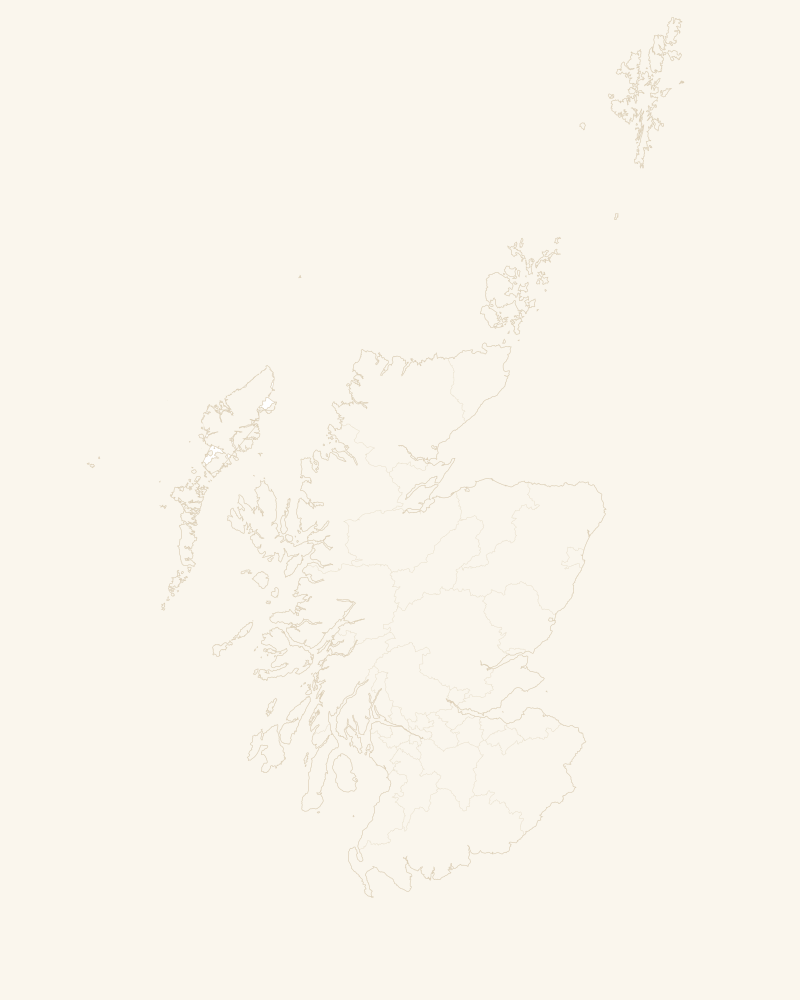
CoreHistoric reach
The seat of Mitchell
Seat vacantChief
No one leads the Mitchell community yet. When the movement opens, you can stand for its leadership, or help elect whoever does.
Current mission
No shared goal set yet. Once Mitchell has leadership, it sets the public focus: a restoration, a gathering, a real-world project that helps its own.
The Mitchell clan is being rebuilt. Join the waiting list for the movement today, and you help decide who leads it and what it does.
Help rebuild the Mitchell clan →Motto
Be traist
“Be trustworthy”
What does the Mitchell name mean?
From Michael, the archangel. The Scots and northern English diminutive Mitch took up surname duty by the 14th century, the patronymic 'son of Mitch' contracting to Mitchell rather than the longer Michelson. Densest in the north-east, where the Michael cult was particularly strong through the medieval church.
The history of Mitchell
Michael, the archangel whose name went everywhere
Mitchell does not begin as a place, a trade or a piece of land. It begins as a first name, and one of the very biggest: Michael, from a Hebrew name meaning "Who is like God?", carried across Europe by the church and reaching Scotland and England through Latin and then through the Old French and Norman French form Michel. It is that Norman-French shape, rather than the Latin one, that stands directly behind the modern surname.
Saints' names spread because the church spread. In Gaelic Scotland the oldest layer of personal names was descriptive or heroic (Fionn, "fair, bright"; Art, "bear"), and those compounds had largely stopped being productive by the end of the Old Irish period. What kept going, reinforced after Christianisation, was the coining of ecclesiastical names, alongside borrowings from Latin such as Pàdraig from Patricius. The pressure that put Patrick into every parish put Michael there too.
The archangel's cult was particularly strong through the medieval church in the Scottish north-east, and that is exactly where the surname is densest today: Aberdeenshire, Banffshire and Angus. A name is not evenly distributed by accident. It is thick where the devotion that produced it was thick.
Mitch: the pet form that grew up into a surname
A man was not called by his baptismal name in the street. He was called by the worn-down version his neighbours used, and in Scots and northern English that version of Michel was Mitch. The same clipping gave Will from William and Wat from Walter, and it is the clipped form, not the churchly one, that took up surname duty by the 14th century. Older records preserve the working alternatives (Michell, Mitcham) before the spelling settled.
The crucial turn is what happened next. "Son of Mitch" contracted straight to Mitchell rather than lengthening into Michelson, so the surname keeps the shape of a nickname rather than the shape of a formal patronymic. One given name can throw off a whole family of surnames this way: there are thought to be over ninety Italian surnames built on Giovanni alone. Mitchell is the short, spoken, everyday branch of the Michael tree.
Nicknaming of this kind was not casual, it was the identification system. In Gaelic-speaking districts a far-ainm recorded a physical feature, a job or an incident: Calum na Coise, "Calum of the leg", or Ailean Còcaire, "Alan the cook", employed at one time as cook at Ormacleit Castle. Such names did the work documents do now, and when documents arrived they wrote down the nickname.
Three roads that end at the same spelling
The standard authorities give Mitchell and Mitchel three separate etymological origins, and they are honest that a spelling cannot tell you which one you carry. The first, and the one behind the Scottish north-eastern name, is the Michel–Michael route above. The second is quite different: the Middle English words michel, mechel and muchel, meaning "big", so that some Mitchells descend from a large man rather than from a saint's name at all.
The third road runs through Ireland, where the surname was adopted as an English-language equivalent of Mulvihill, from the Irish Ó Maoilmhichíl, "descendant of the devotee of St Michael", a name that arrives at the same modern spelling from the far side of the Irish Sea, and loops back to the archangel by another path entirely. Two families spelling themselves identically, one in Angus and one in the west of Ireland, may share no ancestor and no root word.
Multiple origins are normal rather than a defect: De Luca may come from Lucania, from an ancestor named Lucas or Lucius, or from the city of Lucca. Where the sources disagree the honest answer is that Mitchell has several origins, and only a documented descent can say which is yours.
The century the name stopped changing
For most of the Middle Ages a byname described you and died with you; your son was described afresh. Surnames are documented among the barons in England in the 11th century, and their introduction is generally credited to the preparation of the Domesday Book in 1086 after the Norman Conquest. The earliest adopters were the nobility and gentry, some incoming Normans marking themselves out by putting de before the name of their village or estate in France. From there the habit worked slowly down through society.
By the 14th century most English and most Scottish people used surnames, and by 1400 most English families and those of Lowland Scotland had made them hereditary. Wales did not follow until unification under Henry VIII in 1536. The change was not universally welcome (in late medieval England compulsory surnames were resisted because people associated them with taxation), and Henry VIII, who reigned from 1509 to 1547, ordered that marital births be recorded under the father's surname.
Elsewhere in Europe the freeze came by decree and can be dated: Frederik I of Denmark-Norway ordered noble families to take fixed surnames in 1526, and the Netherlands took fixed family names between 1795 and 1811. Britain had no single such act. Mitchell froze earlier and more quietly, in charters, rentals and parish books, and it belongs to the oldest and commonest class of surname there is. A study led by the University of the West of England, published in 2016, examined 45,602 surnames of the British Isles and found over 90 per cent native to Britain and Ireland.
Why there is no Clan Mitchell, and why that costs you nothing
Mitchells who turn up at Highland games are often handed a tartan and told they are a sept of some larger clan. A sept, properly, is a family that followed another family's chief while holding a different surname, sometimes through marriage, sometimes simply because they lived on a powerful laird's land and followed him whether they were kin or not, with bonds of manrent tying lesser kin groups to greater ones.
The lists themselves, though, are largely Victorian commerce. They date from the 19th century, when clan societies and tartan manufacturers drew up rolls linking as many surnames as possible to a clan regardless of whether any historical connection existed, so that people without a "clan name" could feel entitled to a tartan. Miller and Millar were made a sept of Clan MacFarlane, Taylor of Clan Cameron, Mason of Clan Sinclair. There is no official list of septs, the same sept name is claimed by more than one clan, and each clan decides the question for itself.
The Highland-versus-Lowland split is a 19th-century convention too. An Act of the Scottish Parliament of 1587 speaks of the "cheiffis and chiftanes of all clannis, alsweill on the hielandis as on the bordouris", chiefs and chieftains of all clans, in the Highlands as on the Borders. What confers standing in Scots law is not geography but a chief recognised by the Court of the Lord Lyon. A name without one is not a lesser name; it is a name that never had a court case about it. Mitchell stands on its bearers instead.
The north-east, and the Glasgow snuff man who bought a library
Mitchell is among the more common Scottish surnames and its bias is unmistakably north-eastern (Aberdeenshire, Banffshire, Angus) with the name also long established in Moray, Dundee, Fife, Edinburgh, Lanarkshire and Ayrshire. As of 2014 it was carried by roughly one Scot in 261.
The best monument any Mitchell ever left stands in Glasgow. Stephen Mitchell (1789–1874) made his money manufacturing tobacco and snuff, and his bequest of 1874 founded the Mitchell Library, which grew into the largest public reference library in Europe. It is a particular kind of legacy: a trade fortune turned into free books for anyone who walks in off the street, still doing that job a century and a half later.
Around him stand bearers documented across Scottish and Irish public life: David Mitchel (c. 1591–1663), a Scottish bishop; Mitford Mitchell (1843–1914), a minister; Sydney Mitchell (1856–1930), an architect; Jane Mitchel (c. 1820–1899), the Irish nationalist; Hannah Mitchell (1872–1956), the English suffragette and socialist; and Colin Campbell Mitchell (1925–1996), soldier and politician. General Sir Philip Mitchell (1890–1964) was Governor of Kenya from 1944 to 1952, holding the colony through the years immediately preceding the Mau Mau emergency.
K5054: the Mitchell who drew the Spitfire
R. J. Mitchell (1895–1937) was a Staffordshire schoolmaster's son who joined Supermarine at Southampton in 1916. Between 1922 and 1931 he designed the four Schneider Trophy winners, the fastest racing seaplanes of their day, and turned what they taught him into something else entirely.
On his own initiative, and while dying of pancreatic cancer, he designed the prototype that flew as K5054, the aeroplane that went into production as the Spitfire and came off the floors at Castle Bromwich in 1940 to save the country. He did not live to see it. Of all the things the name Mitchell has been attached to, that is the one a reader in Ohio or Dunedin is most likely to have watched fly.
Where the Mitchells went
The name is now overwhelmingly a diaspora name. As of 2014, 65.5 per cent of all bearers of Mitchell lived in the United States, 12.0 per cent in England, 5.6 per cent in Australia and 5.1 per cent in Canada, against 2.8 per cent in Scotland itself. Those proportions are the shape of emigration: the tacksmen and tenants who left through the clearances, and the long departure that followed and ran on, with a pause for the First World War, until the Great Depression.
Those who left kept the name working. Maria Mitchell (1818–1889) was an American astronomer; Margaret Mitchell (1900–1949) wrote Gone with the Wind; Edgar Mitchell (1930–2016) flew as an American astronaut; W. O. Mitchell (1914–1998) became a Canadian writer of the first rank; Roma Mitchell (1913–2000) became an Australian judge; and Joni Mitchell, born in Saskatchewan in 1943 into a Mitchell line of Norwegian and Scots origin, made the Canadian prairie into songs the whole world learned.
For a surname with no castle, no chief and no charter, that is a considerable account. Mitchell was never the name of a lordship. It was the name of the man everyone called Mitch, in a corner of Scotland where the archangel Michael was loved, and it has been carried by ministers, suffragettes, novelists, astronomers, a library's founder and the designer of the Spitfire. The motto attached to it asks one thing only, and it is the right thing to ask of a name like this: Be traist: be trustworthy.
Champions of the Mitchell name
The bearers whose lives are inseparable from this surname. Each has their own page, biography, achievements, geography, connection to the family.
Historic Places, Rebuilt
Explore the streets and seats the Mitchell name knew, rebuilt with AI as they stood in history.
Historic Places, Rebuilt · New
The castle on its crag, St Giles' crown spire, and the closes tumbling to the Cowgate.
Historic Places, Rebuilt · New
Scotland's ecclesiastical capital at its peak, the great cathedral, the bishop's castle on the sea, and the new university.
The castles of the homeland
The great strongholds of the homeland, look one up, see what it looked like in its prime, and recreate it to explore.
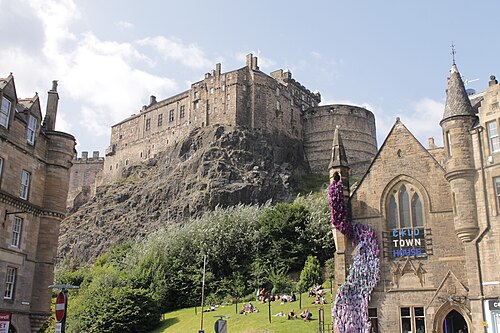 Edinburgh CastleRestored · prime 1520
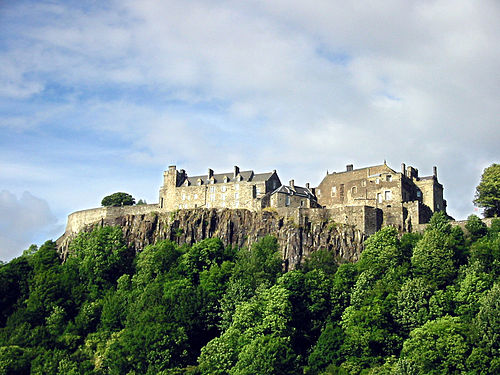 Stirling CastleRestored · prime 1542
 Glamis CastleStill standing · prime 1900
All castles in Scotland → · Strongest castles in Scotland → · Castles of Europe
Play As Your Clan
Hold a real castle against whatever you choose to send at it, take a ship out in her own service years, or stand at the shoulder of someone the record remembers. The chronicler sets the scene; the deeds are yours.
Notable bearers of the Mitchell name
- Stephen Mitchell (1789–1874), founder, by bequest, of the Mitchell Library
- Joni Mitchell (b. 1943), singer-songwriter
- Sir Philip Mitchell (1890–1964), colonial governor
- R. J. Mitchell (1895–1937), aircraft designer of the Spitfire