Scotland · Ruin
Linlithgow Palace
Lùchairt Ghlinn Iucha
Linlithgow Palace is a late medieval royal palace in Linlithgow, West Lothian, Scotland. It was a principal residence of Scottish monarchs in the 15th and 16th centuries and the birthplace of Mary, Queen of Scots; the building was burned out in 1746 and remains today as substantial roofless ruins cared for as a visitor site.
Its prime
1542
Today
Ruin
As it stood in 1542
What Linlithgow Palace looked like in its prime.
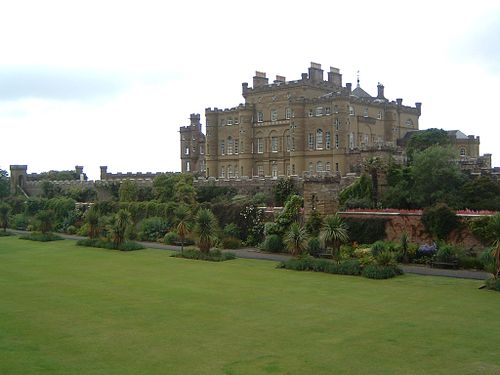
A broad rectangular courtyard palace of warm-brown sandstone forming a four-sided range of three to four storeys, with a taller projecting tower at one corner and crenellated parapets with continuous wallwalks; many mullioned windows face a central paved court and the south façade overlooks Linlithgow Loch. At its prime the roofs and chimneys were intact, the outer gatehouse and courtyard fountain stood in the forecourt, and painted stonework adorned parts of the courtyard.
Its story
The story of Linlithgow Palace.
The English Peel, 1301–1313
A royal manor stood on the site from the 12th century. In 1301–2 the occupying English forces of Edward I enclosed it with a timber palisade and an outer fosse to make the fortification known as the Peel, a base well placed to secure the supply routes between Edinburgh Castle and Stirling Castle. The fort was begun in March 1302 under two priests, Richard de Wynepol and Henry de Graundeston, to designs by Master James of St George, who was present himself. In September 1302 sixty men and 140 women were digging the ditches, the men paid twopence and the women a penny a day. The parish church beside it served as a storeroom during the occupation.
The Peel was retaken for Scotland in September 1313 by a Scot named William Bunnock, who was in the habit of selling hay to the garrison. When the gate was opened for him he halted his wagon so that it could not be closed, and he and his seven sons leapt out from their hiding place under the hay and captured the place for Robert the Bruce. The king sent reinforcements and then had the Peel dismantled so that the English could not take it again; it was repaired once more in January 1360, 'for the king's coming', when David II visited.
From the Fire of 1424 to the Birth of James V
In 1424 a great fire partly destroyed the town of Linlithgow. James I began rebuilding the palace as a grand residence for Scottish royalty, and the church of St Michael immediately to the south with it. What he set out to build was a palace rather than a heavily fortified castle, perhaps with Sheen Palace in mind, which he had probably seen in England. Matthew the Painter decorated the royal apartments in 1433, Mary of Guelders made improvements in 1461 for the visit of the exiled Henry VI of England, and over the following century the buildings grew into a formal courtyard, with substantial additions by James III and James IV.
On 31 May 1503 the palace was given to Margaret Tudor, bride of James IV, and became her favourite home in Scotland. The future James V was born there in April 1512. When the English diplomat Nicholas West saw the baby prince in April 1513, he wrote that 'verily, he is a right fair child, and a large of his age'.
James V's Fountain and the Coming of Mary of Guise
James V added the outer gateway and the elaborate courtyard fountain, and in the 1530s his keeper, James Hamilton of Finnart, renewed and unified the stonework of the south façade. Timber imported from Denmark-Norway was shipped to Blackness Castle and carted up to the palace. Finnart was then given 400 French gold crowns to make the palace ready for Mary of Guise, who stayed in March 1539. At Epiphany the court watched an interlude in the great hall that was an early version of David Lyndsay's A Satire of the Three Estates; Mary of Guise left for Edinburgh on 3 February and was crowned soon afterwards.
The Infant Queen and the Armed Factions of 1543
Mary, Queen of Scots was born at Linlithgow in December 1542 and lived there for a time, kept with her mother and, as Viscount Lisle heard in January 1543, 'nursed in her own chamber' with five cradle rockers. When the English ambassador Ralph Sadler rode from Edinburgh in March to see her, Mary of Guise showed him the child out of her swaddling, and Sadler wrote that she was 'as goodly a child I have seen, and like to live'.
Possession of the child was the whole politics of that summer. Regent Arran, fearing that Cardinal Beaton and his other enemies would seize her, came in July with Archibald Douglas, 6th Earl of Angus and brought his artillery, and considered moving her to the stronger fortress of Blackness; Henry VIII hoped instead to see her separated from her mother and taken to Tantallon. Mary was teething, and the plans were delayed. Supporters of the Auld Alliance signed the Secret Bond at Linlithgow, pledging to prevent her marriage to Prince Edward, and after long negotiation between the armed factions she was carried to Stirling Castle by her mother on 26 July 1543, escorted by Lennox and a force described as a great army.
Collapse, Rebuilding and the Fire of 1746
In the wars that followed Mary's abdication the palace held a garrison again: Captain Andrew Lambie and his lieutenant John Spreul kept an armed guard of 28 men of war, an iron yett was brought from Blackness Castle in 1571, and the church steeple was fortified with timber. James VI held a parliament in the great hall in December 1585 because of plague in Edinburgh (the first gathering of the whole nobility in the palace since his grandfather's reign), and later gave the lands and the palace to Anne of Denmark as a morning gift; on 14 May 1590 the Admiral of Denmark, Peder Munk, rode over from Niddry Castle and took symbolic possession by accepting a handful of earth and stone.
After the Union of the Crowns in 1603 the court was largely in England and Linlithgow was barely used. The north range, called ruinous in 1599, came down at four in the morning on 6 September 1607; the Earl of Linlithgow wrote to the king that 'the north quarter of your Majesties Palice of Linlithgw is fallin, rufe and all, within the wallis, to the ground'. James had it rebuilt between 1618 and 1622, with carving designed by the mason William Wallace and three thousand stones' weight of lead for the new roof, costing £3,600 Scots, sent from Leadhills in Lanarkshire. He planned to come north in 1622 but never returned.
Only one reigning monarch stayed after that: Charles I, for a single night in 1633, for which the burgh council forbade the wearing of plaids and blue bonnets as indecent. An English visitor in October 1641 found the roof of the great hall already gone and the fountain vandalised by those who objected to its motto, 'God Save the King'. The palace was described as ruinous again in 1668. Its last royal occasion came in September 1745, when Charles Edward Stuart passed through Linlithgow on his march south without staying the night, and the fountain is said to have been made to run with wine in his honour. On the night of 31 January to 1 February 1746 the Duke of Cumberland's army destroyed most of the buildings by fire, started accidentally by lamps left on straw bedding. The ruin passed to the Commissioners of Woods and Forests in 1832 and to the Office of Works in 1874, and was consolidated in the 1930s and 1940s.
Step inside
9 places to explore in 1542.
The record describes 9 distinct spots at Linlithgow Palace, including 4 interiors: great hall (interior), st michael's chapel (quire), king's kitchen (north end) and more. Create your own photoreal reconstruction and explore every one, more scenes means more rooms, more angles, and more of the place to stand in.
Build Your Own Castle
Recreate Linlithgow Palace with AI to explore it.
The artist rebuilds it as it stood in 1542, a photoreal reconstruction that belongs to you alone. Pay with coins, no subscription needed.
Recreate this castle →Defend this castle →Nearby