Scotland · Ruin
Roxburgh Castle
Roxburgh Castle is a ruined royal castle that stood on a mound overlooking the junction of the Rivers Tweed and Teviot in the Scottish Borders. Founded by the twelfth century and repeatedly contested between Scotland and England, it was demolished by the Scots after its capture in 1460; today only a large mound and small fragments of stone wall remain within the grounds of Floors Castle.
Its prime
1417
Today
Ruin
As it stood in 1417
What Roxburgh Castle looked like in its prime.
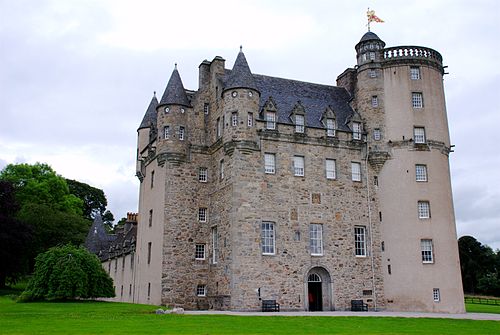
Perched on a raised grassy mound at the junction of the Rivers Tweed and Teviot, Roxburgh Castle in its prime presented as a compact medieval stone fortress: a continuous pale grey rubble-stone curtain forming a high enclosed perimeter atop the mound with defensive parapets and an entrance facing the river approaches. The site commands the river bend and surrounding floodplain; today only low fragments of masonry survive, especially on the south side.
Its story
The story of Roxburgh Castle.
A Royal Fortress at the Meeting of Tweed and Teviot
Roxburgh Castle stood on a mound above the junction of the rivers Tweed and Teviot, with the royal burgh of Roxburgh growing up beside it. Tradition credits King David I with founding the castle, which is first recorded around 1128, during his reign. In 1174 it was surrendered to England after the capture of William I at Alnwick, and it was often in English hands thereafter, the Scots making many attempts to win it back. Edward I of England kept Mary Bruce imprisoned in a cage hung outside the castle from 1306 to 1310.
The Black Douglas's Night Attack, 1314
On 19 February 1314 Sir James Douglas, the "Black Douglas", retook the castle in a night attack. His men, clothed in black cloaks, were apparently mistaken for cattle in the darkness, then climbed the walls on ladders of rope and board. Robert the Bruce ordered the castle demolished by his brother Edward Bruce, Earl of Carrick: in the words of the Lanercost Chronicle, "all that beautiful castle the Scots pulled down to the ground, like the other castles that they had succeeded in capturing, lest the English should ever again rule the land by holding the castles." The capture later became one of the inspirations for James Hogg's The Three Perils of Man.
Edward III's forces took the castle in 1334. Alexander Ramsay recaptured it for the Scots on 30 March 1342 by a daring night escalade, but the English retook it shortly after the Battle of Neville's Cross in October 1346, and a Scottish siege in 1417 necessitated repairs.
Two Kings Before the Walls: 1436 and 1460
In August 1436 James I of Scotland gathered a huge army against Roxburgh, sporting "fine, large guns, both cannons and mortars" manned by German crews under Johannes Paule, "Master of the King's engines". Alexander of Islay, Earl of Ross, brought 3,000 Highlanders, Islesmen and archers, alongside Lowland men-at-arms under Archibald, Earl of Douglas, and his distant kinsman and rival William, Earl of Angus, head of the Red Douglases of Tantallon. Then the Queen arrived with a warning that princes of the realm were conspiring to kill the king. With the Archbishop of York, the Bishop of Durham and the Earls of Northumberland arriving with a force of northerners, James left the field; his army dispersed, abandoning his expensive German equipment.
The Scots besieged Roxburgh again in 1460, and this time the guns turned on their own king: James II of Scotland was killed by metal fragments when one of his bombards exploded. The Scots stormed and captured the castle nonetheless, and James's queen, Mary of Guelders, had it demolished; the burgh of Roxburgh was destroyed along with it.
Hertford's Fort and the Treaty of Boulogne, 1550
In 1545, during the War of the Rough Wooing, an English garrison commanded by Ralph Bulmer built a rectangular fort on the site at the instigation of the Earl of Hertford. In 1547 Hertford ordered the surveyor William Ridgeway and the master carpenter John Revell to add a brewhouse, using a frame made for Wark Castle; Bulmer complained that Ridgeway's visits were infrequent and the works incomplete, and wanted to build a blacksmith's forge and a bulwark to the south to secure access to drinking water. The fort was destroyed in 1550 under the terms of the Treaty of Boulogne.
Step inside
6 places to explore in 1417.
The record describes 6 distinct spots at Roxburgh Castle, including the full exterior approach. Create your own photoreal reconstruction and explore every one, more scenes means more rooms, more angles, and more of the place to stand in.
Build Your Own Castle
Recreate Roxburgh Castle with AI to explore it.
The artist rebuilds it as it stood in 1417, a photoreal reconstruction that belongs to you alone. Pay with coins, no subscription needed.
Recreate this castle →Defend this castle →