
Scotland · Restored
Saddell Castle
Saddell Castle is a 16th-century stone castle on the shore of the Kilbrannan Sound near Saddell in Kintyre, Argyll and Bute, Scotland. Built c.1508–1512 from reused abbey and earlier castle stone, it served as a seat of the MacDonald family and was later restored by the Landmark Trust for holiday letting.
Its prime
1512
Today
Restored
As it stood in 1512
What Saddell Castle looked like in its prime.
A compact early 16th-century stone tower-house and ancillary ranges set directly on the rocky shore of Kilbrannan Sound, built of pale, weathered masonry partly reclaimed from Saddell Abbey. The castle is enclosed by a low defensive curtain wall defining a small paved courtyard, with a pronounced entrance passage through the wall. Narrow slit windows and modest rectangular openings puncture thick walls; rooflines are simple pitched ranges over the tower and service blocks. A subterranean dungeon is reached from the entrance passage.
Its story
The story of Saddell Castle.
Somerled's Shore and the Bruce at Saddell
A castle stood on the shore of the Kilbrannan Sound at Saddell in Somerled's time, in the 12th century, and the site served as a bastion of the MacDonald family for several centuries. Among the MacDonald lords who resided there was Alasdair Mor MacDonald, younger brother of Angus Mor MacDonald, Lord of the Isles, in the 13th century. In the early 14th century, during the First War of Scottish Independence, Angus Og MacDonald gave refuge at Saddell to Robert the Bruce before taking him on to Dunaverty Castle on the Mull of Kintyre.
Bishop Hamilton's Tower and the Burning of 1558
The castle standing today was built between 1508 and 1512 by David Hamilton, Bishop of Argyll, from the stones of the ruined castle and of Saddell Abbey. In 1556 Bishop James Hamilton gave it to James Hamilton, 2nd Earl of Arran, as payment for debts and taxes. Arran was later forced to exchange it with James MacDonald, chief of Clan MacDonald of Dunnyveg, for James's lands on the Isle of Arran, and the tower became one of several ancestral homes of the MacDonald family in Scotland.
In October 1558 an English force led by Thomas Radclyffe, 3rd Earl of Sussex, Lord Deputy of Ireland, captured and burnt Saddell under orders from Queen Mary I of England, in retaliation for James MacDonald's involvement in Ireland against the English Crown.
MacDonald Lairds, the 1607 Conveyance to Argyll, and Decay by 1774
Successive MacDonald lairds rebuilt and enlarged the castle. A trap door in the main entrance passage sent unwanted visitors into a dungeon with no exits. In 1607 King James VI conveyed the Clan Donald lands in Kintyre, Saddell among them, to Archibald Campbell, 7th Earl of Argyll. The castle fell into disrepair when Saddell House was built around 1774.
The Landmark Trust and the Clan Donald Pilgrimage
The castle was bought and restored by the Landmark Trust, which lets it as a self-catering property, and it has been a category A listed building since 20 July 1971. Members of Clan Donald continue to make pilgrimages to Saddell every year, in memory of its place in Scottish history.
Step inside
6 places to explore in 1512.
The record describes 6 distinct spots at Saddell Castle, including 2 interiors: main entrance passage and gate, subterranean dungeon. Create your own photoreal reconstruction and explore every one, more scenes means more rooms, more angles, and more of the place to stand in.
Build Your Own Castle
Recreate Saddell Castle with AI to explore it.
The artist rebuilds it as it stood in 1512, a photoreal reconstruction that belongs to you alone. Pay with coins, no subscription needed.
Recreate this castle →Defend this castle →Whose castle
Clans who held Saddell Castle.
The families that held Saddell Castle for a decade or more across its history, follow a name to its clan.
From the archive
Saddell Castle on paper: the measured plan and period views.
The survey plan and photographs below are the ground truth this page's reconstructions are checked against, drawn and photographed while the castle was still a working garrison. Every image is public-domain or openly licensed, with its source named.
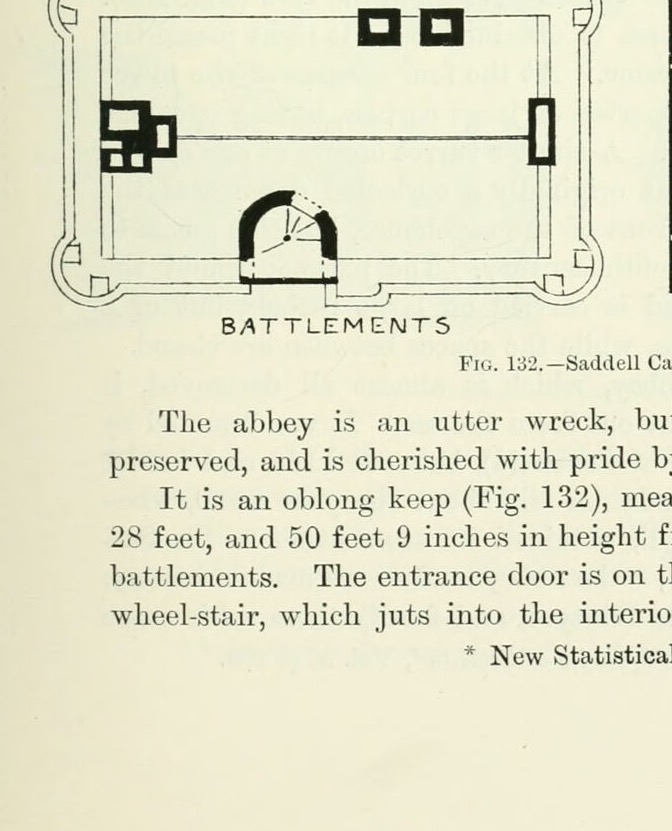
ENTRANCE
1889 · MacGibbon & Ross, vol. 3 (1889)
Public domain
FIRST FLOOR
1889 · MacGibbon & Ross, vol. 3 (1889)
Public domain
SECOND FLOOR
1889 · MacGibbon & Ross, vol. 3 (1889)
Public domain


