Scotland · Restored
Seton Castle
Seton Castle is an 18th-century Georgian castellated house in East Lothian, Scotland, designed as Robert Adam's final Scottish project and built on the site of the older Seton Palace. The house forms a curved fortified screen wall with shaped towers around an entrance court and sits within parkland beside Seton Collegiate Church. It retains classical interior details and was restored and lived in into the 21st century.
Its prime
1791
Today
Restored
As it stood in 1791
What Seton Castle looked like in its prime.
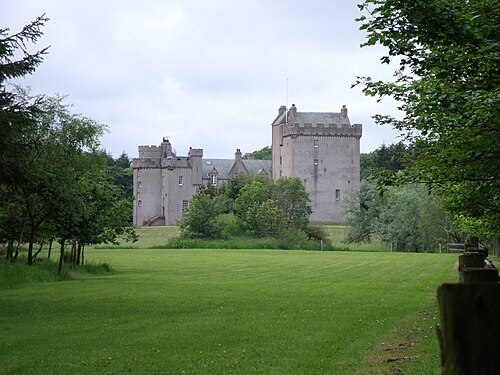
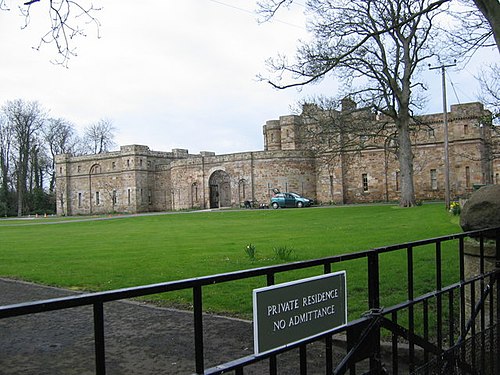
A late-Georgian castellated mansion of yellow-brown ashlar forming a low, horizontal silhouette; a curved screen wall with a central rounded carriage arch links shaped, drum-like and rectangular towers with crenellated parapets. Two low wings project each side of the entrance court. Small vertical window openings and blind arches punctuate the screen wall. The house faces a broad clipped lawn and gravel drive, with mature trees and the medieval collegiate church nearby.
Its story
The story of Seton Castle.
Seton Palace, Burned in 1544 and Demolished in 1789
The house stands on the site of Seton Palace, which occupied the lands of Seton and Winton near Longniddry on the Firth of Forth and belonged to the Earls of Winton. The date the palace was first built is uncertain. It was a favoured retreat of Mary, Queen of Scots: she and her second husband, Lord Darnley, spent their honeymoon there, and she came back to it after Darnley's murder. In May 1544, following the burning of Edinburgh, the English army burned the palace.
Historical records describe it as the most magnificent palace in Scotland in the seventeenth century, and both James VI and Charles I were entertained there. It was damaged and burned out again during the Jacobite rising of 1715, and in 1780 it was described as being in ruins. The palace was demolished in 1789.
Robert Adam's Final Scottish Project, 1789–1791
In the summer of 1789 Lieutenant-Colonel Alexander Mackenzie of the 21st Dragoons, eldest son of Alexander Mackenzie of Portmore in Peeblesshire, commissioned Robert Adam to build a new mansion on the site. It was Adam's final project in Scotland. Working drawings were finished by December 1789, the building contract went to Thomas Russell, and construction ran from 12 November 1789 to the summer of 1791.
The remains of the old palace were pulled down and cleared by 1790, apart from the vaulted ground floor, which was left standing; stone from the palace was reused in the new building. John Patterson, Adam's Clerk of Works in Scotland and later a competent architect in his own right, wrote to Adam on 26 April 1790 to report the old building demolished and the ground cleared. What went up in its place was a castellated house in the late-Georgian taste, with shaped towers set about a curved wall enclosing a courtyard entered by a central archway.
From the Earls of Wemyss to Dreamr Hotels, 1796–2024
Alexander Mackenzie died a young man in 1796, and the Earl of Wemyss acquired the estate; his family held it for more than two centuries, letting the castle for a time to the Stevenson family of Prestonfield House. In 2003, "in a dreadful state", it was sold to the property developer Mary McMillan, who carried out a major restoration and then put it back on the market. The entrepreneur Stephen Leach bought it in 2007, completed further renovation and sold it in 2019, when the house was described as an 18,196-square-foot mansion of seven bedrooms on 13.5 acres, with working stables and a private tavern. David Fam, founder of Dreamr Hotels, bought it in 2022, and the property was advertised for sale again in 2024.
Category A Listing and the Neighbouring Collegiate Church
Seton Castle is a category A listed building, listed as Seton House, with its surrounding grounds designated; it has been described as one of the most striking of Robert Adam's late houses in the castle style, and the listing document accords it high value. A report of 1987 recorded that of the palace it replaced, only the walls of the famous sixteenth- and seventeenth-century formal gardens remained. Seton Collegiate Church, immediately adjacent, is in the care of Historic Scotland.
Step inside
8 places to explore in 1791.
The record describes 8 distinct spots at Seton Castle, including 2 interiors: main reception hall with staircase, vaulted ground-floor cellars. Create your own photoreal reconstruction and explore every one, more scenes means more rooms, more angles, and more of the place to stand in.
Build Your Own Castle
Recreate Seton Castle with AI to explore it.
The artist rebuilds it as it stood in 1791, a photoreal reconstruction that belongs to you alone. Pay with coins, no subscription needed.
Recreate this castle →Defend this castle →Whose castle
Clans who held Seton Castle.
The families that held Seton Castle for a decade or more across its history, follow a name to its clan.
Wemyss
The Earls of Wemyss acquired the estate in 1796 and their family held it for over two centuries.
Nearby