
Scotland · Demolished
Seton Palace
Seton Palace was a large Scottish noble residence near Prestonpans in East Lothian, seat of the Lords Seton from the 15th century. By the 17th century it formed a triangular plan of three wings around a central courtyard with associated formal gardens. The medieval palace was burned and fell into ruin after the 1715 Jacobite rising and was demolished in 1789; some garden walls and carved fragments survive nearby.
Its prime
1636
Today
Demolished
As it stood in 1636
What Seton Palace looked like in its prime.
In its prime the palace formed a triangular plan of three stone wings around a central courtyard, set low by the sea. A rebuilt fore-work gatehouse marked the main approach, and a great tower and an older 'jemmay house' wing punctuated the silhouette. Long rooflines with dormered windows and carved strapwork faced a broad lawn for pall-mall, while a high walled garden with tall hedges and round lookout turrets stood adjacent; interiors included a vaulted great hall and long gallery.
Its story
The story of Seton Palace.
Built by Stages on the Lands of Seton and Winton
Seton Palace stood in East Lothian, a few miles south-east of Edinburgh near Prestonpans. The date of the original building is uncertain; it is credited to George, 4th Lord Seton in the fifteenth century, and it sat on the lands of Seton and Winton. Richard Maitland's History of the House of Seytoun describes a house that grew in stages: George Seton, 5th Lord Seton, who died in 1513, completed the "jemmay house", a wing begun by his grandfather John, Master of Seton, dead in 1476. His widow, Janet Hepburn, Lady Seton, built the fore-work or gatehouse.
Lord Hertford's Fire and the Rebuilding, 1544–1561
An English army burned the palace on 16 May 1544, after the burning of Edinburgh. The commander, Lord Hertford, wrote that while he was burning it Lord Seton was nearby with some horsemen, "so that he might well see his own house and town on fire." That Lord Seton was married to Marie Pieris, a French lady-in-waiting; their daughter Mary Seton became a companion of Mary, Queen of Scots. As the war known as the Rough Wooing continued, Regent Arran came to Seton in March 1549 because the English were at Haddington, and whales beached at Cramond Island were salted, packed in barrels and sent on to him there.
The great tower and the jemmay house were afterwards restored by Sir William Hamilton of Sanquhar, Captain of Edinburgh Castle and father-in-law of George Seton, 7th Lord Seton; the walled garden was built at the same time. Mary of Guise kept Christmas at Seton in 1559. The old great tower collapsed in 1561, and Janet Hepburn's gatehouse was then almost entirely rebuilt.
Mary, Queen of Scots at Seton, 1561–1568
In October 1561 the queen's uncle Francis, the Grand Prior, travelled to England, and her four companions (Mary Seton, Mary Beaton, Mary Livingston and Mary Fleming) came with him to Seton and all dined there while the queen herself stayed in bed at Holyrood. She became a frequent visitor. New Year's Day 1562 was marked with Alexander Scott's poem of advice for princes, Ane New Yeir Gift to Quene Mary. In July 1565 she rode to Seton from Edinburgh at night and stayed two days. Her honeymoon with Lord Darnley was spent at Seton in the same month.
She came back to Seton after Darnley's death in February 1567. The articles drawn up against her mention golf (it was said she played "pall-mall and golf" as usual in the fields at Seton), and allege she slept with Bothwell, lodged in an "obscure chamber" beneath her room, near the kitchen with access to a secret turnpike stair. William Drury reported that the gates were "straightly kept" while she was there; he heard she had made an excursion to Tranent and then competed in an archery match at Waughton Castle, but wrote later that she had not stirred from Seton. A marriage contract between Mary and Bothwell, dated at Seton on 5 April 1567 and exhibited by her enemies at the Hampton Court conference on 15 December 1568, was probably a contemporary forgery; the actual contract was made in Edinburgh on 14 May.
The Court at Seton, 1584–1638
Lupold von Wedel admired the tall hedges of the garden in 1584 but could not get in. James VI stayed in September 1589, waiting in vain for Anne of Denmark to arrive in Scotland, and the English ambassador Lord Burgh was welcomed with a banquet on 24 February 1593. Anne of Denmark travelled to Seton by litter on 31 May 1597, despite the rain. The king stayed again on 15 May 1617, when William Drummond of Hawthornden presented his poem Forth Feasting and John Gellie of Gellistoun delivered 300 lines of Latin verse.
By the seventeenth century the completed palace was triangular in plan, three wings around a courtyard, and the records reckon it the most magnificent in Scotland; in 1636 it was described as "a dainty seat placed by sea". Around 1630 the family built Winton Castle further inland, and Charles I commissioned a view of the palace from Alexander Keirincx in 1638.
Burned in the Rising of 1715, Demolished in 1789
The Setons, by then Earls of Winton, had their estates confiscated after the Jacobite rising of 1715, and the palace was burned out during the Rising. By 1780 it was described as being in ruins, and in 1789 it was demolished. That year the owner of the site, Lt Col Alexander Mackenzie of the 21st Dragoons, commissioned Robert Adam to build the mansion that became Seton Castle; some of the palace's stone went into it. Fragments of its carved dormer windows and strapwork are displayed at the adjacent Seton family chapel, Seton Collegiate Church, which is open to the public in the care of Historic Environment Scotland. Some walls of the formal gardens remain, with lookout turrets at the corners.
Step inside
10 places to explore in 1636.
The record describes 10 distinct spots at Seton Palace, including 5 interiors: great hall (interior), samson's hall (decorated chamber), long gallery and mural end wall and more. Create your own photoreal reconstruction and explore every one, more scenes means more rooms, more angles, and more of the place to stand in.
Build Your Own Castle
Recreate Seton Palace with AI to explore it.
The artist rebuilds it as it stood in 1636, a photoreal reconstruction that belongs to you alone. Pay with coins, no subscription needed.
Recreate this castle →Defend this castle →Whose castle
Clans who held Seton Palace.
The families that held Seton Palace for a decade or more across its history, follow a name to its clan.
Seton
Seat of the Lords Seton, erected in the 15th century by George, 4th Lord Seton, and held by the family into the 18th century.
From the archive
Seton Palace on paper: the measured plan and period views.
The survey plan and photographs below are the ground truth this page's reconstructions are checked against, drawn and photographed while the castle was still a working garrison. Every image is public-domain or openly licensed, with its source named.
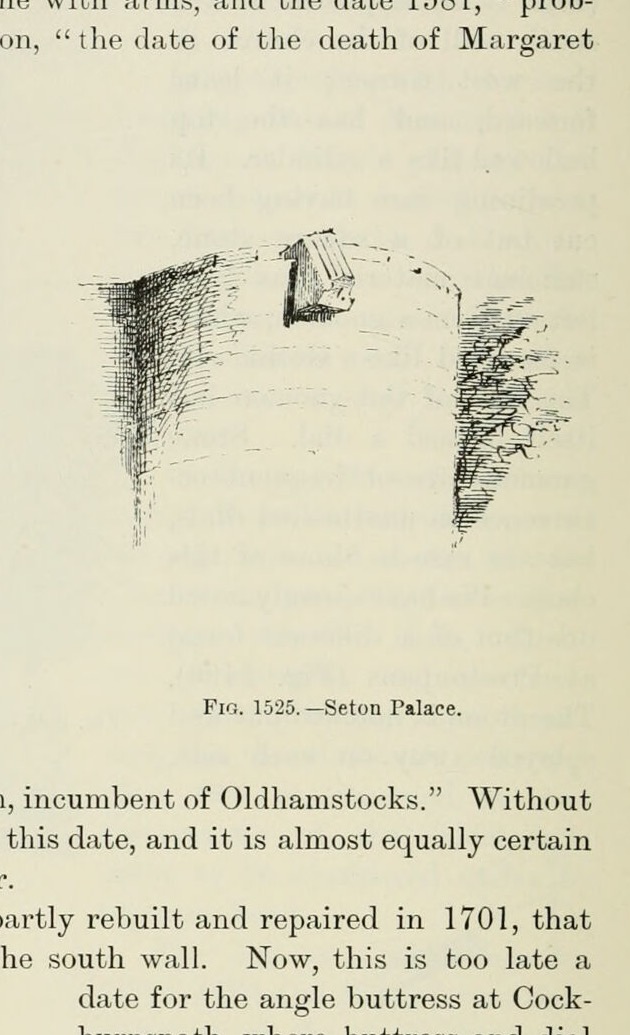
Fig. 1524. Seton Palace.
1892 · MacGibbon & Ross, vol. 5 (1892)
Public domain
Fig. 1525. Seton Palace.
1892 · MacGibbon & Ross, vol. 5 (1892)
Public domain
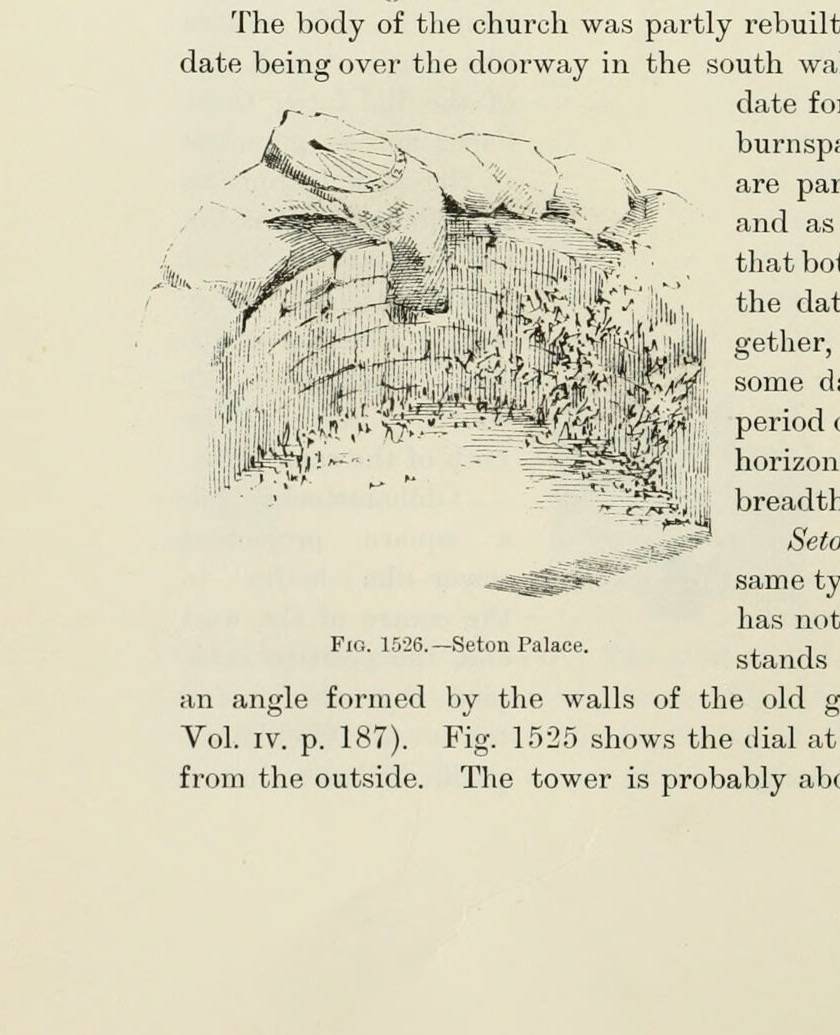
Fig. 1526. Seton Palace.
1892 · MacGibbon & Ross, vol. 5 (1892)
Public domain
Nearby


