
Slovakia · Restored
Trenčín Castle
Trenčiansky hrad
Trenčín Castle is a medieval hilltop fortress above the town of Trenčín in western Slovakia. The complex is centred on a tall rectangular keep (the Máté Tower) and surrounded by layered curtain walls and outworks climbing a steep rocky crag; it now houses museum exhibitions and a castle gallery and is a protected national cultural monument.
Its prime
1320
Today
Restored
As it stood in 1320
What Trenčín Castle looked like in its prime.
Perched on a steep limestone crag, the castle reads as a series of pale stone curtain walls and rectangular buildings stepping up the hillside. A dominant tall square keep with an open wooden gallery and steep hipped roof crowns the summit; below it are a large rectangular residential block with dark pitched roofs, round and square defensive towers, and a long lower enceinte running down the slope. Surfaces are light-weathered stone, narrow slit windows and small regular windows in later residential ranges.
Its story
The story of Trenčín Castle.
From Roman Laugaricio to the Lord of the Váh and Tatras, 13th–14th Century
A rock inscription on the crag records a victory won there in AD 179 by the Second Roman Legion at Laugaricio, the Latin name for Trenčín. The oldest building on the hill is a stone rotunda, probably raised in the Great Moravian period; the site may have begun as a fortified hillfort before any stone castle stood there.
In the mid-thirteenth century the castle was held by Baron Jakab Cseszneky, swordbearer to King Béla IV. In the late thirteenth and fourteenth centuries it passed to Matthew III Csák, the oligarch later remembered as the legendary 'Lord of the river Váh and the Tatra Mountains'. Csák enlarged an eleventh-century residential tower and added a palace within a massive new fortification; the tower, still called the Matúš Tower, remains the dominant feature of the castle's skyline.
The Treaty of Trenčín, 1335
In 1335 the Treaty of Trenčín was concluded at the castle between King Casimir III of Poland, King Charles I of Hungary and King John of Bohemia. John of Bohemia attended the negotiations in person with his son Charles, the future Holy Roman Emperor Charles IV, as did Charles I of Hungary; Casimir III of Poland was represented by deputies.
Anjou, Luxembourg and the Hussite Threat, 14th–15th Century
After Csák's death the castle belonged to the Hungarian crown until the close of the fifteenth century. King Louis of Anjou enlarged the upper castle with a new palace and fortification, and Sigismund of Luxembourg gave the castle to his wife Barbara, for whom a new palace and chapel were built in the first third of the fifteenth century. Further strengthening of the fortifications followed later in the fifteenth century, prompted by Hussite raids reaching into Slovakia.
Zápoľský's Rebuilding and the 1527 Fall to Katzianer
At the end of the fifteenth century Štefan Zápoľský acquired the castle together with the town and began extensive rebuilding. The castle was already a target of Turkish expansion by the early sixteenth century. Despite Zápoľský's fortification work, it was taken in 1527 by Katzianer, a general of King Ferdinand I.
Between 1540 and 1560 the fortifications were restored and expanded to designs by Italian architects, adding a star-shaped artillery defence and modernising the buildings; the high Gothic roofs gave way to horizontal Renaissance attics with swallow-tail battlements. The rebuilding left Trenčín, alongside Spiš Castle and Devín Castle, counted among the most extensive castles in Europe.
Within the lower castle precincts a deep well is known as the Well of Love, after a legend that a Turkish prince named Omar dug it to win the beautiful Fátima. In fact it was dug by the garrison, begun around 1557 and finished between 1564 and 1570, roughly 80 metres deep.
Fire, Ruin and Restoration, 1790–Present
A fire that swept through the town in 1790 also badly damaged the castle, and by the mid-nineteenth century, as the idea of monument preservation took hold in Hungary, the damaged buildings were conserved to halt further decay; into the mid-twentieth century the castle still stood largely as a ruin above the town. A comprehensive renovation and conservation of the fortification has been under way since the late 1950s, with restored buildings progressively opened for museum use.
The castle today houses exhibitions of the Trenčín Museum (historic furniture, weapons, paintings and other artefacts, together with a castle gallery and archaeological collections), and is administered by the Trenčín self-governing region. It is protected as a National Cultural Monument of Slovakia and attracted around 100,000 visitors in 2006.
Step inside
9 places to explore in 1320.
The record describes 9 distinct spots at Trenčín Castle, including 3 interiors: stone rotunda, well of love (lower castle well), castle gallery and exhibition room. Create your own photoreal reconstruction and explore every one, more scenes means more rooms, more angles, and more of the place to stand in.
Build Your Own Castle
Recreate Trenčín Castle with AI to explore it.
The artist rebuilds it as it stood in 1320, a photoreal reconstruction that belongs to you alone. Pay with coins, no subscription needed.
Recreate this castle →Defend this castle →Whose castle
Clans who held Trenčín Castle.
The families that held Trenčín Castle for a decade or more across its history, follow a name to its clan.
Cseszneky
Seat of Baron Jakab Cseszneky, King Béla IV's swordbearer, in the mid-13th century.
Csák
Residence of Matthew III Csák, "Lord of the river Váh and the Tatra Mountains", in the late 13th and 14th centuries.
From the archive
Trenčín Castle on paper: the measured plan and period views.
The survey plan and photographs below are the ground truth this page's reconstructions are checked against, drawn and photographed while the castle was still a working garrison. Every image is public-domain or openly licensed, with its source named.
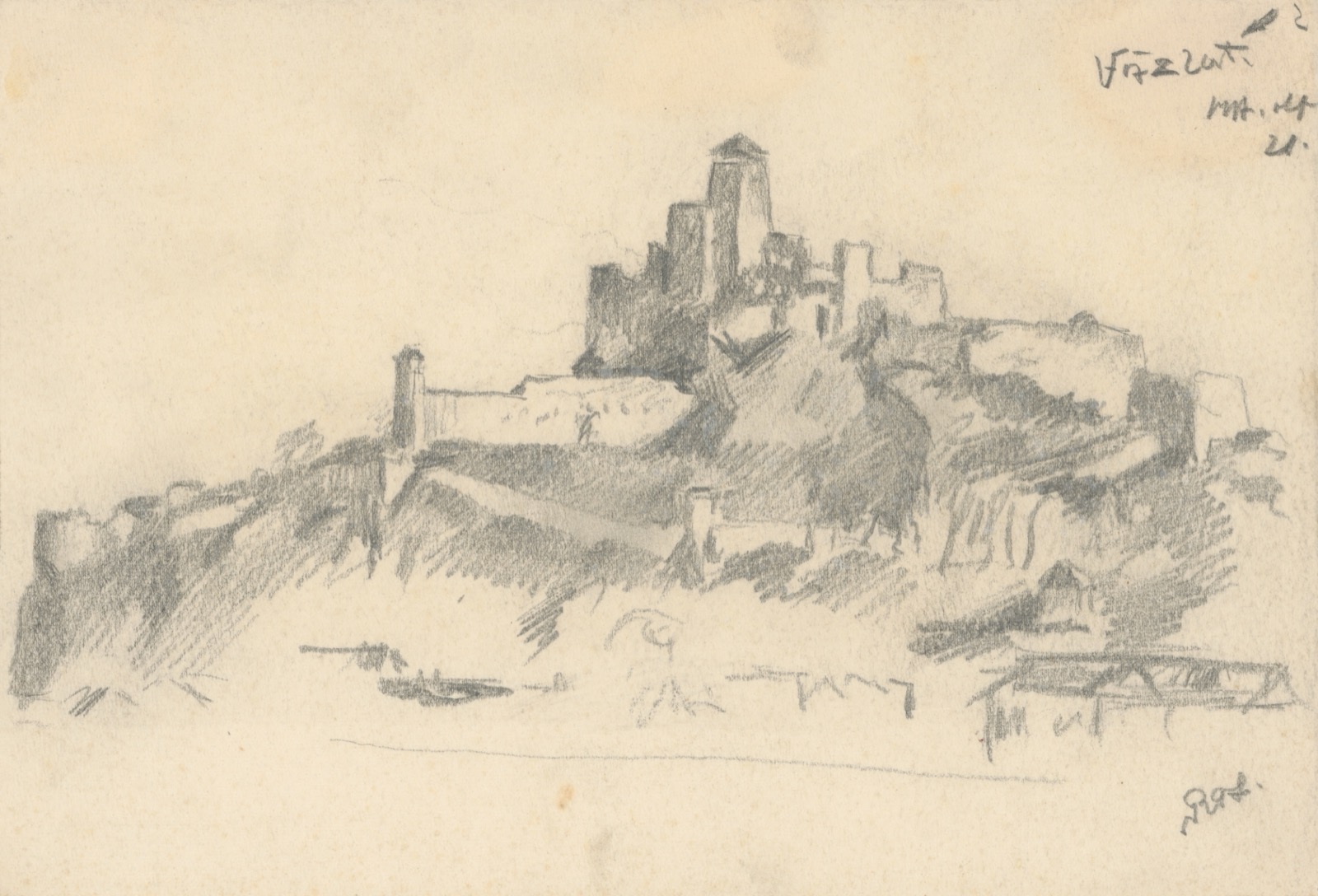
Trenčiansky hrad
· Slovak national gallery (via Europeana)
Public domain


