
Spain · Restored
Castle of Cardona
Castillo de Cardona
The Castle of Cardona is a medieval hilltop fortress in Catalonia overlooking the Cardener valley and the town of Cardona. Founded in 886, its complex includes the cylindrical Torre de la Minyona and the Lombard Romanesque Church of Sant Vicenç; the site now houses a state Parador hotel.
First raised
880
Its prime
1350
Today
Restored
Ranked among Europe’s castles
As it stood in 1350
What Castle of Cardona looked like in its prime.
Massive ochre-brown stone fortress set on a steep, terraced hill with broad retaining walls stepping down the slope; a long, low-roofed Romanesque church with a semicircular apse dominates the skyline at one end, while a freestanding cylindrical tower (Torre de la Minyona) punctuates the profile. Rectangular keeps and domestic ranges with narrow vertical windows sit behind curtain walls; tiled rooflines are low-pitched and the stone shows regular ashlar and rubble construction. At its prime the complex is whole and occupied.
Its story
The story of Castle of Cardona.
Saracen Raids and Guifré's Resettlement, Eighth and Ninth Centuries
The fortress is first documented in the Carolingian era, in the eighth century, when it was recorded as destroyed in one of the earliest Saracen raids into the region. Louis the Pious had it occupied and restored in 798 to support a planned reconquest of Barcelona, but a revolt by the nobles Aissó and Guillemó in 826 wrecked that campaign and left central Catalonia depopulated. The stronghold was permanently re-established during the resettlement led by Wilfred the Hairy; Cardona preserves one of the oldest surviving population charters, the one Count Wilfred granted to the castle's settlers, dated by some accounts to between 872 and 878 and by others to between 880 and 886.
The Rise of the Cardona Dynasty, Tenth to Fifteenth Centuries
From the late tenth century the viscounts of Osona took up residence at Cardona, and the viscounty gradually took the castle's name; a charter of 986 from Count Borrell to Viscount Ermenir appears to confirm the family's existing hold. Ramon Folc I, who took the name Folc de Cardona around 1040, founded the line's barony; he was killed in 1086 in a Saracen raid on the castle of Maldà while aiding Ramon Berenguer II. Ramon Folc II was assassinated in 1175 by the troubadour Guillem de Berguedà. Hug Folc II campaigned with King Peter the Ceremonious in Sardinia in 1354 and, after his struggle against Bernat de Cabrera, was created Count of Cardona in 1375 with extensive civil and criminal jurisdiction over the county's castles and lands. In 1491 the county was raised to a duchy. By the fifteenth century the Dukes of Cardona were the most important family tied to the Crown of Aragon after the royal house itself, styled 'kings without crowns' for their territories across Catalonia, Aragon and Valencia and their dynastic ties to Castile, Portugal, Sicily and Naples.
The War of the Spanish Succession, 1705–1714
Cardona was the Catalan stronghold that held out longest against the Bourbon army during the War of the Spanish Succession. The town had sworn allegiance to Archduke Charles in September 1705 and kept it for the rest of the war. Between 13 November and 22 December 1711 a Bourbon force of more than ten thousand men under the Count of Muret besieged the castle, whose garrison of about two thousand was commanded by the Count of Egkh; after occupying the town on 17 November the besiegers set up three artillery batteries and bombarded the fortress for thirty-five days, weakening the defending garrison, until a relieving army fought its way through on 21 and 22 December. By late 1713 Cardona and Barcelona were the only places in Catalonia still holding out; when Barcelona fell on 11 September 1714, the Duke of Berwick demanded Cardona's surrender as the price of sparing the capital reprisals. Governor Manuel Desvalls i de Vergós refused, saying he could act only on direct orders from his own superiors, but negotiated honourable terms with the Count of Montemar (twenty-three articles protecting the lives and property of the garrison and the townspeople), before the castle capitulated on 18 September 1714, a week after Barcelona.
From Garrison to Parador, 1900–2014
The military command was withdrawn early in the twentieth century and the castle fell into neglect. The Sant Vicenç chapel was declared a national monument in 1931 and the rest of the complex in 1949. It has housed a state Parador since 1976, and in 2001 its management and conservation passed to the Generalitat de Catalunya, through what is now the Catalan Agency for Cultural Heritage; it has been listed as a bien de interés cultural since 1992. On 27 October 2010 it became Catalonia's first parador-museum, run in conjunction with the Museum of History of Catalonia. In 2014, coinciding with the tercentenary of the 1714 surrender, the agency carried out rehabilitation works that added visitor signage, converted the casamata into exhibition space, repaired the bastions and waterproofed the Sant Vicenç roof.
Step inside
7 places to explore in 1350.
The record describes 7 distinct spots at Castle of Cardona, including 3 interiors: church of sant vicenç, nave interior, sala dorada (golden room), sala dels entresols (mezzanine room). Create your own photoreal reconstruction and explore every one, more scenes means more rooms, more angles, and more of the place to stand in.
Build Your Own Castle
Recreate Castle of Cardona with AI to explore it.
The artist rebuilds it as it stood in 1350, a photoreal reconstruction that belongs to you alone. Pay with coins, no subscription needed.
Recreate this castle →Defend this castle →Whose castle
Clans who held Castle of Cardona.
The families that held Castle of Cardona for a decade or more across its history, follow a name to its clan.
Cardona
Held by the dukes of Cardona, heirs of Wilfred the Hairy, by the 14th century the most important family of the Crown of Aragon after the royal house itself.
From the archive
Castle of Cardona on paper: the measured plan and period views.
The survey plan and photographs below are the ground truth this page's reconstructions are checked against, drawn and photographed while the castle was still a working garrison. Every image is public-domain or openly licensed, with its source named.
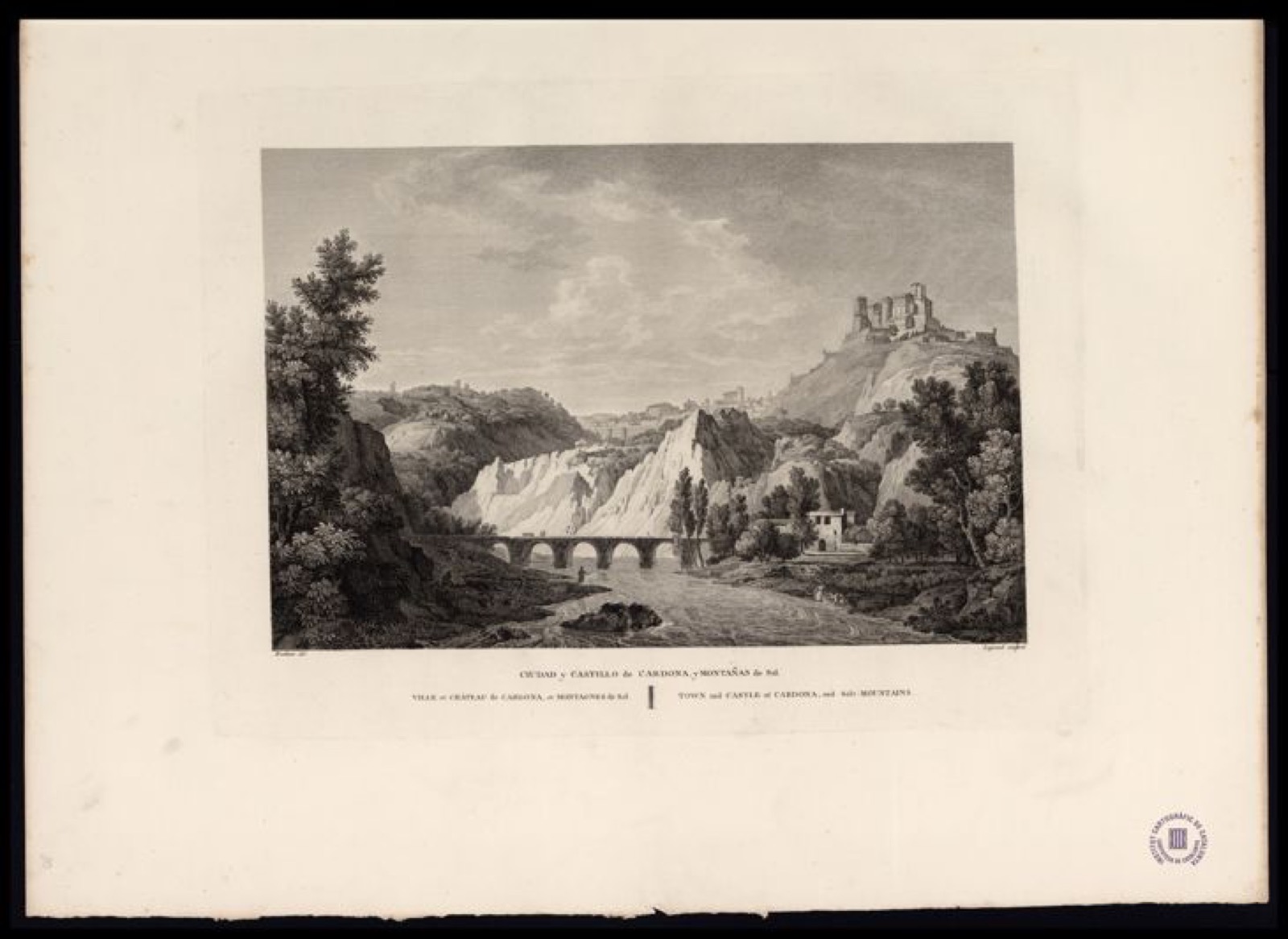
Ciudad y castillo de Cardona y montañas de sal = Ville et château de Cardona et montagnes de sel = Town and ca
1806 · Cartographic and Geological Institute of Catalonia (via Europeana)
Public domain


