
Switzerland · Still standing
Lenzburg Castle
Lenzburg Castle sits atop a nearly circular hill above the town of Lenzburg in the Canton of Aargau, Switzerland. It is one of the country's oldest castles, formed of a cluster of stone buildings, gatehouses and curtain walls arranged around an inner bailey and enclosed by high defenses on the steep southern and eastern cliffs.
First raised
1036
Its prime
1674
Today
Still standing
As it stood in 1674
What Lenzburg Castle looked like in its prime.
Perched on a nearly circular limestone hill about 100 m above the plain, the castle is a compact complex of connected stone buildings and curtain walls arranged in a rough horseshoe around an inner bailey. Steep red clay-tiled gabled roofs cap long rectangular ranges; a multi-storey square keep and gatehouses rise above lower service buildings. Thick pale-grey masonry curtain walls follow the cliff edge, enclosing a paved central courtyard with mature trees and a formal enclosed garden on the southwest.
Its story
The story of Lenzburg Castle.
The Counts of Lenzburg and Barbarossa's Inheritance, 1036-1230
A charter of 1036 names Ulrich, later called the Rich, as count in the Aargau. He was imperial Vogt of Zürich and lay advocate of the abbeys of Beromünster and Schänis, and his family, which gave the castle its name, probably had its ancestral seat built on the hill in the early 11th century. Local tradition told the beginning differently: a dragon once lived in a cave on the hillside, two knights named Wolfram and Guntram killed it, and the grateful country people made the pair counts of Lenzburg and gave them leave to build on the rock.
The first secure evidence that a castle stood on the hill comes from 1077, when Ulrich's grandson Ulrich III took the side of King Henry IV in the Investiture Controversy and held two papal legates for half a year. The counts of Lenzburg were at that time among the most important feudal lords of the Swiss plateau and kept close relations with the German rulers of the day. The Palas, a fortified dwelling of four storeys and some 18 metres in height, was raised around 1100, and the square tower, ten metres to a side with walls three metres thick, was built on to its west flank in the 12th century for Ulrich IV. The line died out in 1173. Ulrich IV, the last count of Lenzburg, named the Emperor Frederick I Barbarossa his personal heir in his will; the two had been friends and had gone on the Second Crusade together. Work on the tower stopped at Ulrich's death, and it was left unfinished for well over a century.
The emperor came to Lenzburg in person to settle the division of the inheritance, and gave the greater part of the lands to his son Otto I, count palatine of Burgundy. After Otto's death in 1200 the Staufer were pushed out of the Aargau. Through two closely allied houses of the high nobility, Andechs-Merania and Chalon, the castle came by marriage to the counts of Kyburg in about 1230, and the Kyburgs founded a fortified market settlement at the western foot of the hill, the present town of Lenzburg.
Habsburg Lordship and the Gugler Siege, 1264-1375
Hartmann IV, the last count of Kyburg, died in 1264 without male heirs. Rudolf I, count of Habsburg and later king of the Romans, took the wardship of the under-age heiress Anna of Kyburg, which carried the administration of the lordship with it; Anna afterwards married Rudolf's cousin Eberhard I of Habsburg-Laufenburg. In 1273 Rudolf bought the property from his impoverished kinsman for 14,000 silver marks, and two years later he held a court day at Lenzburg. Dukes of Austria and their officers governed from the castle after him, though it sank to the rank of a regional seat of administration as Habsburg power shifted further into Austria.
Frederick the Fair granted Lenzburg its charter as a town on 20 August 1306. Duke Frederick II of Habsburg lived at the castle from 1339 and had the Ritterhaus built as a hall fit for his wedding to Joan, a daughter of King Edward III of England, which was to be held there. He died in 1344 without ever having seen his bride, and the hall was left incomplete, its walls unrendered. The tower was finished in the same year, two further storeys of thinner wall being added to it.
From 1369 the castle fief was held by the Ribi-Schultheiss family, who came from Seengen and had risen from the peasantry into the lower nobility. The well in the courtyard and a small chapel dedicated to St Fortunatus beside the Ritterhaus are both first recorded in that year. In 1375 the castle held out against a siege by the Gugler.
Bern's Conquest and the Landvögte, 1415-1531
The latent tension between Sigismund, king of Germany, and Duke Frederick IV of Austria broke open in 1415 at the Council of Constance, when Frederick helped John XXIII, one of the three popes then reigning, to escape from the city. On 30 March 1415 Sigismund called on the Habsburgs' neighbours to seize their lands in the name of the Empire, and Bern took the western part of the Aargau. The town of Lenzburg surrendered to the advancing army on 20 April, while the castle was left untouched for the time being. Konrad von Weinsberg, the king's governor, tried to secure it for the Empire and had it equipped to stand a siege; by August he had given the plan up, and in 1418 he handed the castle back to the Ribi-Schultheiss family. After long negotiations Bern obtained the lower rights of lordship over the county of Lenzburg in 1433 and the castle itself in 1442.
The first Bernese Landvogt moved in during 1444 and governed the Oberamt Lenzburg from the castle, a district taking in the Seetal, the Wynental and the Suhrental. A Landvogt collected the taxes, enforced administrative measures, held judicial and police powers and the military command, and answered for the upkeep of the castle; each was elected for a four-year term from the Great Council of Bern. The best known of them was Adrian I von Bubenberg, Landvogt from 1457 to 1461, afterwards Schultheiss of Bern and the hero of the battle of Murten.
Extensive works followed in 1509 and 1510, when the unfinished Ritterhaus was partly pulled down and rebuilt. A great fire in 1518 destroyed buildings that were not recorded, most probably the Aarburghaus on the north side, and in 1520 the Landvogt was given a new house, the Landvogtei. After Bern adopted the Reformation in 1528 the castle's strategic weight grew, lying as it did close to the confessional border, with attack feared from Catholic Lucerne by way of the Freie Ämter. It served as the base of operations of the Reformed in the First War of Kappel in 1529 and again in the Second in 1531, and afterwards counted as a border fortress from which the nearby crossings of the Reuss could be controlled.
Artillery Works, Grain Store and the Last Landvogt, 1624-1798
In 1624 Joseph Plepp, working for the fortress engineer Valentin Friderich, drew the first exact views and ground plans of the castle, which by then looked more like a fortified farmstead. With the Thirty Years' War running since 1618, Bern set about making Lenzburg fit for artillery on the basis of those plans. A double gatehouse with a zwinger was thrown forward on the north side in 1625 and the earth banks on the east and south were raised. Friderich's scheme of 1628 for several bastions could not be carried out for want of money, but a reduced design by Niklaus Willading was built between 1642 and 1646, when a bank eleven metres high was piled up to form the east bastion on the site of a bulwark of 1582 that had been out of date when it was put up. The bastion closed the gap between the Palas and the Landvogtei against cannon fire from the Goffersberg opposite; rainwater seeped through the adjoining walls, the Landvogtei was uninhabitable from 1646, and a new residence for the Landvogt was built in the north range between 1672 and 1674.
Under the Bernese governors the Palas went by the name Strecke, after the torture chamber inside it, and from about the start of the 17th century the gaol occupied the first upper floor of the tower. In the 18th century the Bernese turned the castle into a great grain store. The Hintere Haus was given an extra wing in 1705-07, the tower and the Ritterhaus were joined over the well by a plain utility building in 1728-29, and in 1758 five intermediate floors were fitted into the Ritterhaus, with additional dormers and windows for ventilation. More than 5,000 tonnes of grain could be held.
In March 1798 Viktor von Wattenwyl, the seventy-first and last Bernese Landvogt, gave the castle up to the advancing French troops as the old political order collapsed. It served for some months as a military hospital before the sick soldiers were moved on to Königsfelden.
The Canton's Empty Castle, Lippe's Institute and the Internees, 1804-1871
The canton of Aargau, founded in 1803, took possession of the castle on 5 June 1804 and could not decide what to do with it. There was no money for the upkeep and no use in view, and government business was out of the question in a building that stood for the rule of Bern over its subjects, so the castle was left empty for more than two decades. A lease sought in 1810 by the Schaffhausen organ builder Johannes Heinrich Speissegger was refused; a plan of 1818 to put the federal central military school here came to nothing, as did a proposed cantonal teachers' seminary. In the autumn of 1822 the schoolmaster Johann Karl Christian Lippe, who had been teaching at Hofwil, asked to lease the castle for a boys' institute. The cantonal government left him the property rent-free for five years on condition that he paid for the necessary repairs, and afterwards renewed the lease every three years at 300 francs. The institute opened on 11 February 1823 and in the 1830s counted up to fifty pupils and twelve teachers, among them the geography master Johann Gottfried Lüdde. Most of the boys were Protestants from Alsace, whose parents mistrusted the Catholic character of French schooling. Lippe taught on principles close to those of his friend Johann Heinrich Pestalozzi. Numbers fell away with the political instability of the revolutions of 1848 and 1849, the running and repair costs drove him to loans he could not repay, and the school closed on 30 September 1853 by agreement with his creditors. Lippe died the following day.
A military hospital was quartered in the castle briefly at the beginning of 1857. In June 1859, during the Sardinian War, 120 Austrian soldiers who had fled into Switzerland after the defeats at Magenta and Solferino were interned in it. In March 1860 the Great Council of the Aargau accepted a purchase offer from the Zürich silk manufacturer Konrad Pestalozzi-Scotchburn, and the castle and its estate changed hands for 60,000 francs; whether he ever lived there is not known. In February 1871, during the Franco-Prussian War, the Armée de l'Est under General Charles Denis Bourbaki crossed on to Swiss territory, and the town of Lenzburg was ordered to take in 600 soldiers. Only the castle could hold so many at short notice. Stoves were installed in haste, food was brought up and an emergency hospital fitted out. The internees returned to France at the beginning of March 1871 and the hospital was kept on until the end of April. Pestalozzi had died in the meantime, and his heirs offered the castle to the canton of Aargau in September 1871 without success.
Wedekind, Jessup and the Ellsworths, 1872-2007
A year later the castle passed for 90,000 francs to Friedrich Wilhelm Wedekind, who had emigrated to San Francisco in 1849 after the failure of the March Revolution and made a fortune there speculating in land during the Californian gold rush. He returned to Europe in 1864 and emigrated again in 1871 in protest at a German Empire dominated by Prussia, settling at the castle with his wife Emilie Kammerer. Their six children spent their youth there, among them the singer Erika Wedekind and the writers Frank and Donald Wedekind. Wedekind died in 1888 and the family tried to sell: a considerable part of their fortune was tied up in the property, and the children pressed for the payment of their shares. Emilie Kammerer ran a boarding house in the castle in the meantime, with little profit.
The American industrialist Augustus Edward Jessup bought the castle for 120,000 francs. He came from Philadelphia but had lived long in England, and his wife was Mildred Marion Bowes-Lyon, an aunt of the Queen Mother Elizabeth Bowes-Lyon. Advised by the art historian Josef Zemp, Jessup took down the later additions and the military works and brought the castle back largely to the state Plepp had recorded in 1624; he furnished the interiors richly and installed central heating, running water and electricity, the work running from 1893 to 1903 at a cost of half a million francs. The granary between the tower and the Ritterhaus was demolished in 1896 and the well, first mentioned in 1369, opened to the sky again. Cutting the east bastion back freed the blocked windows on the south side of the Landvogtei and dried out walls that had been unfit to live in since 1646. James William Ellsworth, another American industrialist and a collector of medieval art, had heard that the castle held a table from the time of Barbarossa; finding that he could not buy the table without the castle, he took both in 1911 for 550,000 francs. His son, the polar explorer Lincoln Ellsworth, inherited in 1925 and lived at Lenzburg only from time to time, planning expeditions there with Roald Amundsen in the room of the Landvogtei that carries Amundsen's name.
Lincoln Ellsworth died in 1951 and his widow Marie Louise Ellsworth-Ulmer, faced with the cost of upkeep, wanted to give the property up. When buyers began to come forward the canton of Aargau approached the town of Lenzburg in July 1955 to acquire it jointly and keep it out of the hands of speculators. Under the contract of 19 December 1955 the town paid 1.5 million francs for the parts not belonging directly to the castle, the building land and the farm, while the Stiftung Schloss Lenzburg, founded jointly by canton and town, paid 500,000 francs for the castle hill, the buildings on it, the furnishings and the collections; the agreement took effect on 30 June 1956 and the castle was opened to the public. The Stapferhaus foundation moved into the Hintere Haus in 1960. In April 1970 the Great Council voted a credit of 9.25 million francs for a thorough restoration, carried out between 1978 and 1986 under the architect Dieter Boller with the cantonal and federal heritage authorities, while the cantonal archaeological service excavated on the hill. The Historisches Museum Aargau opened in the castle in 1987 and has been part of the Museum Aargau group since 2007. The foundation that holds the site is owned three quarters by the canton and one quarter by the town, and the castle, its museum and the hill with its Neolithic burial ground are listed as heritage sites of national significance.
Step inside
11 places to explore in 1674.
The record describes 11 distinct spots at Lenzburg Castle, including 4 interiors: middle gatehouse and 180° turning path, knights' hall (incomplete large hall), landvogtei (landvogt's residence) and more. Create your own photoreal reconstruction and explore every one, more scenes means more rooms, more angles, and more of the place to stand in.
Build Your Own Castle
Recreate Lenzburg Castle with AI to explore it.
The artist rebuilds it as it stood in 1674, a photoreal reconstruction that belongs to you alone. Pay with coins, no subscription needed.
Recreate this castle →Defend this castle →Whose castle
Clans who held Lenzburg Castle.
The families that held Lenzburg Castle for a decade or more across its history, follow a name to its clan.
Lenzburg
Seat of the Counts of Lenzburg from the 11th century until Ulrich IV, the last count, willed the estate to Emperor Barbarossa.
Hohenstaufen
Passed by Ulrich IV's will to Barbarossa's line, which withdrew from the Aargau after Count Otto of Burgundy's death in 1200.
Kyburg
Came by marriage to the Counts of Kyburg about 1230; Hartmann, the last count, died without male issue in 1264.
From the archive
Lenzburg Castle on paper: the measured plan and period views.
The survey plan and photographs below are the ground truth this page's reconstructions are checked against, drawn and photographed while the castle was still a working garrison. Every image is public-domain or openly licensed, with its source named.
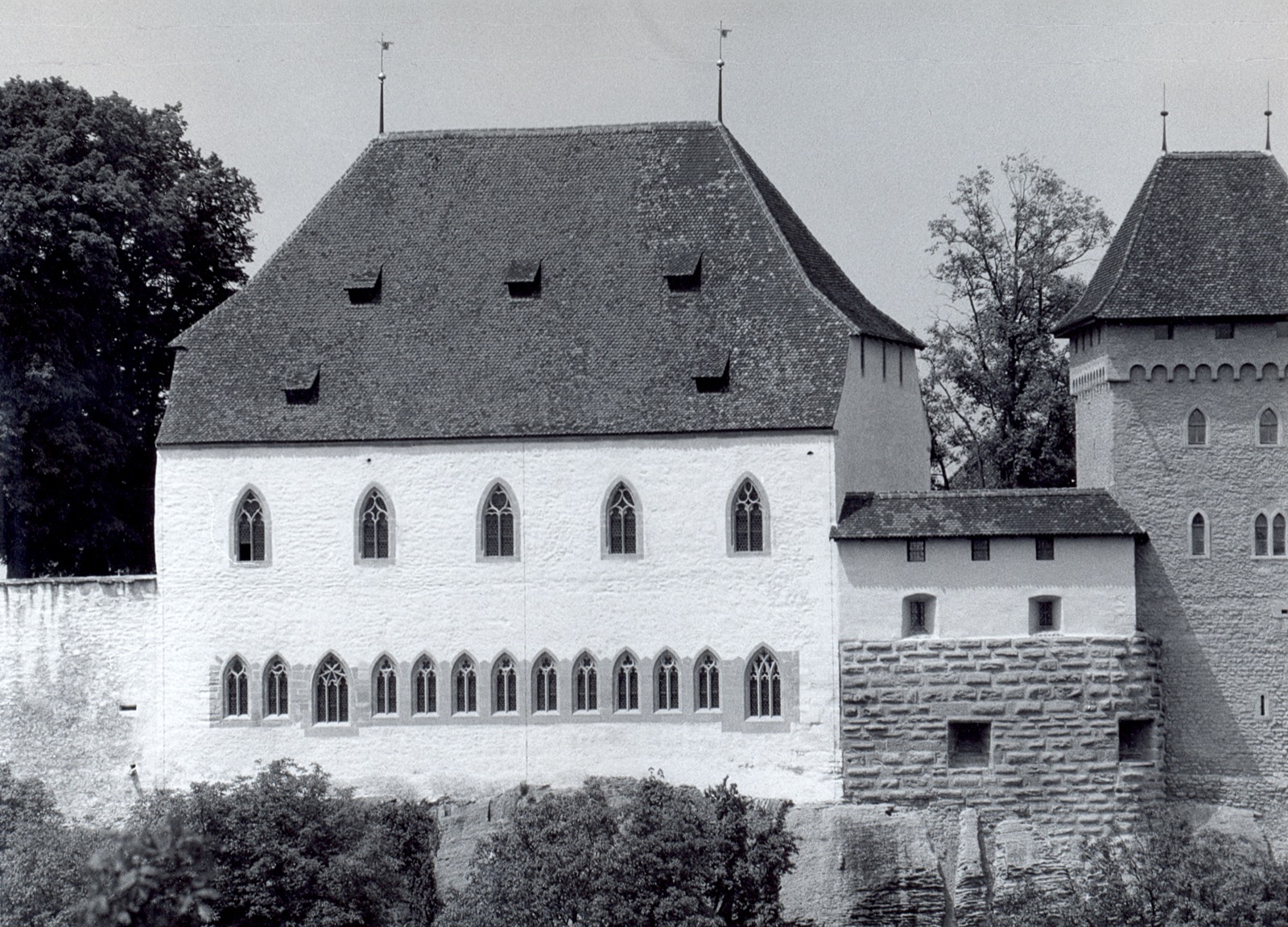
Lenzburg Castle
· European Heritage Awards Archive (via Europeana)
Public domain
Nearby


