Bauer
also Baur, Paur
The farmer, and the German farmer was a name to court.
- Origin
- German
- Register
- German family
The seat of Bauer
Seat vacantChief
No one leads the Bauer community yet. When the movement opens, you can stand for its leadership, or help elect whoever does.
Current mission
No shared goal set yet. Once Bauer has leadership, it sets the public focus: a restoration, a gathering, a real-world project that helps its own.
The Bauer clan is being rebuilt. Join the waiting list for the movement today, and you help decide who leads it and what it does.
Help rebuild the Bauer clan →What does the Bauer name mean?
The farmer, Middle High German būr, the peasant who worked the land, the great mass of the rural population. Thickest in the Bavarian and Franconian south; the same word gives the Pennsylvania-German 'Bower'.
The history of Bauer
Būr, Paur, Baur: a name with ten thousand beginnings
Behind the modern surname sits Middle High German būr, and behind that the plainest fact of German onomastics: occupational designations are the largest class of German family name, and the ten commonest names in the country are all of them. They describe jobs that were ordinary around 1600, the point at which surnames in German-speaking Europe became heritable, which is why they arose independently, all over Germany at once. Bauer has no founder and no first charter, only thousands of simultaneous starting entries in registers that never knew of one another.
The registers wrote him Paur and Baur as well, and the three forms ran alongside one another for centuries, because spelling varied from author to author and even from entry to entry until official registration fixed legal names in the 18th and 19th centuries. Counted with its variants the name accounts for roughly one German in five hundred; counted spelling by spelling it stands ninth in Germany, and ninth in Austria too, where 3,840 bearers put it just above Berger and just below Mayer.
Not the Meyer, not the Hofmann, not the Schulze
German naming drew distinctions inside the farmyard that English flattens. The Meyer ran a full-range farmstead, the senior holding of a settlement in area, workforce and harvest, often as leaseholder of an abbey or a worldly ruler; the Hofmann was a steward, tenant or courtier; the Schulze was the village constable. The Bauer was none of these. He was the working farmer, the man the apparatus of manor, court and demesne stood on top of.
His holding was not a block of ground. The arable of a village lay in two or three great fields cut into narrow strips, and a family's strips were scattered across all of them, so everyone drew a ration of good land and poor. One field lay fallow each year to recover; barley, oats or legumes went into the ground in spring, wheat or rye in autumn. Livestock grazed the fallow and the stubble in common, under rules against overgrazing the community enforced on itself. Few holders owned a full plough team of six to eight oxen or horses, so beasts and ploughs were shared between neighbours as a matter of survival.
The lord's mill, the lord's oven, the lord's court
The obligations were relentless and badly timed. Labour on the lord's demesne came first, and it fell due in the same week the family's own grain stood ready. There were charges for grinding at his mill, baking at his bakery, pressing at his wine-press, for letting pigs feed in his woodland. When a holder died a payment fell before the heir could keep the land; when a daughter married outside the manor she paid for the right to take her labour away with her.
Against that sat rights that were real and enforceable. A tenant could not be dispossessed without legal cause; the lord was expected to shield him from robbers and other lords and to feed him by charity in famine; deadwood from the lord's forest, the fuel that got a household through winter, was his to gather. Such claims were heard in the manorial court, where a man's exact status was usually the first question in the case, because status decided what could be demanded of him. In England, one who ran and reached a chartered town and evaded recapture for a year and a day came out free, and a burgher of it.
No guild would have him
The men who worked in town had an institution the farmer never got. Craft guilds transmitted skill through formal apprenticeship, journeymanship and mastery; their authority rested on charters or letters patent; they kept welfare funds for the sick and the old, and in the German free cities sat inside municipal government and sometimes faced down the patrician elites. None of it reached the fields: no charter to invoke, no seat in the town hall.
The farmer's standing came instead from the Hof, and it outlasted its rival. Centralising states impatient with privileged corporations finished the guilds; there are no Zünfte in Germany now and no craft reserved to a privileged body, only the Innungen, private associations that inherited the old word.
One heir, and the sons with nowhere to go
Long before Nachnamen existed a farmer was known by the name of his Hof. Because impartible inheritance was the long-standing rule in German-speaking Europe, ownership of a farm stayed tied to a single patrilineal line, often for centuries, and the Hofname was the first commoners' family name to become heritable at all, already running in the 14th and 15th centuries, generations ahead of surnames in general. Where a family's name and its estate name came apart, usually because some generation produced no son, the registers joined them rather than choose: A genannt B in Germany, vulgo in Austria.
The same logic built compounds on the word itself: a holding known as 'the rose' produced a Rosenbauer, estate and occupation fused into one word. And the rule that kept a Hof whole made spares of everyone born after the heir. Younger sons dropped into the class below the tenant farmer (a cottage, a garden, just enough ground to feed a family), and that pressure, generation after generation, is why the name travels.
1781, 1807, 1848: the years the Bauer was let go
West of the Rhine serfdom was already dissolving in the later Middle Ages, loosened by the Black Death of 1348–1350. East of the Rhine it did the opposite. The 'second serfdom' took hold across central and eastern Europe from around the 15th century and grew heavier as it aged: in Poland the labour owed ran from a few days a year per household in the 13th century to one day a week in the 14th and six days a week by the 18th.
The unwinding came by decree. Joseph II's Serfdom Patent of 1781 abolished serfdom in Bohemia and the German-speaking lands, and a similar decree reached Hungary in 1785 after the peasant revolt in Transylvania. A peasant could now choose whom to marry, what trade to follow and which estate to live on, but the money dues and the corvée stood untouched until the revolutions of 1848. Prussia declared serfdom unacceptable in its General State Laws of 1792 and abolished it in 1807, in the wake of the Prussian Reform Movement. The manor outlived all of it, working as comfortably with rent-paying freeholders as with bound men, and in eastern Germany the Rittergut estates of the Junkers stood until the Second World War.
Baurs in the European record
The name enters the record of achievement barely a generation after it hardened into an inherited one. Johann Wilhelm Baur (1607–1640) worked as an engraver, etcher and miniature painter. Ferdinand Christian Baur (1792–1860) became a theologian and the leader of the Tübingen school of theology. Erwin Baur (1875–1933) was a geneticist and botanist: the farmer's name on a man who studied plants for a living. Alfred Baur, a Swiss, collected Asian art.
It crossed borders inside Europe as readily as it crossed callings. Harry Baur (1880–1943) acted in France, Goffredo Baur skied cross country for Italy, Michael Baur (born 1969) played football for Austria. Karl Baur (1911–1963) was chief test pilot for the Messerschmitt company; Jürg Baur (1918–2010) composed. In politics it recurs with no dynasty behind it: Valentin Baur (1891–1971), Georg Baur (1895–1975) and Konrad Baur, born 1988, all German politicians; Mieke Andela-Baur (1923–2016) sat in Dutch politics.
The plainest name in the language, abroad
Georg Baur, zoologist and palaeontologist, is filed in the record as German-American: one word doing the work of an entire emigration. A. C. Baur (1900–1931) played American football and worked as a stock broker. Fred Baur (1918–2008) was a chemist and food storage technician in the United States, the farmer's name attached to the problem of keeping food from spoiling. Wolfgang Baur designs games there.
Not everyone kept it: Frances Joan Baur (1920–1990) acted as Nina Bara, a register name traded for two syllables that fit a marquee. Others took it back to the ground it came from: Gene Baur, born 1962, is an activist and the co-founder and president of Farm Sanctuary. Gracia Baur, born 1982, sings; Markus Baur, born 1971, played handball for Germany; Patrick Baur, born 1965, its tennis.
The same name across Europe
Bauer shares its meaning, not its bloodline, with these names from other corners of Europe: cognates, the same word for the same thing, formed independently in each language. Cousins by meaning, with separate ancestral stories a search box flattens into near-twins.
The castles of the homeland
The great strongholds of the homeland, look one up, see what it looked like in its prime, and recreate it to explore.
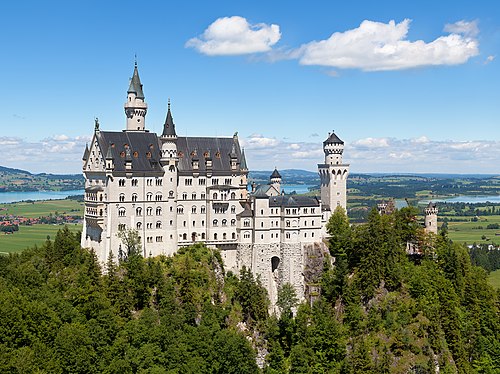 Neuschwanstein CastleStill standing · prime 1886
 Hohenzollern CastleRestored · prime 1867
 Eltz CastleStill standing · prime 1615
All castles in Germany → · Strongest castles in Germany → · Castles of Europe
Play As Your Clan
Hold a real castle against whatever you choose to send at it, take a ship out in her own service years, or stand at the shoulder of someone the record remembers. The chronicler sets the scene; the deeds are yours.