Becker
also Bäcker, Boecker
The baker, and bread was the one thing no town could do without.
- Origin
- German
- Famous bearer
- Boris Becker (b. 1967), Wimbledon champion
- Register
- German family
The seat of Becker
Seat vacantChief
No one leads the Becker community yet. When the movement opens, you can stand for its leadership, or help elect whoever does.
Current mission
No shared goal set yet. Once Becker has leadership, it sets the public focus: a restoration, a gathering, a real-world project that helps its own.
The Becker clan is being rebuilt. Join the waiting list for the movement today, and you help decide who leads it and what it does.
Help rebuild the Becker clan →What does the Becker name mean?
The baker, Middle High German becker / bäcker, thickest in the Rhineland and the west. Cognate of English Baker.
The history of Becker
Beck, Becke, Bäcker: one job spelled a dozen ways
Becker is the younger form. The older German names for the man at the oven are Beck and Becke, thickest in the upper German south, and the ending on -er was built onto them later. Bäcker, the spelling that looks most obviously like the modern word, is the rarer one and sits mostly in the north. Backer and Brodbeck say it again, Brodbeck naming the loaf itself, and the scholars' Latin form is Pistorius. One honest complication: in northern Germany the name can instead mark a man who lived beside a Beck, a brook, exactly as Bach does.
The compounds show the shape of the trade. Kuchenbecker splits the cake-baker off from the bread-baker; Beckenbauer is a farmer who was also a baker, a whole rural arrangement folded into a surname. Becker now stands eighth among the commonest surnames in Germany, and the map is not even. As of 2014 it ran ahead of the national rate across the west, densest of all in the Saarland, and Saxony-Anhalt was the only eastern state above the line. This is a Rhineland and Saarland name before it is anything else.
Zerbst, 1455, and the earliest Beckers on record
The first dated bearer in the German record is not a tradesman at his oven but a man already at the top of a town: Peter Becker, born about 1385 and dead in 1455, burgomaster of Zerbst. Egeling Becker, whose name is also written Engelinus, died in 1481 and is recorded as a preacher and a writer. Dietrich Becker appears before 1498 and last after 1548 as a Münzmeister, master of a mint, the officer answerable for the metal and the weight of a territory's coin.
By the Reformation the name is in the pulpits, and it goes into print translated. Peter Becker (1491-1563), theologian and reformer, stands in the record as Petrus Artopoeus, and Johannes Becker (1520-1566), humanist and jurist, used Artopoeus too. Konrad Becker, who died in 1588, was an evangelical theologian. Within a century of the name hardening into something inherited, men carrying it were minting coin, preaching in German and publishing under a Latin translation of their own surname.
Lambert Becker in the Lübeck council chamber
Lambert Becker was born in Lübeck about 1491 and went to the University of Rostock in 1510 to read law. He came home a Magister and took the humblest seat in city government, chancery clerk, and it was as a clerk that the council sent him on its hardest errand: in 1527 he travelled to Stockholm with Harmen Israhel to demand from Gustav Vasa the repayment of the enormous sum the king owed Lübeck, and the privileges promised for the city's help in taking Sweden.
He was council secretary from 1529 to 1552 and rose to protonotary in 1544. In 1532 he went to Copenhagen with the burgomasters Joachim Gercken and Gottschalck Lunte to press for the exclusion of the Hollanders, the Umlandfahrer, from Baltic trade. Through the disorder of the Reformation years and the Count's Feud he was among the sharpest opponents of Jürgen Wullenwever, and the account he wrote of that period survives. Lübeck elected him to the council in 1552. Illness confined him to his house from 1558; he was still a councillor when he died in 1562, and was buried in the Petrikirche.
Dorothea Becker refuses to confess
The Beckers of Kirchhundem in the Sauerland are documented from 1462, and the tax register of 1536 shows what they were worth: Hans Becker paid four gulden, the second highest assessment in the village, close to a seventh of everything the twenty-four taxpayers owed between them. They were unfree even so, held in serfdom by the lord of Plettenberg at Engstfeld until their release between 1567 and 1570. His daughter Dorothea, born about 1535, married Franz Abhardt around 1560; her husband sat as a Bilstein juror in the 1560s, called himself judge from 1570, and became district clerk to the drost Kaspar von Fürstenberg in 1572.
In 1575 Johann Fronen of Saalhausen, with whom she had quarrelled over a money claim five years earlier, named her under torture as a flier through the air and a dancer at witches' sabbaths. He retracted it in court and was executed on 3 June anyway. Dorothea went after the accusation rather than waiting it out. Her brother, brother-in-law and husband petitioned the drost; the first judge mishandled the hearing so badly it collapsed, and was replaced by the Attendorn geographer Eberhard Halffinner. On 19 July 1575 Dorothea swore to her innocence, her neighbours swore they believed her oath, and the court issued her a documentum purgationis.
It did not save her. The outbreak reached the district of Bilstein in 1590 with twenty-eight accused, eight more the next year and eleven in 1592. Her sister Agnes Stamm was arrested on 16 July 1590, questioned under torture the following day and burned within a fortnight. Dorothea was tortured for the first time on 3 November and admitted nothing; she stood before the Bilstein criminal court on 20 November and again on 22 December. A lawyer was appointed in January 1591 to force a harsher torture on her, and an unnamed defence counsel, who traced the whole case back to Fronen's one false naming, stopped him. Judgment came at the end of January 1593 and she walked out in February. In 1595 Kaspar von Fürstenberg obtained her the right to live unmolested at home again. She died at Bilstein in May 1609.
The Leipzig pastor whose psalms Heinrich Schütz set
Cornelius Becker was born in Leipzig on 24 October 1561, the son of a merchant, went through the Thomasschule and entered the university of his own city in 1573. He was Magister in 1584, deacon at the Nikolaikirche in 1592, pastor there in 1594, doctor of theology in 1599 and full professor in 1601. He was a hard Lutheran who argued in print against crypto-Calvinism, and in June 1601 it cost him his post; he was reinstated that November, found innocent.
He used the suspension. Out of office he began turning the psalms into German song, and finished soon after his return. The Psalter Davids gesangweis appeared at Leipzig in 1602 and ran to more than twenty-five editions by 1712, displacing the Lobwasser psalter that had held the field. Becker died in 1604, at forty-two, and the book kept going without him. Heinrich Schütz set 102 of the psalms in four parts in 1628, ninety of them to melodies of his own; the collection was reprinted at Güstrow in 1640 and became fixed in the prayer hours of the Dresden castle chapel; and in 1661 Schütz republished it at the wish of Johann Georg II of Saxony, completed so that every psalm had a setting, whereupon it entered the reordered Saxon liturgy outright. Hymns of Becker's are still in the German Protestant hymn book, among them Nun jauchzt dem Herren, alle Welt.
The baker's son who became bishop of Königgrätz
Tobias Johannes Becker, in Czech Tobiáš Jan Becker, was born on 15 July 1649 at Grulich in the Königgrätz district, and his father was exactly what the surname says: a baker, and a Schöffe, one of the sworn men of the town. A Jesuit missionary at Glatz noticed the boy's ability and got him into the grammar school there. He read at Prague, took a doctorate in philosophy in 1670, went on to theology because he wanted to be a priest, and was ordained at Prague on 18 March 1673. The Lamboy family gave him the parish of Arnau in eastern Bohemia in 1679; he was called into the Prague cathedral chapter as German cathedral preacher and became scholaster in 1693, and in St Vitus he paid out of his own pocket to restore the statues of the saints that Calvinists had damaged in 1619.
Emperor Leopold I nominated him to the see of Königgrätz; Rome confirmed him on 3 April 1702, he was consecrated at Leitmeritz on 14 May and took possession two days later. He ended the legal quarrels with the town magistrate that had hobbled his predecessors, turned the Palais Gallas into a residence, and built canons' houses and a seminary on the ground of the old castle. Closest to him was the holy place above his home town, the Muttergottesberg: in 1700, before he was ever a bishop, he gave it from his own possessions the image for its new pilgrimage church, a copy of the Marian picture of Santa Maria Maggiore in Rome, and with Count Althann's backing raised there a Servite cloister, a church, a Holy Staircase and a Loreto chapel. As the crown pressed its claims over the church, men held his common birth against him. He died on 11 September 1710 and was buried in his own cathedral.
A priest's mines, and an anatomy chair at Halle
Johannes Franz Becker, born on 18 December 1689 at Meinkenbracht, son of the farmer Henning Becker, was parish priest at Förde from 1718 and at Grevenstein from 1721, and one of the very few clergymen in the Duchy of Westphalia to work mines and smelting on any scale. In 1730, he wrote later, he resolved with his partners to drive mines and began that same year; by 1736 he was overseer of the Elpershagen pits, where he kept a laboratory. Much of the capital came from Maria von Schildern, who gave, on her own statement of 1754, not only for sacraments and chapels but for the priest's mines. He held a lead mine at Bönkhausen and cleared its drainage adit, began a working near Grevenstein for iron and, he thought, tin, and experimented with alloys and melting points somewhere between alchemy and assaying. His stated purpose was to spend the hoped-for profit on the poor souls in purgatory. It never came; he died in January 1777 at eighty-seven.
Johann Friedrich Becker, born in Halle in 1696, was the son of the apothecary Friedrich Jeremias Becker (1665-1724), who owned the Löwen-Apotheke there. He matriculated in medicine at Halle on 28 October 1717 and went on to the Collegium medicum in Berlin. When his father died in 1724 he settled the pharmacy on his younger brother and worked on his doctorate instead, taking it under Michael Alberti in November 1728. He was made extraordinary professor of medicine on 29 June 1729, applied for the chair of anatomy when it fell vacant that year and won it, then held it for less than a year, dying in May 1730 in his thirty-fourth year.
Where the name went
The name is thick in modern German public life. Johann Philipp Becker (1809-1886) is on the record as a revolutionary and Nikolaus Becker (1809-1845) as a poet; Hermann Becker (1820-1885) served as chief burgomaster of both Dortmund and Cologne; Ludwig Becker (1819-1900) was building inspector at Cologne cathedral, and Ludwig Becker (1855-1940), a separate man of the same name, cathedral architect at Mainz. Paula Modersohn-Becker (1876-1907) is one of the German painters of her generation, Jurek Becker (1937-1997) was a novelist, Karl Josef Becker (1928-2015) a cardinal, and Boris Becker, born 1967, the tennis player who won Wimbledon. Two lines are recorded as families in their own right: the Mecklenburg house of academics, a scholarly family since the seventeenth century, and a family of painters whose forebears were art and landscape gardeners at Bonn.
By 2014 barely more than half of all known Beckers, 55.3 per cent, were still in Germany. A quarter, 24.7 per cent, were in the United States, and after that the order is unexpected: 8.0 per cent in Brazil, 2.7 per cent in France, 2.0 per cent in South Africa, 1.2 per cent in Canada. The Brazilian share is visible in the present day in Alisson Becker, born 1992, the German-Brazilian goalkeeper, and in André Becker, born 1996, a footballer of the same double descent.
Individuals went further than the statistics suggest. Alexander Becker (1818-1901) was a Russian-German entomologist and botanist; Adolf von Becker (1831-1909) became a Finnish painter and teacher of art; Abigail Becker (1830-1905) was a Canadian trapper and farmer remembered as the Angel of Long Point; Aharon Becker (1905-1995) became an Israeli politician and trade union leader. In the twentieth century the name reached the top of American academic life with the economist Gary Becker (1930-2014) and the sociologist Howard S. Becker (1928-2023).
The trade emigrated too. The German bakery abroad kept rye and dark bread, rolls, pretzels and stollen on tables where nobody had eaten them before, and became a fixture of every American and Australian city with a German quarter. It travelled better than almost any other skill, because wherever the family landed, the neighbours still wanted bread the next morning.
The castles of the homeland
The great strongholds of the homeland, look one up, see what it looked like in its prime, and recreate it to explore.
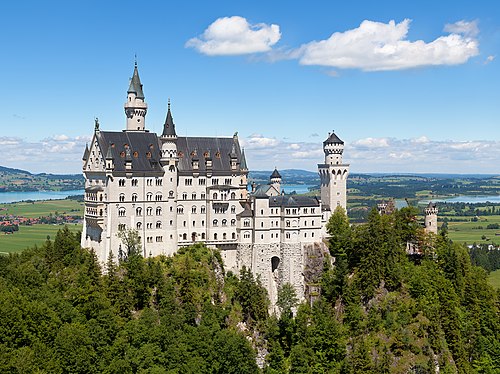 Neuschwanstein CastleStill standing · prime 1886
 Hohenzollern CastleRestored · prime 1867
 Eltz CastleStill standing · prime 1615
All castles in Germany → · Strongest castles in Germany → · Castles of Europe
Play As Your Clan
Hold a real castle against whatever you choose to send at it, take a ship out in her own service years, or stand at the shoulder of someone the record remembers. The chronicler sets the scene; the deeds are yours.
Notable bearers of the Becker name
- Boris Becker (b. 1967), Wimbledon champion