Braun
'The brown one', the German Brown, arrived at separately.
- Origin
- German
- Famous bearer
- Wernher von Braun (1912–1977), rocket engineer
- Register
- German family
The seat of Braun
Seat vacantChief
No one leads the Braun community yet. When the movement opens, you can stand for its leadership, or help elect whoever does.
Current mission
No shared goal set yet. Once Braun has leadership, it sets the public focus: a restoration, a gathering, a real-world project that helps its own.
The Braun clan is being rebuilt. Join the waiting list for the movement today, and you help decide who leads it and what it does.
Help rebuild the Braun clan →What does the Braun name mean?
Descriptive, Middle High German brūn, brown, for brown hair, a brown complexion or brown clothing. The exact German twin of English Brown.
The history of Braun
The brown one, and the other Hans in the room
Braun is Middle High German brūn, brown, fastened to a man for the colour of his hair, the colour of his skin, or the brown clothes he was always seen in. German onomastics sorts family names into four groups: given names, occupations, toponyms, and bodily attributes. Braun sits in the smallest of those, beside Klein for the small man, Groß for the big one and Schwarzkopf for the black head. It never described a man on its own, only as half of a pair, separating him from the other man of the same given name in the same parish, and the German pool of given names was shallow. One Hans is not a record. Hans the brown one is.
The study of British and Irish surnames that concluded in 2016, covering 45,602 names, put Brown fourth in the United Kingdom behind Smith, Jones and Williams. Braun does the identical work in German, and neither language took it from the other. The German evidence shows why no borrowing is needed: the commonest German surnames arose independently across Germany, in every settlement at once, because every settlement had the same need. A colour word for a man's hair is the most available observation there is, so it was made everywhere and owned nowhere.
The century that turned a nickname into an inheritance
Surnames came into German-speaking Europe gradually through the Late Middle Ages. The first commoners' names to pass from father to son were estate names, Hofnamen, heritable as early as the 14th and 15th centuries, because impartible inheritance kept a farm whole and tied it to one patrilineal line, so the farm's name outlasted every man who worked it. A nickname like Braun had no farm behind it. It needed paperwork instead.
German surnames became heritable with the beginning of central demographic records in the early modern period, and the reckoning lands around 1600. The consequence for a name like Braun is plain: a Braun written down in 1500 may well have been called brown because he was brown, while a Braun written down in 1650 was called Braun because his father had been, whatever colour his hair was. Where an estate name and an inherited surname came apart, clerks kept both and joined them, genannt in Germany and vulgo in Austria, so one household could run through a parish book under two names at once.
In church registers of baptism, marriage and burial, until official registration imposed one spelling, the clerks improvised. That registration, rolled out state by state through the 18th and 19th centuries, also ended a habit that still trips up family historians: until then a woman commonly appeared under a female form of the surname, in the south with the ending -in, so that a register carries Peter Huber but Anna Huberin, in West Low German parlance with -sche. A woman and her brother could stand in the same book under visibly different words.
Why there is no Braun castle, and why that is the point
There is no Braun seat, no Braun charter, no forfeiture and no chief. That is not a gap in the research; it is what the name is. A byname invented separately in every German town cannot have one family behind it, and two Brauns meeting in Vienna share an adjective rather than an ancestor. Any pedigree joining two Brauns without a document between them is guessing. The interest of the name is not descent from one man but the number of separate men it was independently true of.
German record-keeping marked that difference in writing. The particle von before a place name was the mark of nobility, so the baron of the village of Veltheim was von Veltheim. The practice ended with the abolition of the monarchy in Germany and Austria in 1919. A plain unparticled Braun is a burgher's name and a farmer's name. When it reached public office it got there by election: Émile Braun (1849-1927), Belgian liberal politician and Mayor of Ghent, and Otto Braun (1872-1955), German Social Democratic politician and prime minister of Prussia.
Georg Braun the geographer, and the scholars after him
The earliest bearer the record dates is Georg Braun (1541-1622), a German geographer. After him the name turns up in the archives and workshops of the German lands with no thread running between the entries: Matthias Braun, in Czech Matyáš Bernard Braun (1684-1738), sculptor and carver; Placidus Braun (1756-1829), historian and archivist; August Emil Braun (1809-1856), archaeologist; Julius Braun (1825-1869), historian.
The 19th century put the name into the natural sciences and kept it there. Alexander Braun (1805-1877) was a German botanist, Maximilian Braun (1850-1930) a German zoologist, Heinrich Braun (1862-1934) a German surgeon, Josias Braun-Blanquet (1884-1980) a Swiss botanist, Hel Braun (1914-1986) a German mathematician. In the United States the name belongs to Annette Frances Braun (1884-1978), entomologist, and Emma Lucy Braun (1889-1971), botanist and ecologist, and further out to Eduardo Braun-Menéndez (1903-1959), Argentine physiologist.
Writers, composers, painters and two baritones
The name carries a long shelf of books. Isabella Braun (1815-1886) was a German writer and Emmy Braun (1826-1904) a German cookbook author; Lily Braun (1865-1916) wrote as a German feminist; Felix Braun (1885-1973) was an Austrian writer and Volker Braun (born 1939) a German one. Lilian Jackson Braun (1913-2011) and Matt Braun (1932-2016), a writer of Western novels, put it on the popular shelves in America.
In music it runs from the concert hall to the pampas: Clemens Braun (1862-1933), German composer, Yehezkel Braun (1922-2014), Israeli composer, Jaime Caetano Braun (1924-1999), Brazilian folk musician and poet. Here the record supplies one of only two family links in the whole roll, Victor Braun (1935-2001), Canadian-born operatic baritone, and his son Russell Braun (born 1965), Canadian operatic lyric baritone. The image-makers are as scattered: Adolphe Braun (1812-1877), French photographer, Maurice Braun (1877-1941), American painter, Herman Braun-Vega (1933-2019), Peruvian painter.
Ma Braun's daughter, and the rest of the sporting Brauns
The second and last pair the record joins is Dutch: Ma Braun (1881-1956), swimming coach, and Marie Braun (1911-1982), swimmer, her daughter. Germany adds the athlete Sabine Braun (born 1965) and the rower Anton Braun (born 1990). József Braun (1901-1943) played football for Hungary, Coloman Braun-Bogdan (1905-1983) managed in Romania, Nico Braun (born 1950) played for Luxembourg, while Egidius Braun (1925-2022) was president of the German Soccer Association from 1992 to 2001.
The name is thick on start lines. Dieter Braun (born 1943) raced motorcycles for Germany and Gregor Braun (born 1955) bicycles, Wilhelm Braun (1897-1969) skied cross-country, Gaston Braun (1903-1990) went down the bobsleigh run for Belgium. Ákos Braun (born 1978) competes in judo for Hungary, Maxim Braun (born 1993) in biathlon for Kazakhstan, and Arik Braun (born 1988) is a German chess grandmaster.
The name that left: Chile, Canada, New Zealand
Braun travelled with the German and Central European emigrations and landed where they landed, arriving already formed because it was never anything more complicated than a colour. Sara Braun (1862-1955) made a business career as a Latvian-Chilean and Carlos Rodríguez Braun (born 1948) is an Argentine economist. North America took the largest share: Albert Braun (1889-1983), American Roman Catholic priest, Robin Braun (born 1958), American vice admiral, and in Canada Adi Braun (born 1962), singer, and Emily Braun (born 1957), art historian.
It reached the far end of the map too, in Meredith Braun (born 1973), a New Zealand film actress, Virginia Braun, a New Zealand psychologist, and Suanne Braun (born 1968), a South African actress. A reader in Ohio or Dunedin who carries this name is not the lost heir of a chief and has no need to be. Braun was earned separately, hundreds of times over, by ordinary people picked out of a crowd by their own hair, and it went wherever ordinary Germans, Austrians, Swiss, Hungarians, Poles and Luxembourgers went.
The castles of the homeland
The great strongholds of the homeland, look one up, see what it looked like in its prime, and recreate it to explore.
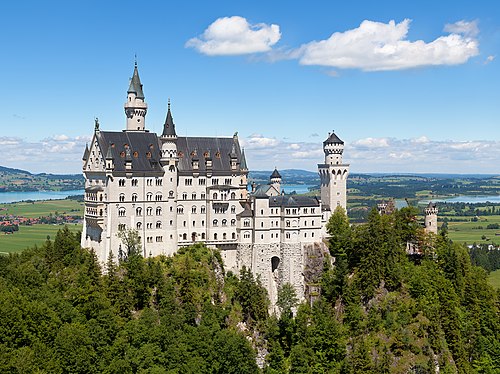 Neuschwanstein CastleStill standing · prime 1886
 Hohenzollern CastleRestored · prime 1867
 Eltz CastleStill standing · prime 1615
All castles in Germany → · Strongest castles in Germany → · Castles of Europe
Play As Your Clan
Hold a real castle against whatever you choose to send at it, take a ship out in her own service years, or stand at the shoulder of someone the record remembers. The chronicler sets the scene; the deeds are yours.
Notable bearers of the Braun name
- Wernher von Braun (1912–1977), rocket engineer