Duffy
also Ó Dubhthaigh
The dark one, erenagh family of the Clogher diocese.
- Origin
- Ulster, Ireland
- Famous bearer
- Carol Ann Duffy (b. 1955), British Poet Laureate 2009–2019
- Register
- Irish family
Where the Duffy name comes from
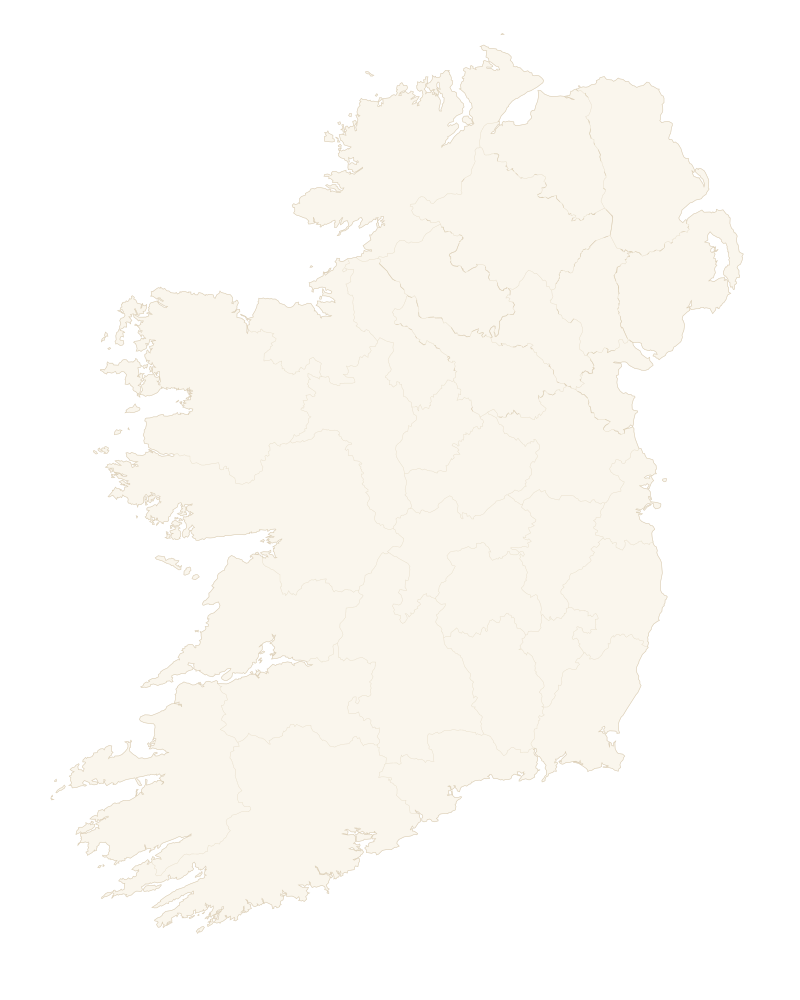
CoreHistoric reach
The seat of Duffy
Seat vacantChief
No one leads the Duffy community yet. When the movement opens, you can stand for its leadership, or help elect whoever does.
Current mission
No shared goal set yet. Once Duffy has leadership, it sets the public focus: a restoration, a gathering, a real-world project that helps its own.
The Duffy clan is being rebuilt. Join the waiting list for the movement today, and you help decide who leads it and what it does.
Help rebuild the Duffy clan →What does the Duffy name mean?
From Ó Dubhthaigh, descendant of Dubhthach ('the dark one'). Multiple distinct Ó Dubhthaigh lines, the principal being the Monaghan-Tír Eoghain Ó Dubhthaigh (a learned ecclesiastical family of the diocese of Clogher), the Donegal Ó Dubhthaigh, and the Roscommon Ó Dubhthaigh of the Sliabh Bawn area. The hereditary office of erenagh (church-tenant) at the Clogher and Killala dioceses gave the Monaghan Ó Dubhthaigh a learned-clerical character that persisted through the high Middle Ages.
The history of Duffy
Dubhthach's people, and the three countries that carried the name
Duffy is the English coat on Ó Dubhthaigh, descendant of Dubhthach, and Dubhthach was an Old Irish personal name meaning black, the dark one. It was never a single family. At least three distinct Ó Dubhthaigh lines are on record: the Monaghan and Tír Eoghain line, a learned ecclesiastical family of the diocese of Clogher; a second line in Donegal; and a third in Roscommon, in the Sliabh Bawn country. The surname literature traces the name itself to Connacht, which is the Roscommon line's ground, while the weight of the modern name sits in south Ulster.
What crossed into English was not one spelling but a scatter of genuinely different words. Duffy, Duffey and Duffee stand beside Duff and Duthie; beside Dufficy; beside Duhig and Duhigg; beside Doey, Dohey and Doohey; beside Dowey and O'Dowey. Where the descendant-prefix was kept the result was O'Duffy or O'Duffe. Each was one clerk's solution to the same spoken name, and once it was written into a register it was handed down the male line unchanged, so that families a townland apart ended up under names that no longer look related.
Erenaghs in the diocese of Clogher
The country the Monaghan Ó Dubhthaigh belonged to was Oirghialla (Airgíalla, or Oriel), the locally powerful grouping that held what are now Tyrone, Armagh, Fermanagh and Monaghan, in the shadow of the Uí Néill. The diocese of Clogher lies across that ground, and it was at Clogher and at Tydavnet that the Ó Dubhthaigh held the office of erenagh: not a post filled by appointment, but a hereditary charge that descended inside the surname itself.
That was Gaelic logic applied to church land. Irish society was organised around the fine (the chief and his patrilineal relatives, together with unrelated clients who took the leading lineage's name as a show of allegiance) and under Brehon law the leaders of a clan were appointed by their kinsmen as custodians of the clan and its property rather than as owners of it. A church family worked the same way. The qualification was the blood, the office was held in trust, and the surname was the title deed, which is how an erenagh family could produce churchmen generation after generation without ever holding a lordship.
Ireland fixed its surnames early. It was in the century of declining Uí Néill dominance (in 1002 the Uí Néill lost the high kingship of Ireland to the Dál gCais leader Brian Boru) that hereditary surnames first came into use there, among the first countries in Europe to adopt them. Ó Dubhthaigh belongs to that first stratum, a fixed inheritance rather than a description of one man's father.
The county and the sheriff replace the country and the chief
The sixteenth century took the ground out from under every family that held anything by Gaelic tenure. English common law was introduced across Ireland along with a centralised royal administration, and the county and the sheriff replaced the 'country' and the clan chief as the units that counted. When the Kingdom of Ireland was created in 1541 the Dublin administration set about drawing the Gaelic chiefs into the new entity, inventing titles for them (Baron Upper Ossory, Earl of Tyrone, Baron Inchiquin) and granting them new coats of arms in 1552.
The policy was surrender and regrant, and its sting was in the succession. A title now passed by the European rule of primogeniture instead of by tanistry, under which a group of male cousins descended from a common grandfather or great-grandfather elected the next chief from among themselves. At a stroke the mechanism by which a Gaelic family renewed its own leadership, and by which a hereditary charge like the Clogher erenaghy stayed inside a surname, had no standing in law.
The break came in the early seventeenth century. In 1607 the senior Gaelic chiefs of Ulster left Ireland to recruit support in Spain, failed, and spent the rest of their lives in Rome; after the Flight of the Earls the English authorities in Dublin held real control over the whole island for the first time, disarmed the native lordships, and cleared the way for the Plantation of Ulster. The Ó Dubhthaigh hold on Clogher and Tydavnet did not survive it. The name did, because by then a surname was heritable property in its own right and needed no office to carry it.
The clerk's ear and the emigrant's own hand
The Gaelic name was built to be parsed. Ó, historically Ua, means descendant; Mac means son; the word that follows stands in the genitive. A daughter took Ní in place of Ó, and a woman who took her husband's name took Bean Uí, or simply Uí, with the following word lenited, so the men and women of one household did not carry the same written surname at all. English record-keeping had no room for any of it.
In anglicising, the prefix was most often cut away entirely. Ó Fathaigh came out as Fahey or Fay; Ó Ceallaigh and Ó Cadhla both came out as Kelly; Ó Dubhthaigh came out as Duffy, with nothing left of the descendant at the front of it. Where the prefix was retained, Ó became O'. The later diaspora reshaping was not done to the Duffys by officials, whatever the story says: no name was ever legally changed at Ellis Island, and immigrants who altered a spelling almost always did it at their own discretion, so as to be read and said correctly by the people they now lived among.
Inside Irish-speaking districts the older machinery went on working underneath the register. A man was called by his own name and his father's and grandfather's in the genitive (Seán Ó Cathasaigh, son of Pól, son of Séamus, was Seán Phóil Shéamuis to his neighbours) and epithets did the rest of the sorting: Óg or Beag for the younger, Mór for the elder, Rua for the red-haired, Bán for the fair. Where a townland held a dozen households of one surname, that was the only system that told them apart.
The Monaghan shoemaker's second son
Charles Gavan Duffy was born in the market town of Monaghan, on the southern Ulster border, on 12 April 1816, the second son of a Catholic shoemaker. He was schooled at the Catholic Latin school in Monaghan and then, on a scholarship his parish priest arranged, at a Belfast hedge-school. At fifteen he left for a Dublin printer's office. It was not a detour: printing and journalism were the trade he worked in for the next sixty years, and everything else he became was built on top of it.
He moved to Belfast in 1834 and from 1837, at twenty-one, edited the Vindicator, a Catholic-Emancipation weekly. Those years gave him three things: an editorial register, a working apprenticeship in the printing economics of the Catholic press of the day, and the connections into Daniel O'Connell's Repeal Movement that decided the rest of his life. He was admitted to the Irish bar in 1845.
On 15 October 1842 he founded The Nation in Dublin with Thomas Davis and John Blake Dillon. It became the principal organ of the Young Ireland Movement, and its editorial principle was foundational to nineteenth-century Irish cultural-political journalism: Irish history and Irish literature, the ballads and the poetry of Mangan and Davis, set in the same columns as the current argument over Repeal, Catholic Emancipation and Famine relief. At its peak it carried a circulation of about ten thousand.
Five trials, no conviction, and a passage to Victoria
Between 1844 and 1849 he was tried five times for sedition and never once convicted by an Irish jury. He came out of the courtrooms as the public figure of the Catholic press in post-Famine Dublin. In 1852 he was elected MP for New Ross and led the Independent Irish Party at Westminster on a platform of tenant-right land reform; in 1855, in frustration at Parliament's refusal to bring the tenant-right bills to a vote at all, he resigned the seat.
That November he emigrated to the new colony of Victoria, and the second half of his life ran in an entirely different register. He was elected to the Victorian Legislative Assembly in 1856, served as Minister of Lands, and was Premier of Victoria from 1871 to 1872, the first Catholic Irishman and the first foreign-born man to hold the office. He became Speaker of the Assembly in 1877, was knighted KCMG in 1873, and retired in 1880.
In retirement he wrote the books that have been the primary source for his own generation's historians ever since: Young Ireland, Four Years of Irish History, and My Life in Two Hemispheres. He died at Nice on 9 February 1903, eighty-six years old, and was buried by his own bequest at Glasnevin Cemetery in Dublin. The compound surname recurs on both sides of the world he lived in: George Gavan Duffy in Irish politics, Frank Gavan Duffy (1852–1936) on the Australian bench.
Bishops, chaplains and two Victoria Crosses
The ecclesiastical thread the Clogher erenaghs began never quite ran out. Joseph Duffy served as an Irish Catholic bishop, John A. Duffy as an American Roman Catholic bishop, and Francis P. Duffy as a Canadian-American Catholic priest; Philip Duffy composed sacred music in England. The printing trade that made Gavan Duffy had a Duffy of its own in James Duffy, the Dublin publisher of Nationalist and Roman Catholic books, bibles and religious texts. Eamon Duffy and the British historian Christopher Duffy both write history for a living.
Two men of the name hold the Victoria Cross: Thomas Duffy (1805–1858), an Irish recipient of the decoration in 1857, and James Duffy, an Irish recipient in 1917. George Frederick Duffey, carrying one of the variant spellings, was President of the Royal College of Physicians of Ireland. Charles John Duffy, an American pilot of the Second World War, has a United States warship named after him, the USS Duffy. Brian Duffy went further out than any of them, as an American astronaut.
The name in a hundred trades
The modern spread follows the emigration routes exactly. In Ireland, Shane Duffy plays football, Joe Duffy broadcasts, Keith Duffy sang with Boyzone, and Francis Noel Duffy has sat as a Green Party TD for Dublin South-West since 2020; Luke Duffy was a trade unionist and politician, Mark Duffy and David Duffy bankers, Martin Duffy and Mik Duffy filmmakers. Jim Duffy, the journalist and political commentator, was the Irish adviser to Australia's Republic Advisory Committee.
In Britain the name is loudest in music and pictures. Billy Duffy and Martin Duffy of Primal Scream played it on stage, Stephen Duffy and Nick Duffy wrote songs, and the Welsh singer Aimée Duffy performs under the surname alone; another Brian Duffy drummed for The Stranglers as Jet Black, while Brian Duffy the photographer worked behind the camera. Maureen Duffy is an English poet, playwright and novelist, and Hetha Duffy and Kevin Duffy founded the publisher Bluemoose Books.
Across the Atlantic and in the southern colonies the name runs through sport and public life: Jimmy Duffy, the Irish-Canadian distance runner; Arthur Duffey, the American athlete; Mike Duffy, the Canadian senator and retired television journalist; Sean Duffy in Wisconsin politics and Robert Duffy as an American mayor; Megan Duffy in basketball, Pat Duffy on a skateboard, Kiera Duffy in opera, Meghan Duffy in biology. In Australia and New Zealand it is Bill Duffy (1866–1959) the sportsman, Kevin Duffy (1897–1977) the footballer, Max Duffy in two football codes, and Ron Duffy in rugby league.
Champions of the Duffy name
The bearers whose lives are inseparable from this surname. Each has their own page, biography, achievements, geography, connection to the family.
The castles of the homeland
The great strongholds of the homeland, look one up, see what it looked like in its prime, and recreate it to explore.
 Ashford Castle, County MayoRestored · prime 1880
 Manderley CastleRestored · prime 1840
 Dublin CastleRestored · prime 1790
All castles in Ireland → · Strongest castles in Ireland → · Castles of Europe
Play As Your Clan
Hold a real castle against whatever you choose to send at it, take a ship out in her own service years, or stand at the shoulder of someone the record remembers. The chronicler sets the scene; the deeds are yours.
Notable bearers of the Duffy name
- Carol Ann Duffy (b. 1955), British Poet Laureate 2009–2019
- Patrick Duffy (b. 1949), actor (Dallas)
- Hugh Duffy (1866–1954), baseball outfielder, .440 batting average 1894