Fischer
The fisherman, the name maps the German waters.
- Origin
- German
- Famous bearer
- Joschka Fischer (b. 1948), German Foreign Minister 1998–2005
- Register
- German family
The seat of Fischer
Seat vacantChief
No one leads the Fischer community yet. When the movement opens, you can stand for its leadership, or help elect whoever does.
Current mission
No shared goal set yet. Once Fischer has leadership, it sets the public focus: a restoration, a gathering, a real-world project that helps its own.
The Fischer clan is being rebuilt. Join the waiting list for the movement today, and you help decide who leads it and what it does.
Help rebuild the Fischer clan →What does the Fischer name mean?
The fisherman, Middle High German vischære. Among the most common German surnames, thick wherever water fed a community, the Rhine, the Elbe, the Danube, the Baltic and North Sea coasts. Cognate of English Fisher.
The history of Fischer
Vischære, and the map the name draws
The surname is simply the German word for the fisherman, from Middle High German vischære, and it has become the fourth commonest family name in Germany. In Switzerland its 15,093 bearers make it the eleventh commonest, and in the United States it is counted among the hundred commonest. What separates it from the other great German occupational names is that it refuses to spread evenly. A tailor or a cook was wanted in any village on any soil; a Fischer needed water, and the name thickens exactly where the water is, along the Rhine, the Elbe and the Danube and on the Baltic and North Sea coasts.
The same job in a neighbouring language produced the same name: Fisher in English, Visser in Dutch. Inside German the registers wrote Vischer, Fischers, Fischler and Fischmann, with Fischl and Fischel in the Upper German south and Fischle in Swabia. In Jewish use the word carries a second sense, a reference to Ephraim, the youngest son of Joseph in Genesis, and when European Jewish immigrants reached Israel the name was frequently reshaped into its Hebrew equivalent, Dayag.
Because it stayed an ordinary word as well as a name, German writers could reach for it and be understood at once. The Brothers Grimm collected Vom Fischer und seiner Frau, the tale of the man sent back to the water again and again on his wife's behalf until she has asked for too much; Goethe wrote the ballad Der Fischer. The trade had standing in the church too. The Apostle Peter was a fisherman, and from him the Catholic Church took the fisherman's ring into the Pope's vestments; fish and fishing run through the gospel miracles and parables.
Traps, nets, and the knowledge that went with them
Fishing is one of a very small number of ways of getting food that has run without a break from prehistory into the present, surviving both the Neolithic Revolution and the successive industrial ones. Where the earliest permanent settlements appear, as at Lepenski Vir, they are almost always sitting on a fishery, because a river that can be fished lets people stop moving. The gear came early too: basketry was worked into fish traps, and spinning and early knitting produced nets that took far more fish than a spear.
The methods available to a medieval Fischer were most of the methods still in use: hand gathering, spearing, netting, angling and trapping, with gaffing and snagging beside them, and in some places trained cormorants and otters sent in to do the catching. What separated the man who fed a household from the man who supplied a market was not the tackle but what he knew, where a species ran, when it fed, which water it held to. There were shortcuts, poisoning, blasting and electrocution, which strip a stretch of water of everything living in it.
The catch was never simply the catcher's. German river and lake fisheries were a regulated right, held, let and fought over, hedged about by guild rule and by the weir rights that decided who could dam a run of water and trap what came down it. Nor did the whole catch go on a plate: fish became isinglass for clarifying wine and beer, and glue, oil, meal and fertiliser.
The silver of the sea
Of everything a net could take, herring mattered most. Europe called it the silver of the sea, and the trade in it has been reckoned the most commercially important fishery in history. In the Middle Ages herring did not merely feed towns, it founded them: Great Yarmouth and Copenhagen both grew out of the herring, and it played a critical part in the medieval development of Amsterdam.
On the northern German coasts the fish was the Baltic herring, a small subspecies running 14 to 18 centimetres where an Atlantic herring reaches 46 and weighs 700 grams. That fishery was one of numbers rather than size, and herring, cod and sprat remain the three commercially important species of the Baltic, the cod at the top of the chain preying on the other two. Small fish in enormous quantity is a particular kind of work, done with nets and salt rather than with lines.
Fresh herring does not travel and salted, smoked or pickled herring does, which is why the curing mattered as much as the catching: it turned a few violent weeks of glut on a coast into food available far inland months later. The fish had a standing that had nothing to do with luxury. In 1274, dying at the monastery of Fossanova and pressed to eat something to regain his strength, Thomas Aquinas asked for fresh herring.
Twelve trawlers, and the nucleus of a German fleet
The trade the name records was remade inside a single century. By the early nineteenth century the fishermen of Brixham in South Devon had exhausted their own inshore water and needed to reach further; the trawler they developed there was sleek and tall-rigged, fast enough for long trips to distant grounds and robust enough to tow a large trawl in deep water. It made large-scale ocean trawling possible for the first time and emptied the southern English ports northwards. Grimsby, a village, became the largest fishing port in the world by the middle of the century, and Queen Victoria opened its Royal Dock in 1854 as the first modern fishing port.
The consequences reached the German coast directly. By the end of the century there were more than 3,000 fishing trawlers in commission in Britain, almost a thousand of them at Grimsby, and they were sold on to fishermen in the Netherlands and Scandinavia; twelve of them went on to form the nucleus of the German fishing fleet. Steam trawlers arrived at Grimsby and Hull in the 1880s, and by 1890 an estimated 20,000 men were working the North Sea. The herring fishery held out longest: the steam drifter did not enter it until 1897, and the last sailing trawler was built in 1925.
The Kassel tailor's son who ended with half a village
The first Fischers the archives catch by name are already off the water. Georg Fischer (1444–1519) was abbot of Zwiefalten and Reichenau; Benedikt Fischer (1491–1554) served as an evangelical pastor in Silesia, and Christoph Fischer (1518–1598) rose to general superintendent at Celle. The fullest life belongs to Johann Fischer gen. Walter (1488–1554), son of the Kassel court tailor Walter Fischer, who matriculated at Erfurt in 1506 and was Riedesel bailiff at Lauterbach by 1511. In 1520 he was a secular canon of St Martin's collegiate church in Kassel and studying at Orleans, and that year his father wrote to the Hessian chancellor Johann Feige about his son's wounding in a duel with a Mainz cathedral canon.
He entered the service of Landgrave Philipp I of Hesse, sat as a councillor in the Kassel chancery from 1523 and took his doctorate in both laws in 1526. In 1528 he and Heinrich Hesse went as Philipp's envoys to the court of Francis I of France, during the Pack affair, to ask for subsidies for the landgrave's struggle against the Habsburgs. In 1532 he negotiated the widening of the Schmalkaldic League. In 1532 and 1533 he was one of three Hessian representatives at Münster who brokered the treaty between the city and its territorial lord, Bishop Franz von Waldeck, confirming religious freedom in imperial law and with it the introduction of Protestantism there.
He went as a Hessian envoy to the diets of Regensburg in 1541, Speyer and Nuremberg in 1542, Nuremberg in 1543, Speyer in 1544 and Worms in 1545, negotiating in person with King Ferdinand at the 1543 diet. From at least 1537 to 1543 he was Rentmeister at Ziegenhain and answerable for the money that built the water fortress there, and Philipp's will of 1542 named him executor and co-guardian for the landgrave's children, lands and people. The reward was land. In 1534, the von Holzheim line having failed, Philipp enfeoffed him and vice-chancellor Georg Nusspicker the Younger with half each of the village of Elfershausen near Malsfeld and its lower jurisdiction; in 1537 he received the castle seat of the extinct lords von Elben on the Obernburg at Gudensberg. He died on 2 August 1554, leaving at least six children.
From a Graz sculptor's workshop to the Karlskirche
Johann Bernhard Fischer von Erlach was born in Graz on 20 July 1656 and baptised in the parish church of Heiligen Blut. His father, Johann Baptist Fischer (1626–1702), was a provincial sculptor who worked on the interior decoration of the Landhaus and of Eggenberg Palace, and it was the Princes of Eggenberg, patrons of the father, who arranged for the son to go to Italy. In 1671, at sixteen, he moved to Rome and entered the workshops of his fellow Austrian Johann Paul Schor and of Gian Lorenzo Bernini. By 1685 he had followed Schor to Naples, where he was reported to have made a considerable fortune serving the Spanish viceroy.
He came back to Austria in 1687, when royalty and the highest aristocracy were repairing country residences wrecked in the Ottoman campaign of 1683, and secured the post of court architect that year; he held it under three emperors. Two temporary triumphal arches built in Vienna for Joseph I's coronation in 1690 brought him acclaim, and he taught the monarch architecture so successfully that Joseph raised him to the nobility in 1696 as Fischer von Erlach. For the Archbishop of Salzburg he built the Holy Trinity Church (1694–1702), the Kollegienkirche (1696–1707) and the country seat of Schloss Klessheim (1700–09), whose pitched domes and convex facades permanently altered the outline of the city.
After Joseph I died in 1711 the commissions thinned, the lighter designs of his rival Johann Lucas von Hildebrandt suiting the young Charles VI better, and Fischer turned to drawing reconstructions of the buildings of antiquity, published in 1721 as A Plan of Civil and Historical Architecture, one of the first comparative studies of world architecture. The Karlskirche in Vienna, begun in 1715 and completed by his son Joseph Emanuel, was his attempt to harmonise the Temple of Solomon, Hagia Sophia, the Pantheon, St Peter's and St Paul's Cathedral in one building. The name recurs among builders after him: Johann Georg Fischer (1673–1747) and Johann Michael Fischer (1692–1766) as master builders, two more Johann Georg Fischers (1697–1780 and 1769–1850) as organ builders.
A doctor to the Tsarina, a postmaster of Bern, a provost in Bohemia
Johann Caspar Ferdinand Fischer, born about 1656 by one reckoning and about 1665 by another, seems to have been of Bohemian origin and spent his youth at Schlackenwerth. By 1695 he was Kapellmeister to Ludwig Wilhelm of Baden, and he may have stayed with that court until his death in 1746 at Rastatt. Le journal du printemps of 1695, eight orchestral suites for strings, was among the first collections of orchestral suites published in Germany. Ariadne musica of 1702, twenty preludes and fugues in nineteen different keys, is reckoned a significant precursor of Bach's Well-Tempered Clavier, and both Bach and Handel knew his work and sometimes borrowed from it.
Johann Bernhard von Fischer (1685–1772) was born in Lübeck and taken to Riga at the age of two. He read medicine at Halle, Jena, Leiden and Amsterdam and from 1710 ran a practice in Riga, becoming second town physician in 1733. The Tsarina Anna then called him as her personal physician, archiater and director of Russian medicine; Charles VI ennobled him and the Leopoldina elected him a member in 1736. In St Petersburg he began in 1739 the first anatomical atlas ever printed in Russia, published in 1744, and he wrote a Livonian household book and treatises on cattle plague. When Elizabeth came to the throne he refused the archiater's post and withdrew to a small estate near Riga.
Beat Fischer (1641–1698) founded the post of the old city and republic of Bern. He joined the Great Council in 1673, and in 1675 the postal monopoly he had himself proposed was leased to him for twenty-five years; he built the Bernese post into one of the fastest services in Europe, and Emperor Leopold I made him a hereditary imperial knight for it in 1680. He published Bern's first weekly newspaper, the Gazette de Berne, from 1677. Conrad Fischer (1631–1701), son of the surgeon Caspar Fischer of Krenkingen in Baden, was ordained in 1651 before he was twenty, taught as canon and professor at Klosterneuburg, was sent to Forbes in southern Bohemia in 1663 and elected provost there in 1677.
The chemists, and the name back at the water
In the nineteenth and twentieth centuries the name attached itself to chemistry hard enough to end up inside the vocabulary of the subject: the Fischer projection for drawing a molecule flat, the Fischer indole synthesis, the Fischer-Hepp rearrangement and the Fischer-Tropsch synthesis that converts coal into hydrocarbons. Behind the procedures stand the men: Emil Fischer (1852–1919), Franz Fischer (1877–1947), Hans Fischer (1881–1945), chemist and physician both, Ernst Otto Fischer (1918–2007), and the Swiss-American biochemist Edmond Henri Fischer (1920–2021). A chemist recorded only as F. E. Fischer made the first laboratory synthesis of serotonin in 1951.
The exact sciences kept the name busy elsewhere. Ernst Sigismund Fischer (1875–1954) worked as an Austrian mathematician and Bernd Fischer (1936–2020) as a German one; Charlotte Froese Fischer (1929–2024) was an American mathematician, physicist and computer scientist, and Irene Kaminka Fischer (1907–2009) an Austrian-American mathematician and geodesist. Emigration is written into the entries themselves: Alfred G. Fischer (1920–2017) is filed as a German-American geologist, Carl Fischer (1849–1923) as a German-American publisher and instrument maker. Bobby Fischer (1943–2008) is recorded as an American and Icelandic chess player and Jack Fischer, born 1974, as an American astronaut; in Germany Joschka Fischer, born 1948, served as Foreign Minister from 1998 to 2005.
The plainest ending is the one that goes back to the water. Bernhard Fischer (1852–1915) worked as a physician and marine microbiologist, the fisherman's name turned on the sea itself and on what lives in it too small to net. The word meanwhile went into commerce and stayed: the Swiss industrial group Georg Fischer AG, the Upper Austrian ski maker Fischer Sports, the S. Fischer house in Frankfurt, and the Fischer group that makes wall plugs and fischertechnik.
The castles of the homeland
The great strongholds of the homeland, look one up, see what it looked like in its prime, and recreate it to explore.
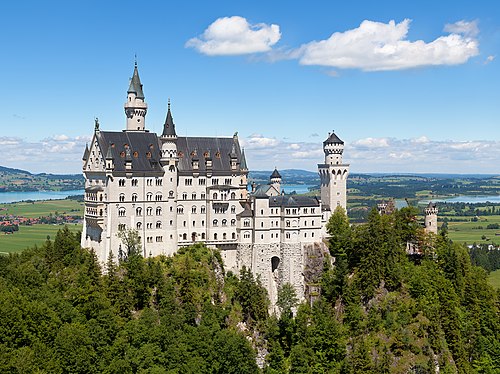 Neuschwanstein CastleStill standing · prime 1886
 Hohenzollern CastleRestored · prime 1867
 Eltz CastleStill standing · prime 1615
All castles in Germany → · Strongest castles in Germany → · Castles of Europe
Play As Your Clan
Hold a real castle against whatever you choose to send at it, take a ship out in her own service years, or stand at the shoulder of someone the record remembers. The chronicler sets the scene; the deeds are yours.
Notable bearers of the Fischer name
- Joschka Fischer (b. 1948), German Foreign Minister 1998–2005