Hartmann
also Hartman
'The strong man', an old knightly given name.
- Origin
- German
- Register
- German family
The seat of Hartmann
Seat vacantChief
No one leads the Hartmann community yet. When the movement opens, you can stand for its leadership, or help elect whoever does.
Current mission
No shared goal set yet. Once Hartmann has leadership, it sets the public focus: a restoration, a gathering, a real-world project that helps its own.
The Hartmann clan is being rebuilt. Join the waiting list for the movement today, and you help decide who leads it and what it does.
Help rebuild the Hartmann clan →What does the Hartmann name mean?
From the old Germanic personal name Hartmann, hart, 'hard, strong', plus mann, a given name from the early Middle Ages that hardened into a surname.
The history of Hartmann
A christening name that stopped being a christening name
Hartmann began as a personal name in the German-speaking lands, built from hart, meaning hard or strong, joined to mann. It was something parents called a boy long before it was anything a family kept, and the record here shows the two uses running side by side for a long stretch: households with Hartmann fixed on them as a surname while other families were still handing the word to sons at the font.
Literary weight attached early. Hartmann von Aue, one of the founding poets of Middle High German, bore the name around 1200 and carried the Arthurian romance into German verse, so the name entered its career as a surname already sounding courtly rather than martial, an unusual inheritance for a word whose root means hard.
The fifteenth century has it working both ways at once. Johann Hartmann, a Schöffe and burgomaster of Aachen who was dead by 1450, is recorded among the bearers of the surname; a sculptor of the early 1400s is recorded under no style at all but Meister Hartmann. The font use outlasted both by a long way, and the noble Roggenbachs were still christening sons Hartmann in 1620.
The Roggenbach son who bought his way into a bailiwick
Johann Hartmann von Roggenbach, born 11 April 1620, carried Hartmann as a christening name and von Roggenbach as his family name: he belongs to the name in its older use, not to the surname. He was one of fifteen children of Hans Hartmann von Roggenbach and Maria Susanna von Zu Rhein, an old family of imperial ministeriales, and his brother Johann Konrad became prince-bishop of Basel. His first recorded service was military and he was very young for it: in 1634 he was with the imperial army against the Swedes at the defence of the Capuchin friary at Freiburg.
His first application to the Teutonic Order failed in 1642, for the flat reason that the bailiwick was admitting no knights at the time. By 1649 he was house commander at Freiburg and ten years later commander of the Freiburg commandery, and he held Beuggen from 1660 to 1666 and Mainau from 1666 to 1676. In 1667 he became Landkomtur of the bailiwick of Swabia, Alsace and Burgundy.
A report survives of the journey he made that year to Mergentheim for his confirmation by the Hoch- und Deutschmeister, and it tells the truth about the institution: it itemises his travelling costs beside the payments made to the order's officers, and shows how expensive buying into the post was. He ruled from Schloss Altshausen and held a seat in the Swabian college of imperial counts, and with it a curiate vote in the Reichstag. He died there on 16 October 1683.
Two printers on the Oder, and the grandson who read law
The clearest documented Hartmann line here is a printing family on the Oder. Johann Christoph Hartmann, born about 1585, had a father, Friedrich Hartman, who was a printer in Frankfurt an der Oder, and a grandfather, Hans Hartman, who had printed in the same town before him; his mother Hedwig died in 1593. He went to the university there rather than into the shop. From 1606 his name begins appearing in works printed in Frankfurt, his dissertation came out in 1622, and he sat as a Rathmann on the council.
More than twenty publications between 1606 and 1624 name him as author or contributor. The last mention of him in the town is from 1624; by 1625 he was at Prenzlau as Landsyndikus of the Uckermark, legal officer of a whole district. Martin Friedrich Seidel gave him a place in the collection of portraits he published in 1698.
The Bohemian Euclid and the superintendent of Rothenburg
Sigismund Ferdinand Hartmann was born in Vienna on 28 October 1632 and joined the Jesuits in 1647. Ordained priest and made doctor of theology, he took the chair of mathematics at Breslau, taught at Olmütz from 1664 to 1667, then moved to a professorship of theology at the Charles University in Prague, where he became dean and senior of the philosophical faculty in 1678. He taught geometry there as well, and Prague called him the Bohemian Euclid.
He had a habit worth remembering him by: every year he set a geometrical problem in public. In September 1679 he asked who could double the area of an equiangular triangle. The question caught the Piarist Augustin Thomas Sackl, an acquaintance of the circle around Leibniz and later professor at Horn in Lower Austria, whose answer grew into his book of 1690 on the metamorphosis of geometrical proportions. Hartmann died in Prague on 17 June 1681. Most of his Latin writing is lost, though his work on the comet of 1664 survives in print.
The confessional other half of those years belongs to Johann Ludwig Hartmann of Rothenburg ob der Tauber, born there on 3 February 1640, son of the pastor Johann Georg Hartmann. He took his master's degree at Wittenberg, preached at Spielbach from 1660, was made rector of the Rothenburg Gymnasium in 1661 and superintendent of the town in 1666, and took his Tübingen doctorate in 1670. His books return again and again to what he thought was wrong with church life around him, and the Pastorale Evangelicum counts among the major works of Lutheran orthodox pastoral theology. He was friend and brother-in-law to Philipp Jacob Spener and wrote to him until his death in 1680.
Portrait plates from Rostock to Riga
Wolffgang Hartmann is known almost entirely from what he cut. Born before 1606, possibly in Danzig, he worked as an engraver and painter in Stockholm and Riga and was in Rostock around 1640; his dates have to be reconstructed from his output, the record of his life never having been assembled. What survives is portraits and city views: the geographer Philipp Clüver, the theologian Johann Quistorp the elder, the Riga cathedral pastor Matthias Reland, the gun-founder Georg Gulten.
His plate of the Swedish commander Gustaf Horn dates from 1652, and the original copper for it was still in the cathedral museum at Riga in 1923. Around 1658, in Lübeck, he engraved the grave slab of the burgomaster Matthäus Rodde, set in the Marienkirche while Rodde was still alive. He died in Stockholm in 1663. An older bearer had worked the same border between craft and science: Georg Hartmann, 1489 to 1564, mathematician and maker of instruments.
Copenhagen, 1779, and a national style out of Silesia
Johann Ernst Hartmann was born at Groß-Glogau in Silesia on Christmas Eve 1726. In 1754 he was playing violin in the orchestra of the Archbishop of Breslau, Count Schaffgotsch; he became concertmaster in the small town of Rudolstadt and then at Plön under Duke Frederick Charles. When the duke died in 1761 the duchy passed to Denmark, the Plön chapel was dissolved, and Hartmann went with some of his colleagues to Copenhagen. He was taken on at once as a violinist in the Royal Chapel, taught pupils who included the future King Christian VII, and in 1768 was made concertmaster for the next twenty-five years.
Copenhagen wanted Danish opera and could not get it. Hartmann was reluctant, writing in 1778 that putting music to sung matter had never been his main business, and the theatre director pressed him anyway. Balders død was first performed on 30 January 1779 and succeeded past anyone's expectation: he used two orchestras, the usual one in the pit and eighteen further players behind the scenes, with three choirs, to get the old Nordic atmosphere. The next year Fiskerne set the lives of contemporary fishermen to Scandinavian folk melodies, and it contains the song Kong Christian stod ved højen mast, adopted in 1780 as the Danish royal anthem.
He died on 21 October 1793, and most of his instrumental music burned in the Christiansborg fire of 1794, the king having bought his collection and placed it in the castle shortly before. What did not burn was the line. His three sons all became musicians; his grandson Johan Peter Emilius Hartmann, 1805 to 1900, stood at the centre of Danish nineteenth-century music, and Johan Peter Emilius's son Emil was a noted composer and conductor. Emil's daughter Bodil kept musical gatherings at the manor of Fuglsang on Lolland from 1885 to 1959, where Edvard Grieg and Carl Nielsen were among the guests.
Locomotive works, textile mills and shipping lines
Nineteenth-century industry took the name up hard. Richard Hartmann, 1809 to 1878, built machines and was a pioneer of the Saxon railways, and his works carried his name long after him as the Sächsische Maschinenfabrik, formerly Richard Hartmann. Ferdinand Hartmann, 1790 to 1842, and Wilhelm Hartmann, 1808 to 1872, ran textile firms, and Eugen Hartmann, 1853 to 1915, worked in the new electrical engineering.
The name went onto products too. A German small car of 1905 was sold as the Hartmann, Max Hartmann built small tractors, and the Hartmann Gruppe still makes hygiene goods. At sea, Emil Hartmann, 1927 to 2007, was a shipowner, and Alfred Hartmann, born 1947, founded the Hartmann line. Medicine got an institution out of the name as well: Hermann Hartmann, the physician who lived from 1863 to 1923, founded the doctors' association still called the Hartmannbund.
A jaw in a sand pit, and the name carried abroad
Not every bearer who left a mark was educated to do it. Daniel Hartmann, born in 1854 and dead in 1952, worked a sand pit and found the lower jaw at Mauer, one of the most consequential objects ever turned out of German ground. Gustav Hartmann, 1859 to 1938, drove a cab and was known to everyone as the Iron Gustav. Hans Hartmann, an officer who died in 1951, is recorded among the Righteous Among the Nations.
The name travelled early and in unlikely directions. Johann Adam Hartmann, 1748 to 1836, left for America and lived as a trapper. Anastasius Hartmann, 1803 to 1866, went from Switzerland as a missionary and ended as apostolic vicar of Bombay and Patna. At home it became a fixture of philosophy through Eduard von Hartmann, 1842 to 1906, and Nicolai Hartmann, 1882 to 1950, and of the sciences through the astronomer Johannes Franz Hartmann, 1865 to 1936. An asteroid carries it too, catalogued as 3341 Hartmann, a long way from a boy in a medieval village called the strong one.
The castles of the homeland
The great strongholds of the homeland, look one up, see what it looked like in its prime, and recreate it to explore.
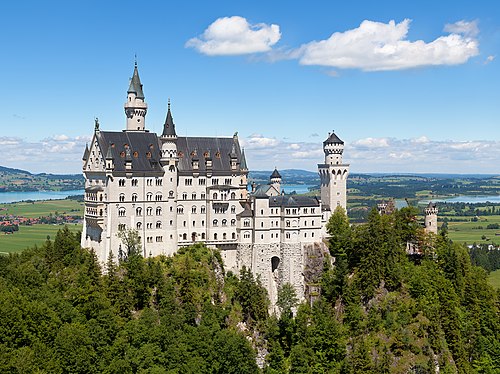 Neuschwanstein CastleStill standing · prime 1886
 Hohenzollern CastleRestored · prime 1867
 Eltz CastleStill standing · prime 1615
All castles in Germany → · Strongest castles in Germany → · Castles of Europe
Play As Your Clan
Hold a real castle against whatever you choose to send at it, take a ship out in her own service years, or stand at the shoulder of someone the record remembers. The chronicler sets the scene; the deeds are yours.