Hoffmann
also Hofmann, Hofman
The man of the farmstead, a holding of one's own.
- Origin
- German
- Famous bearer
- E. T. A. Hoffmann (1776–1822), writer and composer
- Register
- German family
The seat of Hoffmann
Seat vacantChief
No one leads the Hoffmann community yet. When the movement opens, you can stand for its leadership, or help elect whoever does.
Current mission
No shared goal set yet. Once Hoffmann has leadership, it sets the public focus: a restoration, a gathering, a real-world project that helps its own.
The Hoffmann clan is being rebuilt. Join the waiting list for the movement today, and you help decide who leads it and what it does.
Help rebuild the Hoffmann clan →What does the Hoffmann name mean?
From Middle High German hof, the farmstead or manorial court, plus mann: the man of the Hof, the steward of a great farm, or a farmer who held his own freehold rather than working another's land.
The history of Hoffmann
The man of the Hof, and the man of the Hufe
Hof in Middle High German carried two senses at once, the farmstead and the manorial court, and a Hoffmann was the man attached to it in either sense: the tenant of a substantial Gehöft, the farmer who owed service to a lord for it, now and then a Höfling about a court. Hessian speech made him Hobemann, and Low German ground the same word down to Havemann and Hamann.
The near neighbours mislead. Huber, Hufner and Hubbauer sound like relations of Hoffmann and are not: they descend from the Hufe, the measured allotment of land dealt out to a tenant, and say how much ground a man held. Hoffmann descends from the Hof and says what he answered for. Alongside it grew a whole shelf of names off the same three letters, close in sense and separate in root: Hofer and Höffner, Hofbauer, Hofrichter, Hofmeister, Hofstätter, Oberhofer.
Silesia, where every estate had one
Hoffmann with the doubled f stands tenth among German surnames and Hofmann with one stands twenty-third, and the two spellings ran side by side in the same families for centuries. The distribution is not even. Meyer and its variants cluster in the far north and the far south of the German-speaking lands; Hoffmann fills the broad band between them, and it lies thickest in the east.
In Silesia it was the commonest occupational surname of all, doing there the work that Meier did in the west and the south. A Silesian Hoffmann managed a lordly estate, or the country property of a town patrician who had bought land with merchant money. So it is no accident that the earliest Hoffmanns the records name in full turn up at Schweidnitz, Jauer, Görlitz and Breslau.
Schweidnitz to Leipzig: the walkout of 1409
Johannes Hoffmann von Schweidnitz was born around 1375 in Schweidnitz, in the duchy of the same name, and went to Prague in 1393 to read theology. He took his baccalaureate in 1396 and his licentiate four years after that, then a master's degree, and climbed the university: dean of the faculty of arts in 1408, rector by 1409. Czech records know him as Jan Hofman ze Svídnice, the Latin ones as Iohannes Hoffmanus Svidnicensis.
1409 was the year the Jan Hus crisis broke over Prague and came to a head in the Decree of Kutná Hora. Hoffmann's answer, organised with Johannes Otto von Münsterberg, was to take the German university out of the city altogether. Somewhere between five thousand and twenty thousand doctors, masters and students left for Leipzig, and the reputation of Prague's university was severely damaged by it. Münsterberg became rector at Leipzig; Hoffmann became co-founder and professor of theology in the Princes College, and was elected rector himself for the summer semester of 1413.
The rest of his life belonged to the church of Meissen. He was a canon of the cathedral by about 1415 and provost of the collegiate chapter at Großenhain, and he sat at the Council of Constance from 1414 to 1418, the council that closed the Western Schism. When Münsterberg died in 1422 he founded the College of Our Lady at Leipzig for Silesian professors. Appointed Bishop of Meissen in 1427 as Johann IV, he was reckoned wise and prudent in the office, steered the diocese through the Hussite Wars, and ended the exemption with the archbishopric of Magdeburg that had stood since 1400. He died at Burg Stolpen in 1451; his sandstone grave slab in Meissen Cathedral shows him with the crook, his right hand raised in blessing. He left two works behind him, a book of theological questions with their solutions and a treatise in six books on the office of the mass, addressed to the brothers Friedrich and Wilhelm, margraves of Meissen; both mark him out as loyal to the papal scholars and an opponent of the Hussites.
Görlitz, 1543: the arrival of Hans von Jauer
The Görlitz burgher lists record their first Hoffmann in 1543. He had come out of the Schweinitz country, had probably been living at Jauer in Silesia since some point after 1525, and the citizenship roll enters him plainly as Hans von Jauer. He was a cloth merchant and a wealthy one, and the judgement passed on him locally was that he was to be found wherever there was money to be made. His first wife, Dorothea Marquart of Glogau, died in 1537 leaving a son, Friedrich; his second, Ursula Schütze, was the eldest daughter of Sebastian Schütze the elder of Nuremberg and bore him Elisabeth, Georg, Sebastian and Katharina. Husband and wife were buried in the Frauenkirche, each with an epitaph set over the door of the sacristy. The Schütze connection was then doubled: Friedrich, the son of the first marriage, married Sabina, the youngest daughter of that same Sebastian Schütze, and so became his own father's brother-in-law.
The family carried arms before it carried Görlitz citizenship. On 15 May 1525, out of Ofen, King Ludwig granted a patent of arms to Andreas Hoffmann together with Hans and Christoph: a Moor in a green wreath on a shield parted blue and gold, a rising silver moon in his raised right hand. Emperor Maximilian confirmed the family's noble standing at Vienna on 13 March 1574 for Sebastian, his brother Georg and their half-brother Friedrich, adding a silver lily to the arms; Rudolf II confirmed it a second time out of Prague on 12 March 1577, with the mantling swapped left for right and the shield quartered.
How the two ends of that story join is genuinely disputed, and worth saying so. Konrad Blažek, working through all three patents in 1890, made Andreas the grandfather of Sebastian. In 1914 the Hennersdorf pastor Johannes Trillmich pointed to an inconsistency: the 1574 confirmation makes Andreas the brother of Hans's father, which would make him a great-uncle, where the 1525 patent has Andreas as father of Hans and Christoph. One document or the other must be wrong. The 1525 grant survives only as a copy, it spells the name Hoffmann where the burgher list writes Hofemann, and patents of arms are rare that early: those are the grounds on which the document itself has been doubted, which would leave Andreas the great-uncle. The other reading, a slip of the pen in the 1574 confirmation and Andreas the grandfather, is held to stand quite open. It has never been settled.
The mayor of Görlitz, and the end of the line
Sebastian Hoffmann was born on 14 October 1551 and matriculated at Leipzig in 1565, aged fourteen. He was an orphan at sixteen, and was probably brought up after that by his half-brother Friedrich or his sister Elisabeth. He travelled a great deal and studied at several academies, mostly in law; he joined the convivium musicum, the town's musical circle; and he kept a diary, still held in the Görlitz council archive, whose Latin passages were written with real facility. He read enormously, as the size of his library made plain.
He came of age in 1575, twenty-four being majority under the law of the day, and took up his inherited share of Hennersdorf under a contract of 14 June that year; his brother Georg's share was divided in three among the surviving brother and sisters on Georg's death. On 16 February 1577 Rudolf II summoned him, with great ceremony, to the burial of Maximilian II in St Vitus in Prague on 20 March. That April he married Magdalena, daughter of Joachim Schmidt, himself several times mayor of Görlitz. From May 1579 he owned the so-called Schlösschen, later rebuilt as the Görlitz Ständehaus, and sold it again in 1582; from September 1580 he held the house on the Neißestraße that was rebuilt in the baroque after the town fire of 1726.
There was a shadow over the inheritance. Hans Hoffmann had given himself to the teaching of Kaspar Schwenkfeld, the physician whose following stamped the household with a high moral seriousness and cost it something in influence; Sebastian appears to have renounced the doctrine, holding it mistaken and at odds with the established order. What he kept was the outward observance, an evident valuation of church order set down in the diary beside a streak of superstitious fear, and a piety plain enough that his attendance at confession was noted. He was a friend of Scultetus. His standing was reckoned higher than his father's had been, though he was much the lesser merchant: it rested on his own competence, on marriages into the respected families of the town, on the fortune Hans had built, and, contemporaries said, on his character.
He entered the senate in 1587 and worked through its offices in turn: the church property and the oversight of the school until 1592, then the wine cellar and the mills, and he sat as Schöppe in nine of the thirteen years between 1591 and 1603. He was church warden from 1590 to 1592, and his wife died inside that stretch; he stayed a widower. He was mayor of Görlitz in 1593, 1597 and 1601, and again in 1605, when on 16 January Rudolf II released him from the office at his own petition, for age and infirmity, while asking him expressly to go on making his help available. Of his three children by Magdalena, the boy Johannes Sebastianus lived only two years; the daughters, Magdalena and Anna, both married and had children of their own. He died on 4 May 1605 after a quarter of a year's rest, and the noble line of Hoffmann ended with him.
The stonemason who furnished Trier
Hans Ruprecht Hoffmann was born around 1545, most likely at Worms, and learned the trade under Dietrich Schro at Mainz and Johann von Trarbach at Simmern before making master in the stonemasons' guild. He built a large sculpture workshop, and what people noticed in the work were the faces, unusually expressive for their date. He became one of the leading exponents of Mannerism west of the Rhine.
Trier is where to go and look at him. The pulpit of the cathedral is his, cut between 1570 and 1572; so is the Peter Fountain of 1595 on the main market square, a marble altar relief in the cloister of 1596, and three altars raised over the graves of three successive archbishops, the Trinity Altar of 1597 for Jakob von Eltz-Rübenach, the St John Altar of 1601 for Johann von Schönenberg, the All Saints Altar of 1614 for Lothar von Metternich. The Liebfrauenkirche holds his grave altar for Hugo Schonenburg, and the basilica at Prüm a stone pulpit finished before 1590. He outlived two wives, Katharina and Anna Örthin, married a third in 1590, and died in 1617 with the cathedral full of his work.
Breslau: the mayor who wrote the poems
Christian Hoffmann von Hoffmannswaldau was baptised in Breslau on 25 December 1616 and died there in 1679. He was schooled at Danzig and at Leiden, where he fell in with Martin Opitz and Andreas Gryphius, the two commanding figures of German poetry in that century, and in later life he went into the politics of his own city and rose to be its Bürgermeister.
His verse circulated in manuscript while he lived. It was the posthumous Deutsche Übersetzungen und Gedichte of 1679, and then Benjamin Neukirch's much larger collection from 1695, that fixed him as the most influential poet of his era. The manner took the name galant poetry: extravagant metaphor, a practised command of rhetoric, and an eroticism that made no apology for itself, with the Italian Giambattista Marino audible behind it. It stayed popular until Johann Christoph Gottsched attacked it for bad taste in the middle of the next century.
Hoffmannswaldau also shows a habit of this name: a second element could be joined to it, usually a von and a place, and the compound then inherited. So the officer lists and the studios carry Hoffmann von Löwenfeld, Hoffmann von Waldau, Hoffmann von Wendheim, Hoffmann von Vestenhof; the Germanist, writer and librarian August Heinrich Hoffmann von Fallersleben (1798-1874) carried a place name into his own; and Austria produced Hofmannsthal, borne by the merchant Isaak Löw Hofmann, ennobled as Edler von Hofmannsthal, and most famously by the poet and librettist Hugo von Hofmannsthal.
Halle apothecaries, and the Friedrichs after them
Laurentius Hoffmann was born at Halle on 12 April 1582 into a house of medicine. His father, also Laurentius, was an apothecary; his mother Elisabeth Holzwirth was an apothecary's daughter; and after his father's death she married Balthasar Brunner, physician in ordinary to the elector of Saxony, which put the boy inside a working practice. He began his own career in 1617 by editing his stepfather's collected works, and he married Brunner's daughter Maria.
In Halle he assembled a cabinet of natural curiosities that he named the Thaumatophylakion and described himself in 1626. On 24 June of that year he was appointed physician in ordinary to Johann Georg I and sworn in a week later beside two colleagues, on terms the record keeps to the last item: five hundred florins a year, eight stacks of beech firewood, free transport when travelling, and board on the same footing as the councillors. He died in Halle in 1630. His epitaph stood in the Ulrichskirche until it was removed during restoration work in 1885, and pieces of it are now in the Gothic vault of the Moritzburg museum.
His brother Andreas (1592-1665) was an apothecary and city chamberlain in Halle, and from Andreas the medicine ran three generations further, documented at every step. Andreas's son Friedrich (1626-1673) was physician in ordinary to the prince of Magdeburg. That Friedrich's son, another Friedrich (1660-1742), became a well-known physician, professor and privy councillor, and physician in ordinary to the king of Prussia. His son Friedrich (1703-1766) was court councillor and professor of medicine in turn. Three Friedrichs in succession, each of them in medicine.
Spelling the name with a single f, Moritz Hofmann came at medicine from the dissecting table. Born at Fürstenwalde in 1621 to David Hofmann, mayor of Beeskow and Storkow, orphaned and taken in by an uncle who was professor of medicine at Altdorf, he studied at Padua under Johann Vesling and in 1641 found the pancreatic duct in a rooster. Johann Georg Wirsung then found it in humans, and it is Wirsung's name the duct carries. Hofmann taught anatomy and surgery at Altdorf from 1648 and held the chair from the year after, was known above all as a teacher of anatomy, and his son Johann Moritz (1653-1727) took the same subject there after him.
The name that travelled
The best-known Hoffmann of all did his writing beside a legal career. E. T. A. Hoffmann (1776-1822) was a jurist by profession and a writer, composer and draughtsman besides, and the record files him under those four initials rather than under Ernst Theodor Amadeus. His grandfather Friedrich Christoph Hoffmann (1708-1758) was a pastor, his mother was Louise Albertine Hoffmann (1748-1796), and his wife Michalina (1778-1859) was Polish.
The name emigrated well because it needed almost no adjusting. American records carry Hoffman, Hofman, Huffman, Hopman and Coffman; Russian turned it into Goffman, Lithuanian into Hofmanas. It went into chemistry with August Wilhelm von Hofmann (1818-1892) and the Swiss Albert Hofmann (1906-2008), into Austrian architecture and design with Josef Hoffmann (1870-1956), onto the concert platform with the Polish-American pianist Josef Hofmann (1876-1957), onto American canvas with the painter Hans Hofmann (1880-1966), and back into chemistry with the Polish-American Roald Hoffmann, born in 1937.
It went onto letterheads as readily: Hoffmann-La Roche in Basel, the publishers Hoffmann und Campe, the Hoffmann Group in tools, Hoffmann Propeller, the Emanuel Hoffmann art foundation in Switzerland. In Naples, Florida, the family firm David Hoffmann founded in 2015 has gathered some hundred and twenty brands and sixteen thousand employees across thirty countries, nineteen publications among them, and in December 2025 it was announced that the family was buying the Pittsburgh Penguins. A name that began with the man who answered for somebody else's farmyard has stayed, remarkably steadily, a name for people who run things.
The castles of the homeland
The great strongholds of the homeland, look one up, see what it looked like in its prime, and recreate it to explore.
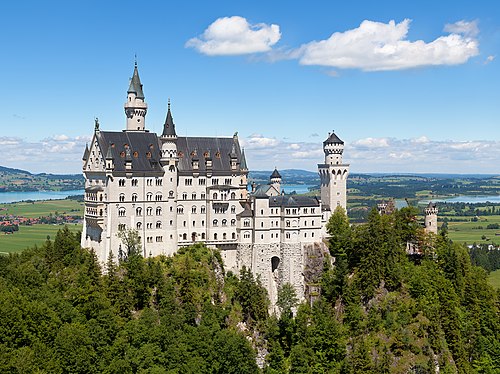 Neuschwanstein CastleStill standing · prime 1886
 Hohenzollern CastleRestored · prime 1867
 Eltz CastleStill standing · prime 1615
All castles in Germany → · Strongest castles in Germany → · Castles of Europe
Play As Your Clan
Hold a real castle against whatever you choose to send at it, take a ship out in her own service years, or stand at the shoulder of someone the record remembers. The chronicler sets the scene; the deeds are yours.
Notable bearers of the Hoffmann name
- E. T. A. Hoffmann (1776–1822), writer and composer