Huber
also Hueber, Huebner
The full-holding farmer, and proof the German tree runs past the German state.
- Origin
- German
- Register
- German family
The seat of Huber
Seat vacantChief
No one leads the Huber community yet. When the movement opens, you can stand for its leadership, or help elect whoever does.
Current mission
No shared goal set yet. Once Huber has leadership, it sets the public focus: a restoration, a gathering, a real-world project that helps its own.
The Huber clan is being rebuilt. Join the waiting list for the movement today, and you help decide who leads it and what it does.
Help rebuild the Huber clan →What does the Huber name mean?
From Middle High German huobe (Hube), a 'hide' of land, the standard full farm-holding, so the Huber was the substantial farmer who held a whole Hube, a man of weight in his village. The great surname of the upper-German south: Bavaria, Swabia, Austria and German-speaking Switzerland.
The history of Huber
A Hube of arable, and the man who held a whole one
In the upper German speech area a Huber was a rent-paying farmer who held a fief of a defined size, one Hube of arable land, from a lord. That is a measure of standing as much as of acreage. Under manorial tenure very little ground was owned outright: the lord held rights granted from above, the tenant held the land for rent and labour, and his user rights passed to the next generation. Holdings were never equal, and around half the adults on a manor held no land at all. The man who held the full measure fed his household from it and had a surplus besides, and he sat at the head of the village's farming families without being gentry.
The name has a second root that is a place rather than a person. It can be a dwelling-place name taken from a locality called Hub. The map still carries the result: there is a Huber in the municipality of Irschenberg and another in Weyarn, both in the Landkreis Miesbach in Bavaria, a Huber am Bach in Halsbach in the Landkreis Altötting, and the hamlet of Huber in Thalgau in the Salzburg district.
Both routes were open in every village of the south at once, which is why the name multiplied without any of its bearers being related. Huber stands among the five to ten commonest surnames of the German-speaking lands. In Austria it is second only to Gruber, 5,109 entries against 5,482, and accounts for roughly 0.3 per cent of all surnames there; in Switzerland it is the seventh commonest. Hueber, Huemer, Humer and Hufner are the same word worn differently, and Hinterhuber and Sinnhuber are the same word with a qualifier stuck on the front to tell two Hubers apart.
The carver who signed a king's canopy at Wawel
Jörg Huber, attested from before 1495 to after 1509, was a sculptor and woodcarver of the late Gothic who probably came out of Passau. By 1495 at the latest he was in Kraków, where he worked first for the painter Lucas Molner, who died that year. In 1496 he was granted the city's citizenship, and by 1503 he was elder of the painters' guild: a German-speaking carver made a burgher of Kraków and then set over its painters.
One work is certainly his because he put his name on it, the baldachin over the tomb of King Casimir IV in the Holy Cross Chapel of Kraków's Wawel cathedral. The rest is attribution: the tomb of King John I in the Wawel's chapel of St John, the tomb of Bishop Peter of Bnin in the cathedral at Leslau, the tomb of Archbishop and Primate Zbigniew Oleśnicki in the archcathedral at Gnesen, and a triptych in the Wawel bell tower. He is thought to have worked often alongside Veit Stoss and Stoss's son Stanislaus. Then he wound up the Kraków workshop and left the city for a destination nobody recorded. The last trace of him is dated 1509.
Wolf Huber of Feldkirch, court painter on the Inn
Records place the birth of Wolf Huber at Feldkirch in Vorarlberg, and his birth date is estimated at about 1485 because works dated between 1510 and 1515 already show a mature, well-established artist. By 1515 he was living in Passau, where he spent most of his life as a leading member of the Danube school. Nothing is known of his training beyond the likelihood that he served in a family workshop before going out as a journeyman, and his connection to the other painters of the name at Feldkirch is not documented. His drawings of local subjects show he saw the Salzkammergut at least once, and his grasp of Italian Renaissance technique suggests he had been to northern Italy.
In 1517 he became court painter to Ernst, Duke of Bavaria, who administered the Passau diocese until 1540. In 1529 Count Niklas II von Salm commissioned him to rebuild Neuberg Palace on the river Inn; only fragments of it survive, and they show wings added in Italian Renaissance style with rich decorative painting. He probably also designed the reliefs for the tomb of the count's father, Niklas I von Salm, which now stands in the Votivkirche in Vienna. For the palace he was paid in a pension and a manor house, Neufels.
When Count Wolfgang von Salm became bishop of Passau in 1542 he confirmed Huber as court painter and recorded, unusually, that the painter was not subject to the laws of the painters' guild. Huber died in his manor house at Passau on 3 June 1553. Almost nothing of the architecture survives and few of the paintings; what remains is thirteen woodcuts, the portrait pendants of the mintmaster Anton Hundertpfund and his wife from 1526, and a strange image of the scholar Jakob Ziegler from 1550, set frontally against a panorama of the cosmos.
The Burgdorf pastor who argued his way out of Bern and out of Saxony
Samuel Huber was born on 21 May 1547 at Burgdorf, son of Peter Huber, rector of the town school, and his wife Apollonia. He studied at Bern from 1561 to 1565 and then at Basel, Heidelberg and Marburg, served as conrector of the Bern school from 1567, and in 1570 took the parish of Büren an der Aare, for which he had to sign the Confessio Helvetica posterior. Saanen followed in 1576, and in 1581 his own birthplace, where he later became vice-dean of the Burgdorf chapter.
Then he turned toward Lutheran theology and liturgy and began contesting the Calvinist teaching on the Lord's Supper and on predestination, which made him the trigger of the Bern predestination dispute of 1588. At the colloquy of Mömpelgard in May 1586 he took the side of Jakob Andreae and called the doctrine of Théodore de Bèze unchristian and hideous, and the church court disciplined him for it in 1587. Outside theologians were brought in and still no agreement could be reached, so to restore quiet the Swiss church released him from its service altogether.
Württemberg took him in. He signed the Formula of Concord, got the parish of Derendingen, and produced a Latin work contradicting Calvinist predestination in 1,329 theses. That brought him to Saxony's notice and a chair on the theological faculty at Wittenberg, where he took the required doctorate on 30 September 1592 under Polycarp Leyser. He proved combative, fell out badly with Aegidius Hunnius the Elder and Salomon Gesner, refused to shift ground, and in 1594 was dismissed and expelled from Electoral Saxony. He matriculated at Rostock that same year with his son Salomon, was granted a kind of stipend by Duke Friedrich Ulrich of Brunswick-Wolfenbüttel in 1611, and died at 77 at Osterwieck near Halberstadt, in his son-in-law's house.
Five thousand faces, and a register to prove it
Johann Rudolf Huber, born in Basel on 21 April 1668, was the son of Alexander Huber, an innkeeper who sat on the city's Grand Council. He took drawing lessons as a child from one of the Wannenwetsch family of glass painters, was apprenticed at fourteen in 1682 to the portraitist Hans Kaspar Meyer, and studied from 1684 to 1687 at Joseph Werner's private academy in Bern. In his own time he painted craftsmen for very little money, and found his lifelong subject in it. From 1683 to 1718 he catalogued every finished work in a book he called his Register der Contrafeit, so Ich nach dem Leben gemahldt habe, now held at the Kunstmuseum Winterthur; he later boasted of having executed more than 5,000 portraits.
The training took him a long way round. He stayed at the Prince-Bishop of Basel's residences at Moutier, Delémont and Arlesheim, picking up commissions, and on Werner's advice went to Italy in 1687. The decisive stretch was three years at Haarlem under the landscape and marine painter Pieter Mulier the Younger, whose landscapes he peopled with figures. Then Florence, and Rome, where he gained access to Carlo Maratta and the Accademia di San Luca, and home by way of Lyon and Paris.
Back in Basel in 1693 he married Catharina Faesch, a city councillor's daughter, and entered the Grand Council the next year. He painted for Frederick VII, Margrave of Baden-Durlach, then living in exile in Basel, and through the margrave's mediation became court painter to Eberhard Louis, Duke of Württemberg, covering ceilings and walls at the Old Castle in Stuttgart between 1697 and 1699; a fire in 1931 destroyed most of it. In 1701 he was made building inspector for the upper part of the margraviate, wrecked in the Nine Years' War. Lacking recognition at home, he lived mainly in Bern from 1702 to 1738 and produced some 400 portraits of Bernese society there, along with official likenesses of the Schultheissen and designs for title pages, heraldry, city seals and clocks. He returned to Basel in 1738, joined the Small Council in 1740 and died on 28 February 1748, aged 79. Among his sitters were the Emperor Joseph I and Albrecht von Haller.
Marie Huber, arguing theology from Geneva
Marie Huber was born on 4 March 1695, one of fifteen children, and became a Genevan writer on theology as well as a translator and editor, at a time when a woman writing theology at all was rare. She was a proponent of universalism and reckoned by some a deist. Her first surviving books both came out in 1731: Le Monde fou préféré au monde sage, from presses in Amsterdam and Geneva, in which three friends, Criton the philosopher, Philon the advocate and Eraste the merchant, walk and talk their way through twenty-four conversations, and Sentimens differens de quelques théologiens sur l'état des âmes séparées des corps, argued across fourteen letters.
Both were reissued and enlarged rather than left to settle: the pair of them in 1733, the Sentimens again at London in 1739, and the Monde fou in a 1744 London and Geneva edition grown to twenty-six walks. The Lettres sur la religion essentielle à l'homme appeared at Amsterdam in 1738 and at London and Lausanne in 1739. In English translation as Letters Concerning the Religion Essential to Man, that book is known to have been read by Robert Burns. She died on 13 June 1753, and a supplementary volume of her pieces was printed at Berlin the following year. The naturalist François Huber was her great-nephew.
The Freising brewer's son who ran Weihenstephan for forty-four years
Ildephons Huber was born Johannes Hueber at Freising on 10 May 1677, son of Balthasar Huber of the Furtnerbräu and his wife Katharina. He joined the Benedictines at Weihenstephan, took Ildephons as his name in religion, and studied at Munich, Salzburg, Benediktbeuern and Ingolstadt. He became abbot in 1705 and held the office until his death in 1749, and for eighteen of those years, from 1717 to 1735, he was also Generalpräses of the Bavarian Benedictine Congregation.
The job was as much estate management and law as prayer: besides administering the monastery's extensive property he sat as judge in the Hofmarken that Weihenstephan held. He also had an eye for builders. He counts as one of the first patrons of the Asam brothers, and in 1718 he had the Korbinian chapel at Weihenstephan taken down and replaced with a new one of their design. He died at Weihenstephan on 31 October 1749. A tablet on the Furtnerbräu building at Freising still commemorates the brewer's son who left it for Weihenstephan.
A name that keeps crossing the border
Set those lives on a map and the shape of the name shows. Feldkirch in Vorarlberg and Passau on the Inn; Burgdorf, Bern and Basel; Geneva; Freising in Bavaria; and Kraków, where a Huber thought to have come from Passau ended up carving royal tombs. Half of them were born outside what is now Germany, and of those who did work inside it, Samuel Huber was thrown out of Electoral Saxony for his trouble.
The pattern held into the commercial age. The name sits on the Mohrenbrauerei August Huber at Dornbirn in Vorarlberg, on the Richard Huber nursery at Dottikon in the Aargau, on Huber Packaging at Öhringen in Baden-Württemberg and Huber SE at Berching in Bavaria, and on two publishing houses, the Verlag Huber of Frauenfeld and the Verlag Hans Huber of Bern. German, on a page like this one, means a language and a people rather than a state, and the Huber of the Aargau or the Salzburg hills belongs to the same story as the Huber of the Bavarian uplands.
The castles of the homeland
The great strongholds of the homeland, look one up, see what it looked like in its prime, and recreate it to explore.
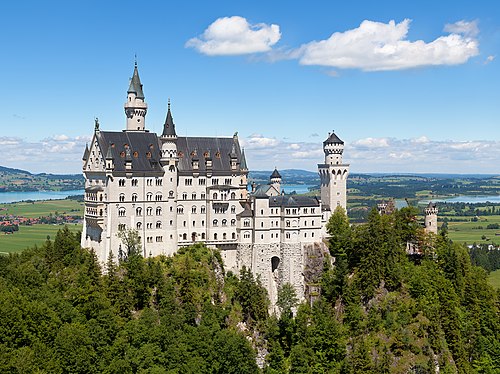 Neuschwanstein CastleStill standing · prime 1886
 Hohenzollern CastleRestored · prime 1867
 Eltz CastleStill standing · prime 1615
All castles in Germany → · Strongest castles in Germany → · Castles of Europe
Play As Your Clan
Hold a real castle against whatever you choose to send at it, take a ship out in her own service years, or stand at the shoulder of someone the record remembers. The chronicler sets the scene; the deeds are yours.