Kaiser
also Keizer
'The emperor', Caesar's name worn as a nickname.
- Origin
- German
- Famous bearer
- Henry J. Kaiser (1882–1967), American industrialist
- Register
- German family
The seat of Kaiser
Seat vacantChief
No one leads the Kaiser community yet. When the movement opens, you can stand for its leadership, or help elect whoever does.
Current mission
No shared goal set yet. Once Kaiser has leadership, it sets the public focus: a restoration, a gathering, a real-world project that helps its own.
The Kaiser clan is being rebuilt. Join the waiting list for the movement today, and you help decide who leads it and what it does.
Help rebuild the Kaiser clan →What does the Kaiser name mean?
Descriptive, Middle High German keiser, emperor, and like König a nickname, for a man of lordly bearing or the winner of a festival crown. The word descends directly from the Latin Caesar, the title carried unbroken from Rome into German.
The history of Kaiser
Caesar's cognomen, handed to men who ruled nothing
The word behind the surname belonged first to a branch of the gens Julia, the Roman clan of Gaius Julius Caesar, forebear of the first imperial family. The personal name hardened into a title, the title became the German word for an emperor, and the word came back down as a by-name for men with no empire whatever. Onomastics files that last step under the cognominal surnames, the broad class grown out of nicknames, where Caesar itself is listed, tentatively, among names taken from a man's appearance rather than his office.
German scholarship groups Kaiser with König and Graf as names pointing at nobility whose bearers were, at the very most, a minor functionary of a monarch. English kept the same trap: King, Bishop, Abbot, Sheriff and Knight look occupational and are not. A Dictionary of English Surnames calls surnames of office often nicknames, and Bernard Deacon reads the first bearer as a man who acted like a king or a bishop, or who was as corpulent as one. The Kaisers of the parish books are the acted-like-one kind.
Forty-first in Germany, thickest in the Black Forest
Kaiser is not one of the great German commons. It runs at roughly 0.05 per cent of the German population and stood 41st as of 2000, against Schmidt and its spellings at 0.87 per cent, Müller at 0.83, Meyer at 0.73 and Schulz at 0.43. Its weight is regional rather than national: central Germany and the southern half of the Black Forest carry it most heavily, the rest of southern Germany less so, and it is carried in Austria and the Czech Republic as well.
The ten commonest German surnames, Müller, Schmidt, Schneider, Fischer, Weber, Meyer, Wagner, Schulz, Bauer and Becker, are occupational to the last one, naming the jobs a settlement needed around 1600 when surnames became heritable, which is why they arose independently everywhere at once. Kaiser spread by the same mechanism for the opposite reason. Every village needed a smith; none had an emperor, so the name repeated wherever the joke did. Austria's own leaders run Gruber, Huber, Wagner, Mueller, Pichler, Steiner and Moser; Kaiser is carried there too, but appears nowhere on that list.
Kaiserin in the baptism book, and the registers that froze the by-name
Surnames entered German-speaking Europe gradually across the Late Middle Ages, many of them out of nicknames, and became heritable with the start of central demographic record-keeping in the early modern period. Governments wanted fixed names to identify subjects for taxation and inheritance. What a neighbour called a man in jest stopped being an opinion and became the legal property of his grandchildren.
Until the 18th century those records gave a woman a distinct form of the family name. In the south it ran Peter Huber but Anna Huberin, so a daughter of this house went into the baptism book as Kaiserin, the exact word for an empress, entered by a village priest about a farmer's child. West Low German parlance used the ending -sche instead, giving de Smidtsche for the wife or daughter of a Schmidt, and elsewhere a genitive s carried the sense, Bäckers for the baker's.
General official registration of legal names ended the female variants through the 18th and 19th centuries, state by state as each legislated, and the same reform fixed spelling, which had varied from author to author and even from entry to entry, to the form the register recorded. That is the moment Kayser, Kaijser, Keiser, Kiser and Kyser stopped being one name in different hands and became separate families with separate paperwork.
Emperor of the guild for twelve months
The guilds of the German free cities were far more than workshops. They held charters and letters patent granting monopolies on production within their locality, set prices, trading hours and the number of apprentices a master could keep, and moved men up through apprenticeship, journeymanship and mastery. In Germany and the Low Countries they pressed hard enough on municipal government to challenge the patrician elites outright, and they ran welfare funds for sick and elderly members, supported widows and orphans, and organised the feasts of the trade.
Those feasts are where the word emperor came down onto ordinary burghers: a man made emperor of his guild, or of the year's shooting-match, held it for twelve months and then could not put the by-name down again. The corporations themselves did not last: France abolished its guilds in 1791 and most of Europe followed as industrialisation made guild production unviable. What survives in Germany are the Innungen, voluntary associations under public law whose president is the Obermeister, master-in-chief, with journeymen electing an Altgesell of their own.
1919, when the emperors lost the word and the Kaisers kept it
German naming law had made nobility visible with a particle rather than a word: von before the village or estate, sometimes zu, sometimes von und zu together. Austria abolished those titles and particles outright on 3 April 1919 and made their use by Austrian citizens punishable until 2019, which is why Austria-Hungary's last crown prince was addressed at home as Otto Habsburg-Lothringen.
Article 109 of the Weimar Constitution turned the surviving titles into ordinary components of the surname, so Graf and its fellows dropped to the level Kaiser had occupied since the registers began: a word on a page, binding nobody. German law does permit a name to be changed for being too common, too difficult or ridiculous by association, but the Namensänderungsgesetz grants that rarely, and at 41st place Kaiser was neither frequent enough to be a burden nor grand enough to read as a claim.
Keizer, the same word on the far side of the border
Dutch carries the word as Keizer, with De Keijzer, De Keyser and Dekeyser beside it. The Netherlands fixed its surnames between 1795 and 1811 under the Napoleonic Code's rule that a person be known by given names and a family name that does not change between generations, the same instinct that had already frozen Kaiser in the German registers, arriving later and by decree. Dutch names carried the other way into German-speaking regions were respelled to suit German pronunciation, Sloothaag becoming Sloothaak.
The Dutch Keizers stand thickest in sport. Piet Keizer (1943 to 2017) played left wing and Marcel Keizer (born 1969) manages football; Cees Keizer (born 1986) is a midfielder and Jan Keizer (1940 to 2024) was a referee. Ilja Keizer (born 1944) ran middle distance, Jolanda Keizer (born 1985) is a heptathlete, Martijn Keizer (born 1988) races bicycles, Joris Keizer (born 1979) swims, Sanne Keizer (born 1985) plays volleyball, and Gerrit Keizer (1910 to 1980) is recorded simply as a Dutch sportsman.
Writers, singers, and the one industrialist
Away from the pitch the Dutch line runs to Bert Keizer (born 1947), a writer and physician, and to Henry Keizer (born 1960), a businessman and corporate director. It runs to two singers, Jan Keizer (born 1949) and Simon Keizer (born 1984), a name ordinary enough in the Netherlands that a referee, a swimmer and a singer all answer to it.
America took the name in both spellings and needed no reshaping of it. Surnames often changed on arrival there, as when European Jews who had fled Nazi persecution anglicised theirs against discrimination, but Kaiser was already legible to an English eye, and Kiser and Kyser trace the same root through a plainer spelling. Henry J. Kaiser (1882 to 1967) is the American industrialist the name is best known for there: the son of a German immigrant, he built dams and ships, his wartime yards turned out Liberty ships faster than the enemy could sink them, and the health plan he ran for his own workers became Kaiser Permanente. Garret Keizer (born 1953) is an American author, Teddy Keizer (born about 1971) an American speed hiker, and Nick Keizer (born 1995) an American football player.
The castles of the homeland
The great strongholds of the homeland, look one up, see what it looked like in its prime, and recreate it to explore.
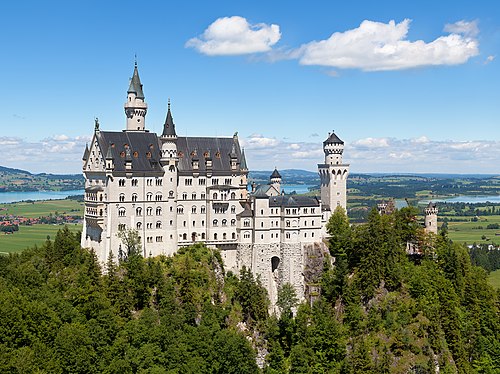 Neuschwanstein CastleStill standing · prime 1886
 Hohenzollern CastleRestored · prime 1867
 Eltz CastleStill standing · prime 1615
All castles in Germany → · Strongest castles in Germany → · Castles of Europe
Play As Your Clan
Hold a real castle against whatever you choose to send at it, take a ship out in her own service years, or stand at the shoulder of someone the record remembers. The chronicler sets the scene; the deeds are yours.
Notable bearers of the Kaiser name
- Henry J. Kaiser (1882–1967), American industrialist