Klein
'The small one', a plain word that became a great Jewish name.
- Origin
- German
- Register
- German family
The seat of Klein
Seat vacantChief
No one leads the Klein community yet. When the movement opens, you can stand for its leadership, or help elect whoever does.
Current mission
No shared goal set yet. Once Klein has leadership, it sets the public focus: a restoration, a gathering, a real-world project that helps its own.
The Klein clan is being rebuilt. Join the waiting list for the movement today, and you help decide who leads it and what it does.
Help rebuild the Klein clan →What does the Klein name mean?
Descriptive, Middle High German klein, small or slight, the by-name for the shorter or younger of two men who shared a Christian name. One of the most characteristic and frequent of all Ashkenazi surnames.
The history of Klein
A name taken from the body, not the workshop
German-speaking Europe quarried its surnames from four places in the late Middle Ages: a father's given name pressed into the genitive, so that Ahrend produced Ahrends; an occupational designation; a toponym, usually with the -er of origin that turned Kissingen into Kissinger; and a bodily attribute. Klein belongs to the last and thinnest of those four, in company with Krause for curly hair, Schwarzkopf for a dark head and Groß for the big man. Trades were the productive quarry, because an unusual job marked a man out to his neighbours in a way his stature never could.
The counterweight to Klein is measurable in the modern German register. Lange and Lang, the tall man's by-name, account for roughly 0.19 per cent of German surnames, ranked twelfth nationally, a shade ahead of Wolf and a shade behind Bauer. The ten names that outrank it when spellings are counted separately (Müller, Schmidt, Schneider, Fischer, Weber, Meyer, Wagner, Schulz, Bauer, Becker) are occupational to a man, and all of them fixed around 1600, when surnames became heritable with the start of central demographic records.
That date matters more to Klein than to any smith. A trade name could be earned afresh in each generation, and often was. A description could not: once the registers froze it, a family called Klein stayed Klein whether its sons stood short or tall, and the word quietly stopped describing anybody. Needing no guild admission, no charter and no estate to fasten itself to, it had already arisen independently in every German-speaking territory at once. The Meyers had to be tenants of something and the Schulzes constables of somewhere; Klein needed only a neighbour of the same Christian name who happened to stand taller.
Kleibl in the Alps, Kleinová in Bohemia
The word is not only German. Dutch, Afrikaans and Yiddish all carry klein for small, which is why the name sits as easily on the Dutch rower Roelof Klein (1877–1960) and the Dutch mental calculator Willem Klein as on any Bavarian. Within German itself, local speech is legible in the spelling: southern German, Austrian and Swiss registers take the diminutive endings -l, -el, -erl, -le and -li, the same endings that turn Nagel into Nägeli and Klein into Kleibl, a small man made smaller by his own dialect.
Women were recorded under their own forms until the states put a stop to it. Parish books of baptism, marriage and burial entered Peter Huber but Anna Huberin; West Low German speech made Ms Schmidt de Smidtsche; a genitive s made the baker's daughter Bäckers. Official registration abolished the practice through the 18th and 19th centuries, state by state, and pinned each surname to a single recorded spelling at the same stroke. Where a farm name and a family name diverged, the two were joined in documents by genannt, or vulgo in Austria, so that one man could be entered as Amann gen. Behmann.
East of the German lands the feminine survived, and eventually became law. Klein takes the Czech and Slovak form Kleinová, borne by the pianist Eliška Kleinová (1912–1999), the table tennis player Gertrude Kleinová (1918–1976) and the tennis player Sandra Kleinová (born 1978). From 1945 the -ová ending was compulsory for Czech women; only on 1 January 2022 did the law let them choose the neutral form instead.
Breslau, 1790: the year the name was fixed by decree
Klein's second history begins at a registry desk. Prussia enacted the Hoym Ordinance at Breslau in 1790, compelling Jewish families to adopt fixed surnames; Napoleon followed with his decree of 1808, insisting on permanent names across the territories he governed. German Jewish surnames were introduced per fiat, in the late 18th and early 19th centuries, a full two hundred years after Christian families had settled theirs.
The officials holding the pen were not neutral. Prussian clerks invented names, and sometimes malicious ones: Waldlieferant, 'forest supplier', was coined to ridicule a Jewish timber trader, and considerably uglier constructions than that were issued. The distinctly poetical names most readily recognised as Jewish today, Rosenzweig and its kind, run the other way, and read as choices the families made for themselves. Ornamental surnames cluster among Eastern Ashkenazi Jews in Germany and Austria, and among Sinti and Romani, for exactly this reason: these were the communities compelled to choose late, and under pressure.
Klein sat outside both camps. It was a plain German adjective already worn by Christian households since the late Middle Ages, invented by nobody and mocking nobody, and it left a family unremarkable in a ledger. Whatever the mechanism town by town, the outcome is not in doubt: the German word for small became one of the most characteristic and frequent of all Ashkenazi surnames.
A Lithuanian grammar, a Prussian herbarium, a Napoleonic general
The earliest Klein the record carries with a body of work attached is Daniel Klein (1609–1666), a German-Lithuanian pastor and grammarian. Jacob Theodor Klein (1685–1759) is catalogued twice over, once as a Prussian botanist and once as a jurist, historian, mathematician and diplomat: the same man, filed under whichever of his careers a librarian happened to be indexing that day.
Louis Klein (1759–1845) rose through the French Revolutionary and Napoleonic wars to general, and ended as a politician and a peer of France. He served the emperor whose 1808 decree was at that moment fastening his own surname onto families who had never held it.
Then the studios and drawing offices. Franz Klein (1779–1840), a Viennese sculptor, cut the famous bust of Beethoven. Roman Klein (1858–1924) built in Russia and Vilhelm Klein (1835–1913) in Denmark. Julius Leopold Klein (1810–1876) wrote drama in Hungary, and Wilhelm Klein (1850–1924) worked the ground as a Hungarian-Austrian archaeologist. Within a century the word had travelled from Rhineland parish books to the imperial capitals. Fernando Heydrich Klein (1827–1903) contrived to be German businessman, politician, engineer and sculptor at once.
The word for small, attached to theorems
Something unusual happened to Klein in the sciences: the surname passed out of the register and into the names of places, concepts and discoveries associated with its bearers, so that the German word for small now labels ideas with nothing whatever to do with size. Felix Klein (1849–1925), the German mathematician, is the reason more than anyone; Oskar Klein (1894–1977), the Swedish physicist, is another. Between them they hung the name on work in mathematics and in physics, two fields sharing nothing but a bearer.
The mathematicians accumulate. Esther Klein (1910–2005) worked between Hungary and Australia; Abel Klein (born 1945) in the United States; Willem Klein (1912–1986) was at once a Dutch mathematician and a professional mental calculator. Lawrence Klein (1920–2013) worked in economics on the American side, and Etienne Klein (born 1958) carried French physics into the philosophy of science.
Away from the equations the pattern holds. Melanie Klein (1882–1960) reshaped psychotherapy in Britain, where Emanuel Edward Klein (1844–1925) had already established himself as a bacteriologist. Ernest Klein (1899–1983) was a Canadian rabbi and a linguist in the same life; Samuel Klein (1886–1940), Hungarian-born, was rabbi, historian and historical geographer; Leo Klein, or Leo Klejn (1927–2019), was a Russian Jewish archaeologist, anthropologist and philologist.
Two Kleins in 1945
The name reached 1945 standing on both sides of the worst thing that happened to it. Fritz Klein (1888–1945), a German doctor, was hanged for war crimes. Hans Klein (1891–1944) died a Luftwaffe major-general, a generation after Johannes Klein had flown as a German fighter ace in the First World War and survived to 1926.
Gerda Weissmann Klein (1924–2022) survived the Holocaust. Gideon Klein (1919–1945), pianist and composer, was dead at twenty-six. Samuel Klein the scholar had died in 1940. Ágnes Keleti (1921–2025) was born Klein in Hungary and lived to become an Olympic champion gymnast and, later, a fixture of Israeli sport.
Where the survivors landed, the name went with them. Samuel Klein (1923–2014) left Poland and built a business empire in Brazil; Leonardo Farkas Klein (born 1967) made his in Chile. David Klein (1935–2021) governed the Bank of Israel, Ralph Klein (1931–2008) played and coached Israeli basketball, and Abraham Klein (born 1934) refereed football at the top of the world game. Aaron Klein (born 1979) advises from inside the Israeli prime minister's office, and Jacques Paul Klein (born 1939), French-born, spent his career as an American diplomat.
The labels that kept the name, and the singers who set it down
In America the name went above the door. Mathias Klein founded Klein Tools; Anne Klein (1923–1974) and Calvin Klein (born 1942) built fashion houses on the plain syllable, and in France Michel Klein (born 1958) did the same. Allen Klein (1931–2009) managed the Beatles and the Rolling Stones from behind it. Jonathan Klein (born 1960) founded Getty Images; Jon Klein ran CNN; Ralph Klein (1942–2013) went into Canadian politics.
The arts carried it further than any register could. Yves Klein (1928–1962), the French painter, was the son of the Dutch painter Fred Klein (1898–1990). William Klein (1926–2022) photographed and filmed as an American in Paris. A. M. Klein (1909–1972) wrote poetry in Canada, where Naomi Klein (born 1970) later wrote polemic; Ezra Klein and Joe Klein write American politics; Robert Klein (born 1942) has stood on stage in front of the name; Chuck Klein (1904–1958) hit baseballs for a living.
Not everyone kept it. European Jews arriving in the United States, particularly those who had fled Nazi persecution, often anglicised their surnames against discrimination, and Klein was an easy one to shed. Carol Joan Klein became Carole King, Gene Klein became Gene Simmons, Barbara Lynn Klein became Barbi Benton, and Hannelore Klein, born in Germany in 1927, wrote as Laureen Nussbaum. The name stayed above the shop doors and came off the record sleeves.
The castles of the homeland
The great strongholds of the homeland, look one up, see what it looked like in its prime, and recreate it to explore.
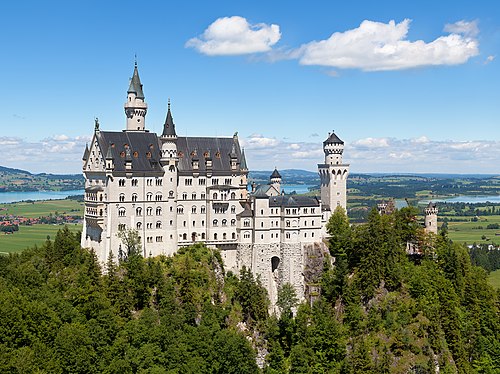 Neuschwanstein CastleStill standing · prime 1886
 Hohenzollern CastleRestored · prime 1867
 Eltz CastleStill standing · prime 1615
All castles in Germany → · Strongest castles in Germany → · Castles of Europe
Play As Your Clan
Hold a real castle against whatever you choose to send at it, take a ship out in her own service years, or stand at the shoulder of someone the record remembers. The chronicler sets the scene; the deeds are yours.