Koch
The cook, the kitchen of the great house.
- Origin
- German
- Famous bearer
- Robert Koch (1843–1910), microbiologist, Nobel laureate 1905
- Register
- German family
The seat of Koch
Seat vacantChief
No one leads the Koch community yet. When the movement opens, you can stand for its leadership, or help elect whoever does.
Current mission
No shared goal set yet. Once Koch has leadership, it sets the public focus: a restoration, a gathering, a real-world project that helps its own.
The Koch clan is being rebuilt. Join the waiting list for the movement today, and you help decide who leads it and what it does.
Help rebuild the Koch clan →What does the Koch name mean?
The cook, Middle High German koch (Latin coquus), the cook of a lord's household, an inn, or a monastery kitchen.
The history of Koch
The cook who worked in another man's kitchen
Middle High German koch, from the Latin coquus, named a man who did not cook for his own household. A cook of any standing worked where somebody kept a table big enough to need one, and by the later Middle Ages the work was reckoned a craft rather than a chore. In northern France between the ninth and fifteenth centuries the cook counted among the trained craftsmen: Taillevent, whose Le Viandier became the classic recipe collection of the medieval French kitchen, set down that he had passed through apprentice and journeyman grades before he was made master. That ladder was the one the craft guilds of the German towns used to pass on every skill they controlled.
The name froze into a family name late. Surnames became heritable in German-speaking Europe only with the start of central demographic records in the early modern period, and occupational designations made the largest class of them. The ten commonest German surnames today (Müller, Schmidt, Schneider, Fischer, Weber, Meyer, Wagner, Schulz, Bauer, Becker) all name common work around 1600, which is why each arose independently region by region rather than descending from one family. Koch belongs to that layer, minted in a thousand separate kitchens, and the church books that fixed it carried female forms until the eighteenth century, entering a sister as Huberin where the brother was Huber.
The first Kochs the records name
By the middle of the eighteenth century the name is attached to documented lives across Europe. Christoph Wilhelm von Koch (1737–1813) made his career as a French politician and diplomat. Johann Heinrich Koch (1748–1801) served as a Hessian soldier in the American Revolutionary War. Franziska Romana Koch (1748–1796) sang as a German opera singer, and Heinrich Christoph Koch (1749–1816) worked as a German musicologist and composer. Julius August Koch (1752–1817) held the double trade of astronomer and physician.
The generation after them put the name into scholarship and building. Joseph Anton Koch (1768–1839) painted as an Austrian; Wilhelm Daniel Joseph Koch (1771–1849) practised as physician and botanist; Carl Ludwig Koch (1778–1857) worked as an arachnologist. Jørgen Hansen Koch (1787–1860) built as a Danish architect. Christian Friedrich Koch (1798–1872) was a German jurist, Georg Aenotheus Koch (1802–1879) a classical philologist and lexicographer, and Eduard Emil Koch (1809–1871) a German pastor and hymnologist.
The Kochs who put names on beetles, spiders and plants
The name turns up repeatedly among the naturalists who catalogued the living world. Gabriel Koch (1807–1881) worked as a German entomologist and Karl Koch (1809–1879) as a German botanist; Ludwig Carl Christian Koch (1825–1908) worked as entomologist and arachnologist both. Gottlieb von Koch (1849–1914) was a German zoologist. Max Koch (1854–1925) worked as a botanist in Australia, and Edward Albert Koch (born 1843) practised medicine there.
Medicine and the exact sciences kept pace. Julius Ludwig August Koch (1841–1908) was a German psychiatrist, Walter Koch (1880–1962) a German pathologist, Julius Arnold Koch (1864–1956) an American chemist and Fred Conrad Koch (1876–1948) an American biochemist. Helge von Koch (1870–1924) worked as a Swedish mathematician and Helmut Koch (1932–2024) as a German one; Adelheid Koch (1896–1980) practised as a German-Brazilian psychoanalyst. Above them all sits the physician and bacteriologist Robert Koch (1843–1910), the reason most readers know the name at all.
Draughtsmen, painters and a man who cut letters
Architecture drew Kochs across half of Europe. Valdemar Koch (1852–1902) practised as a Danish architect and politician, and Mogens Koch (1898–1992) as architect and furniture designer. Gaetano Koch (1849–1910) built as an Italian architect, Ciril Metod Koch (1867–1925) as a Slovene one, Johann von Koch (1850–1915) as a German one. Richard Koch (1889–1971) worked as an American architectural preservationist and Carl Koch (1912–1998) as an American architect.
In paint the roll runs through Elisa Koch (1833–1914), Italian painter, Georg Karl Koch (1857–1927), painter, illustrator and lithographer, and Max Friedrich Koch (1859–1930), German painter, to Pyke Koch (1901–1991) in the Netherlands and Eleonore Koch (1926–2018), the Brazilian painter and sculptor. Rudolf Koch (1876–1934) took the same careful hand-work into letters as a German type designer and calligrapher, and Friedrich Koch (1862–1927) worked as a German composer, cellist and teacher. Konrad Koch (1846–1911), a German teacher, is remembered as a football pioneer.
The name that sailed
By the middle of the nineteenth century the name was working in American and Australian towns. Henry C. Koch (1841–1910) practised as an American architect and John A. B. Koch (1845–1928) as an Australian one. Richard H. Koch (1852–1945) sat as an American judge and railroad magnate; Joseph Koch (1843–1902) worked as an American lawyer and politician, John C. Koch (1841–1907) and John Herman Koch (1864–1929) as American politicians. Theodore Wesley Koch (1871–1941) made his career as an American librarian.
Business and public life followed. Harry Koch (1867–1942) and Ehrhardt Koch (1886–1954) worked as businessmen in America, the second of them German-American. Fred C. Koch (1900–1967), a chemical engineer, developed a new cracking method for refining heavy crude into gasoline and in 1940 started the firm that grew into one of the largest privately held companies in the United States. The name reached further still: F. H. B. Koch served as a Ceylonese judge and lawyer, and Rosslyn Koch (born 1886) as a Ceylonese businessman, company director and politician.
The name on both sides of the Third Reich
The name sits on both sides of the Nazi record. Erich Koch (1896–1986) was a Nazi leader. Karl-Otto Koch (1897–1945) served as an SS officer and Ilse Koch (1906–1967) was a war criminal; Hans Koch (1912–1955) was an SS officer and war criminal in his own right, and Hans-Karl Koch (1897–1934) held rank as a Nazi and SA general. In Italy the name belonged to Pietro Koch (1918–1945), a police officer. Friedrich Koch (1879–1961) was a German general and Walter Koch (1910–1943) a Fallschirmjäger.
Set against them stand others. Hans Koch (1893–1945), a lawyer, was a member of the German resistance, and Gertrud Koch (1924–2016) was a resistance fighter. Werner Koch (1910–1994) worked as a German journalist and theologian; Karel František Koch (1890–1981) was a Czech doctor and humanitarian. In an Allied uniform there was Oscar Koch (1897–1970), a general of the United States Army. Harry Eduard Ottokar Koch (1880–1939) and Hermann Georg Willibald Koch (1882–1957) had meanwhile served as Estonian politicians.
Arctic ice, and around the Moon
The name travelled a long way from a hot kitchen. Johan Peter Koch (1870–1928) was a Danish captain and explorer, and Lauge Koch (1892–1964) followed as a Danish geologist and Arctic explorer. Alfred Michael Koch (1894–1918) flew as a Swiss-born Canadian flying ace; Aubrey Koch (1904–1975) served as an Australian officer of the RAF. Furthest of all went Christina Koch (born 1979), the American astronaut who became the first woman to circle the Moon.
In public life the name kept turning up in office. Ed Koch (1924–2013) was Mayor of New York City from 1978 to 1989 and Thomas P. Koch (born 1963) became the 33rd Mayor of Quincy, Massachusetts. Bodil Koch (1903–1972) sat as a Danish politician, Carsten Koch (born 1945) as a Danish economist and politician, and Ursula Koch (born 1941) as a Swiss one; Roland Koch (born 1958) works as a German jurist and politician. The church claims Kurt Koch (born 1950), the Swiss cardinal, and Heiner Koch (born 1954), a German prelate of the Catholic Church.
The castles of the homeland
The great strongholds of the homeland, look one up, see what it looked like in its prime, and recreate it to explore.
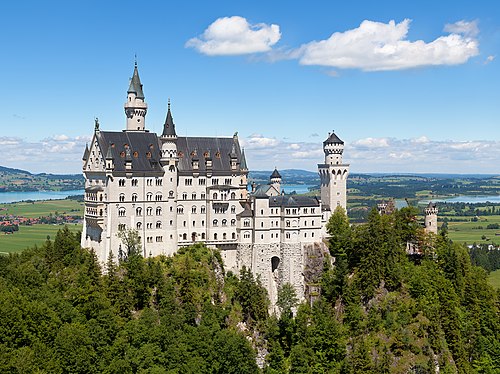 Neuschwanstein CastleStill standing · prime 1886
 Hohenzollern CastleRestored · prime 1867
 Eltz CastleStill standing · prime 1615
All castles in Germany → · Strongest castles in Germany → · Castles of Europe
Play As Your Clan
Hold a real castle against whatever you choose to send at it, take a ship out in her own service years, or stand at the shoulder of someone the record remembers. The chronicler sets the scene; the deeds are yours.
Notable bearers of the Koch name
- Robert Koch (1843–1910), microbiologist, Nobel laureate 1905