König
also Koenig
'The king', the man who won the shooting-match.
- Origin
- German
- Register
- German family
The König arms

Coat of armsWappen der Familie KönigCarl1950 · CC BY-SA 4.0
- Coat of arms: Granted to an individual and inherited down that one documented line. These are the arms of particular families of the name, not of everyone who shares the surname.
The seat of König
Seat vacantChief
No one leads the König community yet. When the movement opens, you can stand for its leadership, or help elect whoever does.
Current mission
No shared goal set yet. Once König has leadership, it sets the public focus: a restoration, a gathering, a real-world project that helps its own.
The König clan is being rebuilt. Join the waiting list for the movement today, and you help decide who leads it and what it does.
Help rebuild the König clan →What does the König name mean?
Descriptive, Middle High German künic, king, a nickname, never a title: for a man who lorded it over his fellows, or who won the marksmen's contest to be crowned 'king' for the year. Cognate of English King.
The history of König
Künic, and the family that translated itself
Middle High German künic is the word behind the surname, and the surname is almost never evidence of a king. It records a moment: a marksman crowned at his town's shooting festival and left carrying the title for the year, a man who bore himself as though the village belonged to him, or a family that had carried a quite different word in another language before it crossed into German.
That leaves a name with no kindred behind it, no seat to point at and no arms the bearers share. What there is instead is a long list of people who had to make the name mean something themselves: a Fribourg soldier who bought a house in order to be a citizen, a priest who cut a map of Peru into silver, a Basel physician who wrote up the three kingdoms of nature, a Thuringian tanner who chose exile over leaving his wife.
The clearest surviving account of how one family got the name belongs to Fribourg in the Swiss Üechtland, and no crown appears in it. Two brothers, Jean and Pierre Rey, called de Moret, grew up at Ménières in the canton of Fribourg. Jean moved to the cantonal capital and worked there as a notary; Pierre served as a Catholic priest around Solothurn, at Altkirch in Alsace and at Ménières. Both lived among German speakers and germanised themselves to suit: Pierre and Jean Rey dit de Moret became Peter and Hans König genannt von Mohr.
The joining word was ordinary clerical practice, the genannt that registers used when a man's two names did not agree, and the Königs kept theirs whole. Later writers took the Mohr in it for a record of expeditions to the Morea, since a Moor's head sits in the family arms. It does not mean that. A similar Moor stands in the arms of the Moret, the name the family had been using all along.
Fourteen or fifteen, and out to the foreign service
Franz Peter König, the notary's son, was born at Fribourg on 6 August 1594 and lost his mother, Anna Bendicht, soon after. His younger half-brothers Albrecht Nikolaus and Anton went to the Jesuit college of St Michael in the town; where Franz Peter was schooled is not recorded. He grew up speaking French, had German and Italian besides and learned Latin, and used all three living languages at work: German for years of letters home to his city, Italian for his patron, Count Rambold XIII of Collalto. At fourteen or fifteen he left for service abroad.
In Fribourg that was the ordinary choice. Soldiering abroad, the Fremde Dienste, was among the town's chief industries, and until the French monarchy fell in 1792 a large part of its men were engaged in it. Swiss troops went out not as individuals but as closed formations, staying under the legal authority of their home cantons, and the governing patrician houses owned and led companies bearing their names, filling the officer posts from their own families.
Fribourg recruited above all for France, and Franz Peter went almost anywhere else. Under a French flag he would have found the Fribourg pecking order waiting for him, taking orders from countrymen out of stronger houses than his own. He was serving Venice by 1617 until Fribourg called him home, Venice being an enemy of the Habsburgs, to whom the town was bound by a hereditary alliance. He went on to Milan and in 1622 or 1623 to Vienna. Both half-brothers followed him into the imperial army; Anton, born in 1601, died a young man around 1629.
Governor of Lindau, and a baron's patent in 1631
Collalto advanced him from captain to lieutenant colonel from 1623 and, from 1628, to field marshal's adjutant and imperial war commissioner. A long suit over an insult to his honour, opened at Vienna in 1625, ended in his favour in July 1627, and the Emperor had the judgment printed and proclaimed in public to the beat of a drum.
In October 1628 Franz Peter and Albrecht Nikolaus travelled home because their father had died and their standing as citizens had to be regularised. Owning a house in town was the condition of the burgher right, so they bought one: the Ratzéhof, which houses the Museum für Kunst und Geschichte today. Ordered next to hand his commissariat and his troops in the Westerwald and the Wetterau to his brother, he took command instead of the force at Fulda meant to relieve besieged 's-Hertogenbosch. Scouting in the middle of June 1629 with about thirty horse, he rode into a Dutch ambush and was badly wounded.
He recovered into the best appointment of his life, imperial colonel and governor of Lindau on Lake Constance, and lost his patron almost at once: Collalto died at Chur in 1630, travelling to Lindau during the war over the Mantuan succession. König held the town against the Swedes and took Kempten in a bold stroke of his own. In 1631 Ferdinand II raised him and Albrecht Nikolaus to Freiherr, and the parchment with its painted arms survives at Fribourg. So does the reason posterity can look him in the face: that same year at Lindau, Samuel Hofmann painted him on a rearing black horse in black steel harness, white lace collar and red silk sash, in the pose Titian had given Charles V. It is the earliest equestrian portrait in Swiss painting.
1634: the charge that did not stick
On 4 January 1634 an imperial instruction left Vienna for König at Lindau, setting out how he was to conduct himself as the Emperor's envoy to the federal Tagsatzung at Baden. He never played the part. The mission was stopped at Innsbruck, and on 11 January the governor of Lindau was stripped of his office and arrested. The charges were attempted murder of Colonel Wolf Rudolf von Ossa, embezzlement of 800,000 gulden of contribution money, and an intention to hand Lindau to the Swedes or the French as general of a Protestant Switzerland.
Fribourg and the seven Catholic cantons pressed for a fair hearing, and the treason charge did not survive scrutiny: underneath it lay a feud between Ossa and König in which three men had demonstrably died, Ossa's secretary, his servant Johann Kerr and a cavalry captain named Weiss. Rather than wait for the Emperor's order of release, König put himself in front of the court martial and laid his own charge against Ossa. The conviction that came back rested on testimony taken under torture, and the Catholic cantons intervened again to have it set aside. Held at Regensburg under house arrest with a widow, Freifrau Margarethe von Eltz, he escaped into Switzerland in October 1635. Ferdinand II acquitted him of treason in the summer of 1636, and the acquittal reached Fribourg on 3 September.
Salt from Salins, and the Schultheiss's chair
Home again, he put money into the salt trade and turned to politics. He had sat in Fribourg's Great Council, the Council of Two Hundred, from 1625 to 1630, moved into the narrower Council of Sixty, and in 1631 entered the Small Council, which sent him on missions to the other cantons and, after 1640, to foreign courts. A formal pardon came in 1637 for what he had done on behalf of the Franche-Comté, and Ferdinand III made him Oberstfeldzeugmeister in 1640.
In 1645 he was elected Schultheiss and stood at the innermost point of the little republic. The next year he travelled on official business by way of Paris to Brussels, taking audiences at the French court and with Cardinal Mazarin, and meeting the governor of the Spanish Netherlands to renew Fribourg's leases on the salt mines at Salins in the Franche-Comté. On 11 December 1647 he died suddenly in his own house, the Ratzéhof, and was buried in the cathedral of St Nicholas.
His first wife, the wealthy widow Marie Chassot, ran the children and the business at Fribourg through his months away and bore him a daughter, Ursule Colombe, in 1616. The daughter took the veil in 1633 with the Dominicans of Estavayer-le-Lac, and König's youngest son entered the Capuchins as Father Leopold; both were painted, and both portraits hang at Fribourg. What the record insists on is the climb. König came of a family neither distinguished nor rich, whatever he said of it himself, and in Vienna he was one baron among many, far below commanders like Tilly or Wallenstein. At Fribourg he reached the highest offices the place had.
Lima, Basel and Kolberg: three Königs of the learned kind
Juan Ramón Koenig was born at Mechelen in 1623 and died at Lima on 19 July 1709. A priest, he reached Peru in 1655 with the viceroy, who made him chaplain of the hospital of Espiritu Santo, and he taught at the college of San Marcos, cosmography above all. By royal order he set out in 1672 to visit the principal places of Peru and take their latitude and longitude, and since the instruments the work needed could not be got in the country he built them himself. In 1677 he took the chair of mathematics and was made royal cosmographer.
He engraved a map of Peru on a silver plate with his own hands, work the French geographer Louis Feuillet praised, and when the viceroy the Duke of La Palata resolved in 1682 to fortify Lima, Koenig drew the plan with General Venegas Osorio and directed the building. He published the Problema de la duplicación del Cubo at Madrid in 1678 and, from 1680 to 1708, daily weather observations at Lima under the title Conocimiento de los tiempos. The geography of Peru he had spent his last years gathering material for was lost when a friend burned nearly all his papers after his death to keep his private affairs private.
Emanuel König (1658–1731) was born at Basel, where his father sold books, took his medical degree there in 1682 and became professor of Greek in 1695 and of medicine in 1711. He wrote up the three kingdoms of nature in turn, Regnum animale in 1682, Regnum minerale in 1686 and Regnum vegetabile in 1688, and pushed back at the received view that plants live on water alone by pointing to salt and to constituents of the air. Immanuel König (1590–1645) was the son of a Greifswald burgher and guild shoemaker, which is the sort of household this surname usually comes out of. Made magister at Wittenberg in 1609, he was on the point of taking a parish at the Marienkirche in Stralsund in 1621 when he was called instead to Kolberg, and installed as Generalsuperintendent of the Stift Kolberg-Cammin on 30 April 1622. He held the office until he died, the last man ever to hold it.
The tanner who would not leave his wife
Johannes König was born at Arnstadt on 2 April 1903, trained as a leather tanner and found work at Altenburg. He joined the Communist Party in 1919 and from the end of 1924 edited its papers at Remscheid, Solingen and Chemnitz. In September 1926 he married Henny Schwarz, who came from a family of Jewish craftsmen. He was sentenced in April 1930 to eighteen months for conspiracy to commit treason, and after 1933 belonged to an underground cell until he was taken into so-called protective custody, held to October 1934, then moved to a prison camp near Colditz and to Sachsenburg concentration camp. Arrested again in February 1936, he was given twenty months more.
In 1938 the Gestapo arrested Henny König and ordered her deported from Germany on account of her Jewish descent. Johannes König refused to be separated from his wife, and the order was extended to cover him. Their flat was wrecked during Kristallnacht that November, and in April 1939 the two of them left for Shanghai. From September 1941 he wrote news commentary there for the Soviet agency TASS, whose work in Japanese-occupied China was shielded by the neutrality pact between Moscow and Tokyo. They came back to Germany in August 1947, and from 1950 he served the new state abroad: ambassador at Beijing first, with Pyongyang and Hanoi added to his brief, then Moscow, then deputy foreign minister, then ambassador at Prague, where he died on 22 January 1966.
Five organ builders who were nothing to each other
One trade carries the name with a persistence the lists cannot account for. Johann König (1639–1691), Caspar König (1675–1765), Balthasar König (1684–1756), Christian Ludwig König (1717–1789) and Franz König (1717–1791) are all set down as German organ builders, and a workshop under the spelling Kœnig still builds organs in France. Nothing in the record makes them one family, and that is the ordinary condition of this surname: a trade or a town will hold several Königs at once who were nothing to each other.
Abroad it travels as Koenig, the spelling that carries the lost umlaut through the diaspora, and sometimes as Konig with nothing in its place. Dénes Kőnig (1884–1944), the Hungarian mathematician, was the son of Gyula Kőnig (1849–1913), one of the few descents the lists actually record. Johann Gerhard König (1728–1785) was a German botanist who worked in India, Charles Konig (1774–1851) a German-born British naturalist, Franz König (1905–2004) Cardinal Archbishop of Vienna, and the sculptor Fritz Koenig (1924–2017) has a museum of his own work at Landshut.
The castles of the homeland
The great strongholds of the homeland, look one up, see what it looked like in its prime, and recreate it to explore.
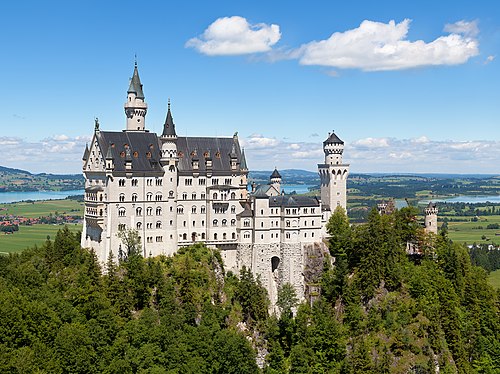 Neuschwanstein CastleStill standing · prime 1886
 Hohenzollern CastleRestored · prime 1867
 Eltz CastleStill standing · prime 1615
All castles in Germany → · Strongest castles in Germany → · Castles of Europe
Play As Your Clan
Hold a real castle against whatever you choose to send at it, take a ship out in her own service years, or stand at the shoulder of someone the record remembers. The chronicler sets the scene; the deeds are yours.